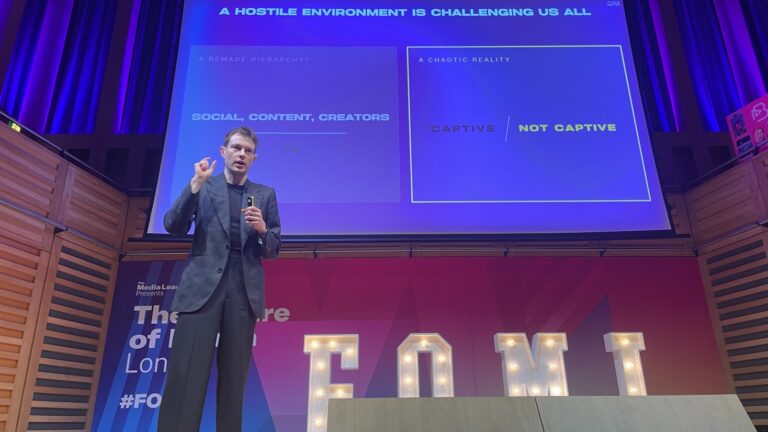
The broadcasting industry’s most influential people spoke at the Institute Of Economic Affairs, Future of UK Broadcasting conference yesterday.
Chris Smith, the heritage secretary, gave the key-note speech. He emphasised his commitment to public service broadcasting for the BBC, ITV and Channel 4. He conceded that ITV was gradually consolidating and he predicted that within a year the network would be controlled by four main companies, three in England and Wales and one in Scotland. He does not believe, however, that a single ITV company will come about in the near future. Mr Smith wants to make clear that, whatever happens, ITV must maintain its commitment to regional identity.
The funding formula of Channel 4 is a matter currently on the top of the heritage secretary’s in-tray. Mr Smith reiterated his much publicised belief that Channel 4 payments to ITV cannot continue at the present level, but he will be looking at ITV’s needs before reaching a decision.
To round-off, ‘government strategies’, Mr Smith emphasised, ‘must not be backward looking’. The heritage department is being renamed so that it is no longer seen to concentrate on the past, but also looks positively to the future.
Ward Thomas, group chairman and chief executive of YTTTV, was the next speaker to step on to the podium. Following on from the heritage secretary, he said that consolidation of ITV was the only solution to the network’s current problems. He would like to see ITV reduced to no more than two major players and eventually merged into a single company. He also believes that regulations controlling ITV should be weakened and the Network Centre should be disbanded. In his view, these measures would work in conjunction to turn ITV into a major global player. Pressure from within the Network was also not helping matters, Mr Thomas sited the recent calls for increased advertising minutage as ‘ridiculous’, ‘such a move will do nothing to improve our already falling ratings,’ he said.
The chairman of the BBC, Sir Christopher Bland, was more optimistic about the future of Britain’s two most popular channels. He predicts that the BBC and ITV would, between them, retain 70-80% of all viewing until at least 2005.