



The power of positivity
Opinion
Positivity improves advertising receptiveness and recall. So why isn’t media spend going to the most positive environments? Danny Donovan asks.
For many years, three pillars have shaped both my business philosophy and my media planning philosophy. I just find it simpler that way. They are Trust, Positivity and Attention.
I try to bring all three into my work life and my relationships with colleagues, clients, and partners. But crucially, I believe they also have a hugely beneficial impact on planning and placing clients’ media investment.
Great people like Mike Follett, founder of Lumen, have successfully put ‘Attention’ on the map in recent years, which is great to see. He and I have been discussing it for about 15 years, since the early days of eye tracking for DFS and Tesco press ads. In its simplest form, I like to think of ‘Attention’ as the front door to effective communication. You don’t have anything without someone’s attention.
There is also a lot more recent talk about ‘Trust’, and that is a good thing. Well, the erosion of trust is terrible, and the fact that younger people trust ads on social media as much as they do regulated channels is pretty scary. But there being more talk and more focus on these issues is a good thing.
But then we come to the much-overlooked area of ‘Positivity’, and the wider importance of emotion generally in decision-making.
In fact, as the ‘Case of Elliot’ described by renowned neuroscientist Antonio Damasio proved, emotion is fundamental.
Elliot underwent successful brain surgery for a brain tumour, which left his high IQ and reasoning intact but damaged his orbitofrontal cortex, robbing him of all emotion. From that point on, he couldn’t hold down a job or even make simple life decisions, such as what to have for lunch. His Somatic Markers, basically gut feeling, that we all rely on to make decisions had disappeared.
Specifically, looking at positivity, Richard Shotton, in his book The Choice Factory, which is a brilliant compendium of all things behavioural science, dedicates a whole chapter to mood and cites several compelling pieces of evidence that ‘Positivity’ improves advertising receptiveness and recall.
Daniel Kahneman (Nobel laureate and author of Thinking, Fast and Slow) offers an evolutionary explanation of how we are hardwired: being in a good mood equates to the absence of danger (think sabre-toothed tigers), which reduces the need to think critically and frees cognitive bandwidth for communication.
Barbara Fredrickson reinforces this view in her 2009 book Positivity, concluding that a positive mindset makes us more open-minded to new ideas and therefore more resourceful and resilient.
If positivity makes such a difference, then media spend must be going to the most positive environments. Well, no, not really.
The Power of Positivity, research commissioned by Hearst UK, lays out where people find the most positivity in media environments, and equally where there is the most negativity.
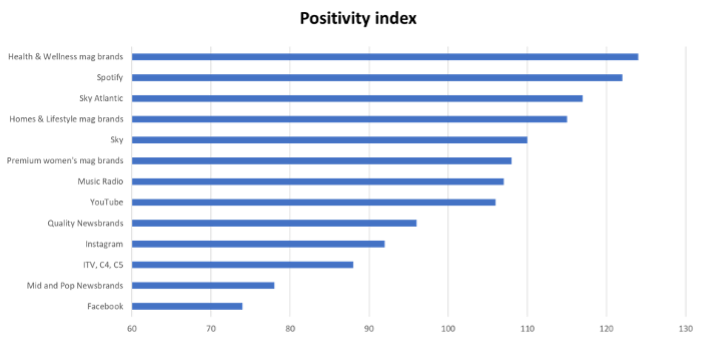
Not amazing news for some Newsbrands, which I suppose is understandable given the content, but at least YouGov say they are trusted.
Also, this more granular level starts to pull apart the social channels, with Instagram being seen as less negative than Facebook.
Sadly for Pinterest, it wasn’t in the survey, despite claiming to be “the last positive corner of the internet”.
2025 research conducted by Pinterest concluded that people’s perception of their experience on a social platform truly matters. Platforms viewed as positive can amplify advertising performance on key metrics, including boosting purchase intent (+35%), brand favourability (+49%) and brand preference (+44%).
YouTube is also seen as pretty positive, which seems to align with channels where consumers make active choices about the content they see or hear, such as radio and Spotify, Sky Atlantic, and the premium end of the magazine brands.
OOH isn’t in the Hearst survey for obvious reasons, but you can see how the Positivity Index might be applied to compare, for example, the tube to roadside posters or shopping mall panels. Where do you feel most at ease, or most likely to meet a sabre-toothed tiger?
Music Radio also scores pretty well on the Hearst ranking, and recent Global Media research, conducted in partnership with Tapestry, reinforced this by examining the emotional impact of audio.
The study found that audio increases positive emotions by 25% while reducing negative feelings such as boredom, anxiety and distraction by 21%. Audio ads heard in these emotionally uplifting environments see an average 24% uplift in brand recall.
Positivity isn’t only good for sales; it’s good for humanity
A 2012 study by one of the field’s seminal scholars, Mary Beth Oliver of Penn State University, identified the power of films that elicit “elevation,” the warm, uplifting feeling we get when we watch someone perform deeply moral acts, such as gratitude, generosity, or loyalty.
They made a key distinction between meaningful movies and pleasurable movies, suggesting positivity isn’t just about happiness. In the study, meaningful movies depicted altruistic values, such as social justice and care for the weak, significantly more often than the pleasurable movies did.
They also found that meaningful movies elicited greater feelings of elevation among respondents, and these feelings of elevation, in turn, were associated with greater motivation to become a better person and do good things for others; pleasurable movies, by contrast, motivated people to enjoy themselves and seek popularity.
If the future of humanity is not enough reason to embrace ‘Positivity’ in your planning, then I don’t know what is.
 Danny Donovan is the Joint CEO of Spirit Media and founder of Build Media. Formerly UK CEO of Mediahub and MD of MediaCom London