Revenue According to agency estimates, total TV revenue for February reached £159.81m, up 4% on the previous year. Of this, ITV came in at £121.81m, up 3.46%, and Channel 4 brought in £38m, up almost 6% year on year. This puts the ITV/C4 ratio at 76:24.
Carlton boosted its revenue by almost 2% points year on year to gain an ITV market share of 17.76% while Meridian had the next biggest increase, rising 0.55% points to 11.71%. Granada/Border had the largest year on year decrease, dropping its share by almost 1% point to 10.55%. LWT also lost share, falling 0.65% points to 11.54%: the franchise had the same number of trading days this year as it did in February 1996. GMTV’s revenue reached £5.4m, up 1.8%, while cable/satellite came in at £14.5m. Predictions for March put ITV at £148m, up 11% year on year, and C4 at £44m, up almost 5%.
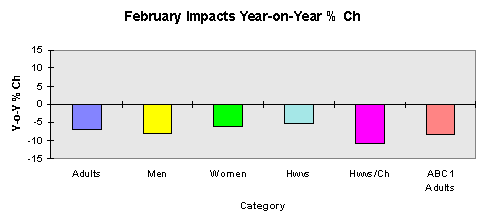
Impacts The decline in impacts in March showed were more uniform, with all categories showing drops of between 7.0 and 10.7% year on year. As usual, Housewives/Children had the biggest drop at 10.7% to 5,607 while Adults showed the smallest drop, down 7% to 35,374.
| Impacts | % Ch | |
|---|---|---|
| Adults | 35374 | -7 |
| Men | 13671 | -8 |
| Women | 21,704 | -6.3 |
| Hwvs | 22135 | -5.3 |
| Hwvs/Ch | 5607 | -10.7 |
| ABC1 Adults | 13002 | -8.2 |
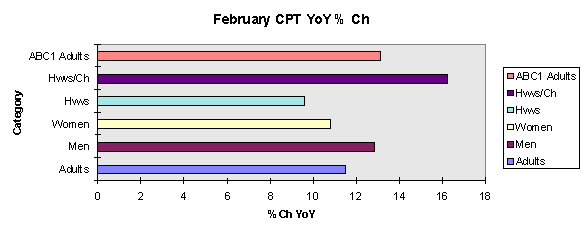
Cost Per Thousands Rises in CPTs showed more variations, with Housewives/Children increasing by 16.2% year on year to 3,446p, compared with women which rose by 10.8% to 890p.
| CPT | %Ch | |
|---|---|---|
| Adults | 546 | 11.5 |
| Men | 1413 | 12.8 |
| Women | 890 | 10.8 |
| Hwvs | 873 | 9.6 |
| Hwvs/Ch | 3446 | 16.2 |
| ABC1 Adults | 1486 | 13.1 |
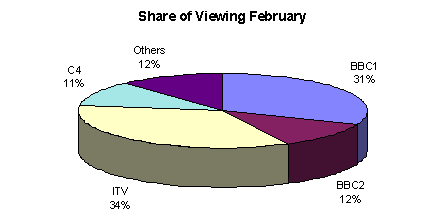
Viewing BBC1 had a bad February, with viewing share showing the largest drop year on year since July 1992, falling 2% points to 31%. ITV had a smaller drop at 1.3% points, though its share for the month was 4% points higher than BBC1’s at 35%. Cable and Satellite channels put in a strong performance, showing the largest year on year rise since September 1995, with an increase in share of 2.6% points to its highest ever share of 11.6%. Both C4 and BBC2 showed small increases.
| BBC1 | BBC2 | ITV | C4 | Others | |
|---|---|---|---|---|---|
| Feb ’96 | 33 | 10.9 | 36.3 | 10.7 | 9 |
| Feb ’97 | 31 | 11.6 | 35 | 10.8 | 11.6 |
| Change | -2 | 0.7 | -1.3 | 0.1 | 2.6 |
Industry News The IPA published its Trends in Television report for the last quarter of 1996 and the year as a whole. It revealed that during 1996 average daily TV viewing remained stable at 3.59 hours, though the last quarter recorded a year on year fall of 1.6%. The trend for terrestrial channels to lose share to cable and satellite continued, with ITV suffering the most.
The Childwise Winter Monitor found that the percentage of children watching commercial TV in the morning had fallen from 70% to 44% over the previous year. Children’s overall pre-school viewing fell 1% to 60%. Both GMTV and the Big Breakfast lost out, with BBC2 and cable channels such as Nickelodeon and the Cartoon Network showing increases.
In the City, STV announced pre-tax profits of £28m, up 40%, while turnover increased 16% to £114.7m. BSkyB also put in a strong performance, with profits rising 26% to £134m. The company now has over 6 million subscribers. News which was not so good for the satellite broadcaster was the report that Digital Television Network, one of the digital TV bidders, was amassing a cash pile with which to challenge its dominance in the pay-TV market. BSkyB is said to be considering moving forward its first pay-per-view football match, which now may be Liverpool’s European Cup semi-final.
Other news was that Channel 4’s Friends had signed a sponsor in the shape of Wella, the haircare company, for around £5m, while the first Wednesday night lottery draw was watched by 10.8 million people. This fell to 6.4 million the week after.
Click here for access to the Television Database