The scale of the problems facing the new owners of the Independent titles is clearly evident from the large drop in sales both newspapers have faced during the 1990s.
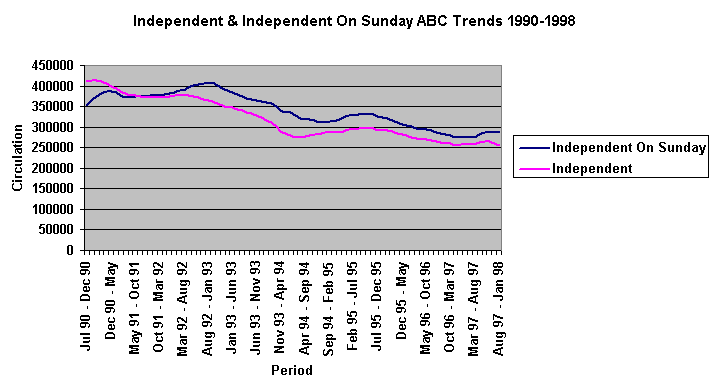
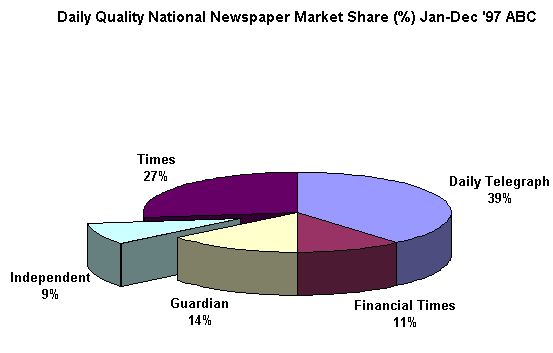
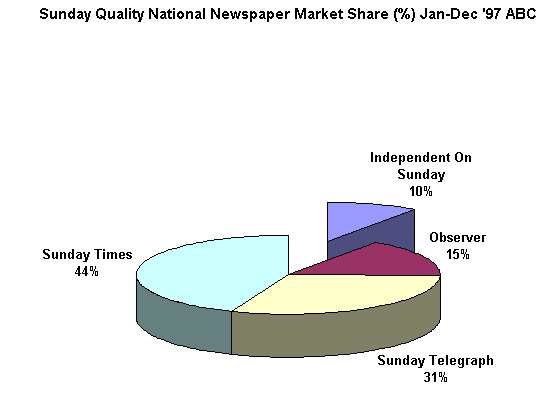
ABC figures from 1990 to 1998 for the Independent reveal a drop in sales from 411,378 for July-December 1990 to 255,324 for August-January 1998. The Independent On Sunday has fared no better, with sales of 352,335 in 1990 compared to 287,562 for August-January 1998. In terms of market share both titles are now the minor players in the national broadsheet sector, with the daily title lagging behind the FT and the Sunday paper chasing the Observer.
While the Sunday title appears to have perhaps halted its decline, the Independent‘s circulation curve appears set on course for another dip. This is despite the Autumn relaunch of both papers – only nine months after the Independent On Sunday title had gone through another major overhaul. While the September move was acclaimed as being radical and innovative it appeared to do little to halt falling sales.
This has been a familiar pattern of events for the newspapers over recent years. A number of revamps, price cuts, new sections and promotional activities have simply not been able to restore the titles to their former sales levels.
While it is nothing new for newspapers to launch new sections, it is the constant tinkering with both the main newspaper and its sections which appear to have put readers off.
The second section, for example, has gone through a number of changes since 1995: changing from Section 2 to The Tabloid and, more recently, becoming The Eye. Additionally, each of these has gone through a number of various redesigns in each of their guises, with new sections being launched within them. Mondays in particular seem to have got rather out of hand, with the Eye being joined by a sports section and a media section.
Indeed one must ask the question of whether the paper would be better off scrapping sections which it clearly does not have the resources to produce. The money saved could be pumped into expanding the main paper which carries good brand values in the market.
The titles have also gone through their fair share of editors recently. In the last two and a half years, for example, the Independent has seen four different people in the editor’s chair: the exit of Ian Hargreaves in November 1995 was followed by the appointment of acting editor Charles Wilson who was then replaced by Andrew Marr. He, in turn, was replaced by Rosie Boycott after alleged dissatisfaction with the last revamp. O’Reilly, however, has now brought Marr back as editor-in-chief (with special responsibility for the comments pages) while Boycott continues in her role as editor.
Stability, however, appears to be the one thing which the newspapers have not tried to use to change their fortunes – the takeover by Tony O’Reilly seems the best chance they have had to achieve this. Many in the industry now hope that O’Reilly will have the patience to persevere with the newspaper and not show the impatience for sales success which appears to have damaged the titles in the past.
Changes already made include appointments to a new board, which includes Chris Patten, Baroness Helena Kennedy QC, Independent founder Andreas Whittam-Smith and Tony O’Reilly. Brendan Hopkins, of Independent Newspapers, now becomes managing director of Independent Newspapers UK.
The management has set its sights on a modest increase in circulation for both titles within three years. They hope to increase sales of the papers by 25,000 and 30,000 for the daily and Sunday titles respectively.
The new ownership has also said that it wants to position the Independent titles as upmarket newspapers, appealing to young professionals looking for an independent viewpoint. “Serious” and “intelligent” have also been used to describe the way the paper wants to present itself.
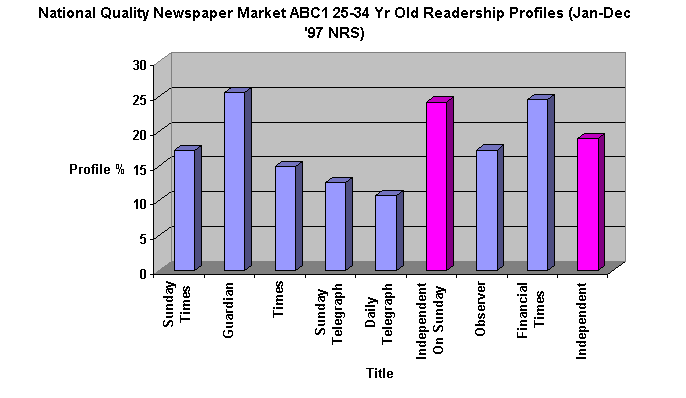
Indeed, it is the attractive audience delivered by the newspaper which has pacified advertisers thus far. As the table below shows, among the national quality titles, both of the Independent titles have a high ABC1 25-34 readership profile – only slightly below the FT and Guardian – and much above the Daily Telegraph and Times. A commitment to providing a newspaper for these readers will be welcomed by the advertising industry though they will also be keen to see an upturn in sales.
National Quality Newspaper Market ABC1 25-34 Yr Old Readership Profiles (Jan-Dec ’97 NRS
| Title | Adults 15+ | Audience | Coverage % | Profile % |
| Sunday Times | 3,700,000 | 640,000 | 14.18 | 17.2 |
| Guardian | 1,247,000 | 319,000 | 7.07 | 25.5 |
| Times | 2,009,000 | 301,000 | 6.67 | 14.9 |
| Sunday Telegraph | 2,382,000 | 301,000 | 6.67 | 12.6 |
| Daily Telegraph | 2,594,000 | 281,000 | 6.22 | 10.8 |
| Independent On Sunday | 883,000 | 214,000 | 4.74 | 24.2 |
| Observer | 1,202,000 | 208,000 | 4.6 | 17.3 |
| Financial Times | 659,000 | 162,000 | 3.59 | 24.5 |
| Independent | 730,000 | 139,000 | 3.08 | 19 |
A key part of the titles’ future success will, of course, depend on investment. While Independent Newspapers has made much of pumping money into their editorial resources, no figures have yet been mentioned. What is beyond doubt is that any financial “rescue-package” will need to involve hefty sums. Two packages were put together in 1996 by the Mirror Group and Independent Newspapers – £23m raised in April of that year and another, undisclosed figure, eight months later – yet these were unable to pull the title out of its sales dip.
The upshot of this is that O’Reilly’s buyout has provided hope among advertisers and agencies that the Independent and Independent On Sunday may, at last, be on the road to recovery. It does mean, however, that the industry may become frustrated if signs of a recovery are slow.
For commments from the industry on the takeover of the Independent titles, subscribers should click Industry Reacts With Cautious Optimism Over Independent Move.
The Press database can be accessed by selecting “Press” from the drop-down box at the top of this page.