More marketers should be tracking ad awareness as an early indicator of advertising effectiveness, according to a study commissioned by TV trade body Thinkbox.
The Awareness Effect: How ad awareness unlocks everything else, conducted by Ebiquity, Gain Theory, and WPP Media using YouGov data, found that ad awareness has both a direct and indirect relationship with brand consideration.
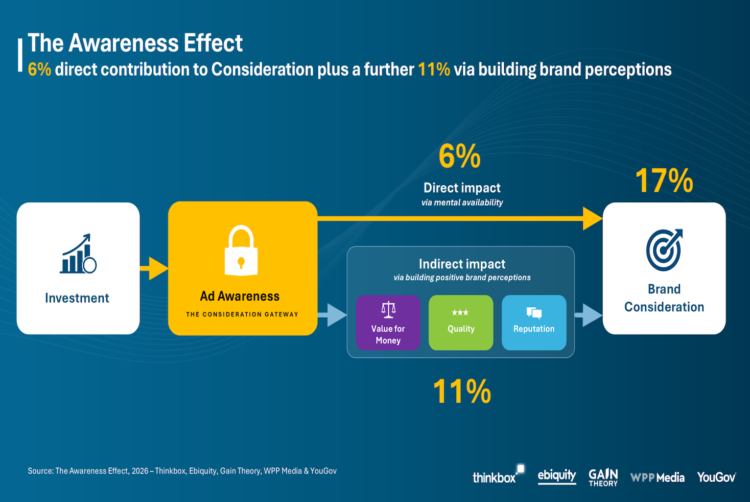
The study estimates that ad awareness – meaning consumers are aware of or recall seeing or hearing advertising for a brand – is responsible for an average 17% of brand consideration, through both direct and indirect effects.
The direct effect is the influence of ad awareness on consideration itself, while the indirect effect comes through changes in perceptions of a brand, such as its quality, reputation and value for money.
On average, the study attributes 6% of brand consideration to the direct effect of ad awareness. Its indirect effects include 12% of brand quality perceptions, 13% of good reputation and 18% of value-for-money perceptions.
The research uses YouGov BrandIndex data to examine the relationship between ad awareness and other measures of brand health in the UK. It covers 1,478 brands across more than 120 product sectors, using data collected between January 2022 and March 2026.
Thinkbox says the findings show that ad awareness could give marketers an earlier indication of campaign effectiveness than brand consideration, which it says changes too slowly to support rapid campaign optimisation.
Brand consideration is widely used in market mix modelling (MMM) and long-term ROI analysis, but the study argues that ad awareness can be tracked more frequently, giving marketers a quicker indication of whether advertising is having an effect.
Anthony Jones, head of research at Thinkbox, described ad awareness as a “pivotal metric”.
He said: “Brand consideration matters, but it is too slow to be useful in today’s fast-reaction marketing. Ad awareness offers marketers a vital early read on whether things are working. If marketers refocus on ad awareness, they can improve their visibility of what lies ahead and adjust accordingly.
“Besides being a practical resource for the industry, this work is also a call to the market to reconsider the value of ad awareness as a leading indicator of success and as a key marketing objective.”
The effect also varies significantly between categories.
In quick-service restaurant delivery, for example, ad awareness accounts for 69% of brand consideration, while the figure is 62% in lottery and 61% in ride-hailing.
The study will be previewed at the IPA Effectiveness Conference on 7 October, with the full research due to launch in November. The complete study will also examine which media channels are most effective at driving ad awareness.