Advertising awareness varies substantially by media channel and brands could create 30% more awareness without increasing their current budget.
Those are two of the core takeaways from a new study commissioned by Thinkbox and conducted by Ebiquity, Gain Theory and WPP Media. It examined how ad awareness is a “vital early warning system” for how brand consideration is likely to change in response to an ad campaign.
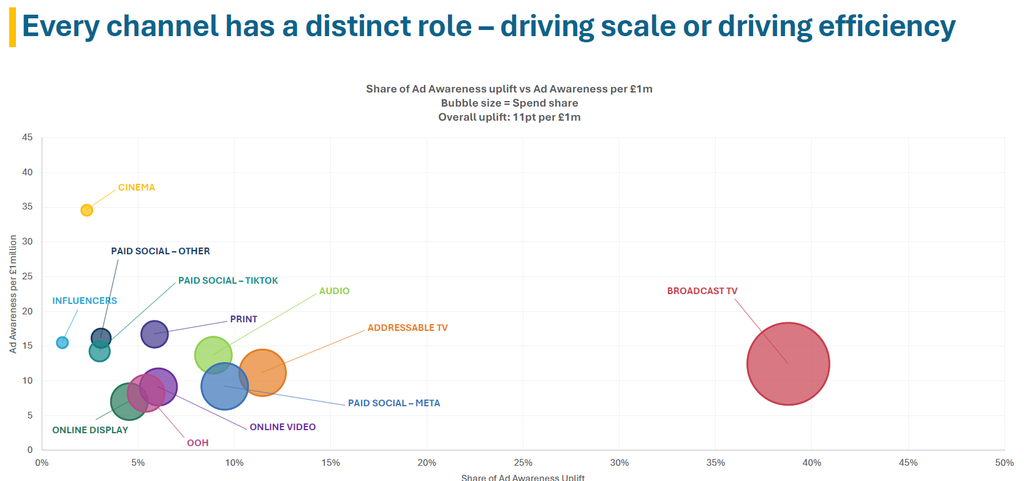
The Awareness Effect found that TV overall accounts for over half of all ad awareness uplift, with broadcast TV alone (39%) generating more than three times as much as any other individual channel.
This was followed by addressable TV (11.5%), paid social via Meta (9.5%), audio (8.9%), online video (namely YouTube, at 6.1%), print (5.9%) and OOH (5.4%), with other channels providing less than 5% share of awareness uplift.
Uplift and efficiency varies significantly by channel
However, breaking down channels by efficiency offers a different picture.
Cinema, despite providing a 2.3% share of ad awareness uplift, was found to be the most efficient channel at driving ad awareness, with 35 “awareness points” generated per £1m invested. The result reflects cinema’s relatively modest scale but high attention.
Other channels that overindexed on ad awareness efficiency included print, audio, influencer marketing and non-Meta paid social.
In contrast, online display, OOH, online video (namely YouTube) and paid social via Meta were found to be relatively inefficient at delivering ad awareness.
While the likes of TikTok and other paid social platforms outperformed Meta in terms of efficiency, paid social via TikTok was notably found to require nearly 10 times greater frequency of exposure as addressable TV to generate the same increase in ad awareness.

Attention is the key factor, the study concluded: 86% of a given ad impression’s awareness power is due to attention. As the study concluded, “lower-attention channels demand significantly higher frequency to drive the same lift” compared with higher-attention channels.
The report’s authors thus grouped channels into three broad groups: consistent scale champions, consistent efficiency champions and sector champions.
Consistent scale champions include audio, total TV and Meta. They “handle big budgets and drive the biggest uplifts in brand awareness”.
Consistent effiiciency champions include cinema and print, providing “high-impact channels that give top return per pound but saturate quickly”.
Sector champions, meanwhile, “thrive when matched with the right product or audience”.
Ad awareness effect by sector
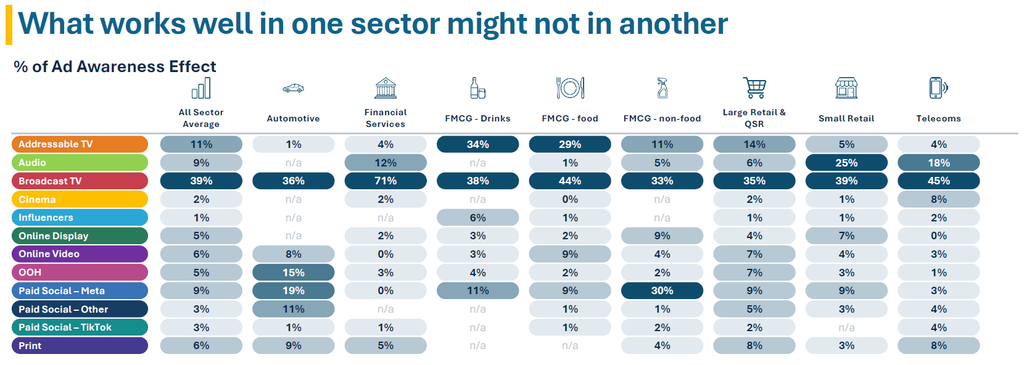
Indeed, the study found that different sectors benefit from different media mixes, as has previously been shown in the landmark Profit Ability 2.
While broadcast TV remained the largest individual contributor to ad awareness in every sector analysed, this was especially the case for financial services (71% share of uplift), telecoms (45%), FMCG (44%) and small retail (39%).
Addressable TV was found to be particularly important for FMCG brands (34% for beverage brands and 29% for food brands).
Meta was found to be especially effective for non-food FMCG companies (30%) and automotive brands (19%).
Audio, meanwhile, was found to be especially effective for small retail (25%) and telecoms (18%).
Plan smarter
The Awareness Effect conducted modelling based on a £15m annual advertising budget, finding that rebalancing investment for the average brand could deliver not only 30% more ad awareness but also a 7% increase in short-term profit without any additional spending.
Optimising for ad awareness would result in increases to the share of total TV investment (from 44% to 54%), cinema (from 1% to 7%), audio (from 6% to 10%) and print (from 3% to 7%).
In contrast, share of investment would decline for paid social (from 13% to 4%), online video (from 4% to 3%) and online display (from 5% to 4%).
OOH investment would remain consistent at 5%.
“Ad awareness has been hiding in plain sight,” said Thinkbox head of research Anthony Jones, who added that measurement of awareness “deserves a much bigger role”.
He continued: “The potential from using this easy-to-track metric is enormous.”