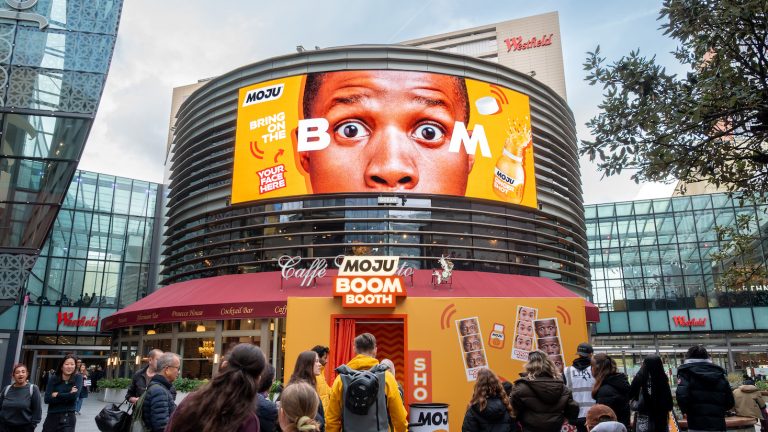

As physical environments become kinetic, marketers will have increased opportunities to make communications dynamic. Within the bounds of consumer expectations and the law, brands will find more ways to add motion to their messaging, writes Phil Rowley.
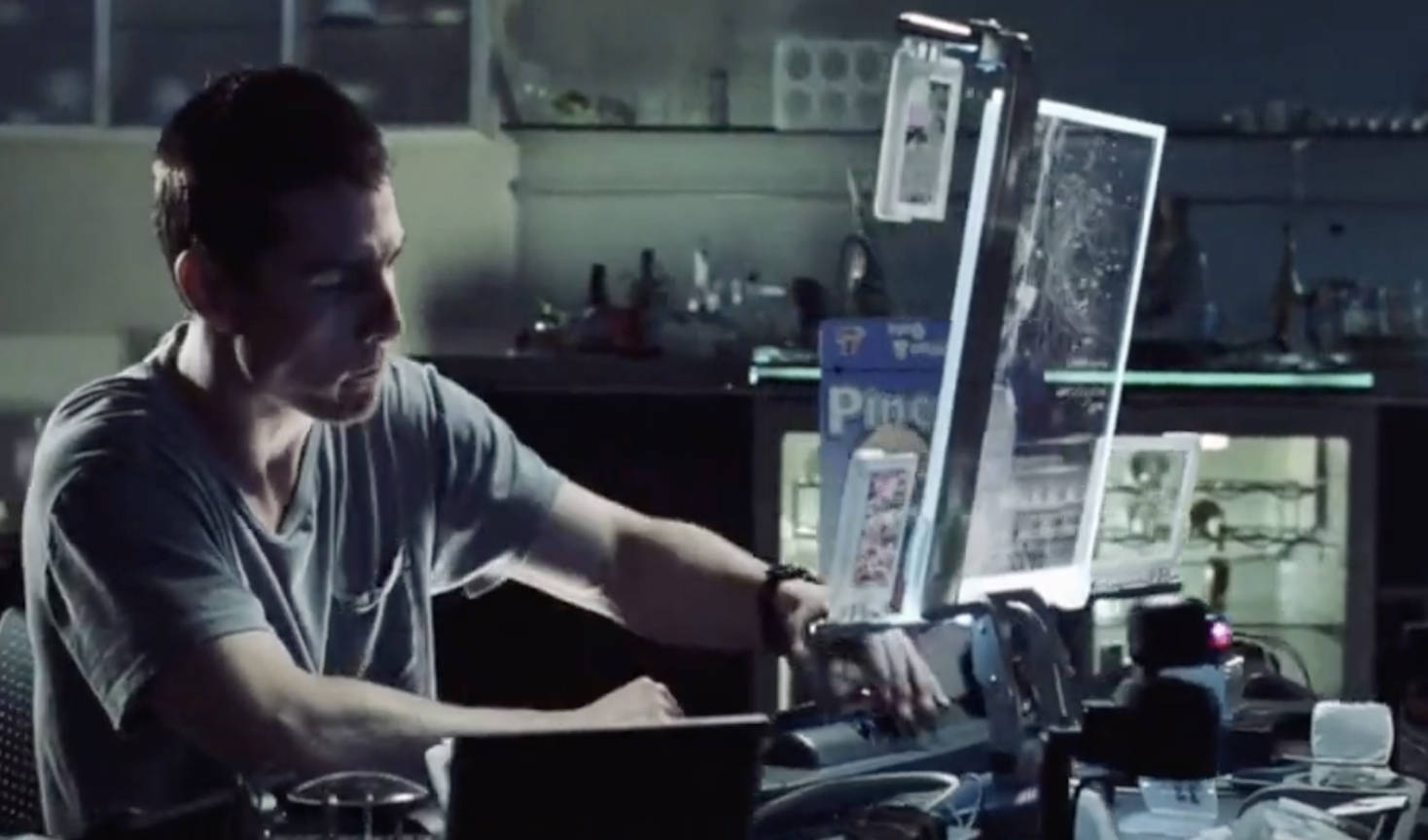
Three years before production started on Minority Report, Steven Spielberg convened a meeting of technologists and futurists to help him understand the year 2054, the film’s setting.
Among the many technologies forecast was the explosion of animated surfaces. Spielberg references it in a brief scene where a grumpy Tom Cruise absentmindedly pours cereal from the box into his mouth, and tipping the box triggers an animation on its surface. The cartoon dances and flickers across the packet, with the cereal’s mascot chirping and whistling its tune, until Cruise throws the box across the room in annoyance.
Although this is a prediction for 2054, it is closer than you think.
From fix to flux
Travel down a tube escalator twenty years ago, and the ads would be paper. Some in frames, some behind a protective layer of plastic. But always paper. The only screen you might encounter was a giant cathode ray TV, creaking on a bracket above the platform. Or the dot-matrix-style scrolling LEDs still present in many stations today.
At some point, however, screens started appearing. Ads moved across surfaces that were thinner and brighter, with crystal-clear pinpoint clarity. Even London’s iconic Oxford Circus station sign on street level became electronic too, featuring scrolling messages like: “Steps might be slippery when wet”.
And it’s not just tube stations. Supermarkets, airports, hotels, EV charging stations and even late-night kebab shops are now behind the shift to ‘moving messages’-animated, scrolling, kinetic symbols rotated and updated at will.
Paper is being replaced by pixels. The trajectory is set, and the tech enabling it is accelerating.
Material science makes messages move
A tapestry of interwoven and overlapping technologies is powering the move from fixed messages to in-flux messaging. There are two areas of material science to note:
First, we have electrophoretic e-paper that mimics ‘real’ ink on paper by using microscopic, electrically charged pigment particles suspended in a liquid. On the plus side, it requires vanishingly tiny amounts of power to operate, and it has no moving parts, so scale and reach may be achievable. However, its glacial ‘frame rate’ makes constant animation a challenge.
Nevertheless, its potential as a message-laden surface – like a cross between an iPad and “The Marauder’s Map” from Harry Potter – means it’s worth paying attention to.
Second, we have both micro-LED and flexible OLED. Ultra-thin malleable materials akin to a TV screen that can be rolled up like a yoga mat. Unlike electrophoretic e-paper, it can display full animation.
However, manufacturing costs are still a challenge. In both cases, the tech is not quite ready for a ubiquitous rollout – that’s a pun, by the way – but once it finally arrives, we can envisage a whole host of applications.
Considering kaleidoscopic communication
Once surfaces can be animated, we might be able to imagine the following:
Animated street furniture like pavements and walkways that buzz with dynamic design and sweeping imagery. Steps that glow red when slippery. Pedestrian crossings that pulse and oscillate to help people cross the road. Programmable cycle lanes that flow and glow when a cyclist is present.
Tube and train windows featuring scrolling updates on network delays. Cars with exterior ‘skins’ carrying imagery that is fluid and bleeds across the vehicle.
Clothing with animated logos and ‘breathing’ designs. Trainers that bloom with colour upon each step. Tattoos that attach to the surface of the skin like a transparent ‘derma-patch’, showcasing evolving, cascading imagery.
Food packaging that displays freshness ‘traffic lights’ with a simple squeeze – or a real-time countdown to the best-before date. On-pack offers that update as you consume more of the product. Animated logos – yes, like Minority Report.
This is a vibrant, newly kinetic world. But an obvious pushback might be: “Our world is already full of distractions. Why add more?”
That might be a valid point. To which the answer is: context matters.
Getting it right
As humans, we have strong opinions when aesthetics are misjudged. For instance, when new buildings in old towns are not sympathetic to the surrounding environment. Or when music in shops or pubs is too loud. We tut. We moan. We complain. Sometimes someone launches a campaign.
Similarly, from a legal standpoint, we have guardrails to prevent misapplication. We have legislation preventing billboards in specific locations from distracting drivers – for instance, stipulating brightness and animation speed.
In the UK, the Committee of Advertising Practice (CAP) Code and local councils can enforce certain threshold rules for ad placements near heritage sites, places of worship and schools.
When we don’t like it, we usually say. And beyond that, we have structures to govern proper use.
However, we must not fall into the trap of assuming that these safeguards will stop technology from continuing to change our physical environment. Indeed, in Los Angeles, there’s a trial of 3,000 new transit shelters carrying e-paper screens reserved for public messaging such as real-time bus arrivals.
And we already know car companies like Porsche are working on e-ink exteriors that display functional safety information to other drivers.
This is coming. And most pertinent, this has implications for brands.
Marketing becomes more ‘mobile’
So, as physical environments become more kinetic, marketers will have more opportunities to make their communications dynamic. Again, within the confines of consumer expectation and the law, brands may find more avenues to deliver motion in their messaging.
The opportunity isn’t to make every surface noisier with full-on, erratic animation for every touchpoint that formerly featured a static image. Rather, the creative challenge will be in developing a new visual language in which motion feels native to its physical context, identifying how and when it should move.
E-ink press ads might use slow, almost imperceptible movement to attract attention without disrupting the reading experience. Ads on building sides could make animation follow the architecture, rather than fight it. Taxi skins might come alive only while vehicles are stationary, then disappear once they move.
But this advancement will require continued collaboration between creative and media disciplines. We’ll need to keep pondering not only how location and message can work in harmony, but also how we can complement the physical environment rather than distract from it.
Spielberg’s dancing cereal box may not be on the shelf just yet, but the surfaces that will make it possible are being built now. The question for brands is no longer whether the world will move, but whether they have the judgement to move with it.
Motion that respects its setting, be it the road, the street or the pause in a commute, will earn attention. Motion that ignores it will invite complaints, and regulation.
The brands that thrive won’t be the loudest. They’ll be the ones that learn to choreograph, not just animate.

Phil Rowley is head of futures at Omnicom Media Group UK and author of Hit the Switch: The Future of Sustainable Business. He writes for The Media Leader about the future of media.