
There is now industry standard proof that television’s reach hasn’t changed in the last 10 years – but, to make the most of it, marketers need to plan across both TV and broadcaster VOD, writes Thinkbox’s Matt Hill
Reach has always been one of TV advertising’s trump cards. Broad reach creates fame and that builds brand desirability.
No-one can truly predict who might end up a customer and to succeed in marketing you can’t simply speak to those who are in market; our emotions drive our decisions and as a result we need to be warm towards a brand for our activation media to work.
You don’t become a household name by avoiding most of the households.
That’s why the term ‘wastage’ is such a misnomer in TV. There is no waste in TV, just bonus views. In TV, advertisers only pay for the audience they buy – everything else is a windfall of extra viewers.
But those viewers you reach who are outside your bought audience are far from worthless; they are simply worth less. If the first time you see a Mercedes ad is in your 50s, it’s too late.
So reach is crucial. However, as people have embraced new ways to watch TV, their viewing has split across different times, places and devices and getting a proper picture of TV’s reach has become harder.
Industry standard measurement (viewing within 7 days of broadcast on a TV set) has not been able to keep pace with the changes in TV viewing.
For example, among 16-34s there’s an extra 13% of TV viewing that is not included as part of the industry standard measurement, these being the most enthusiastic adopters of the new ways we have to watch TV.
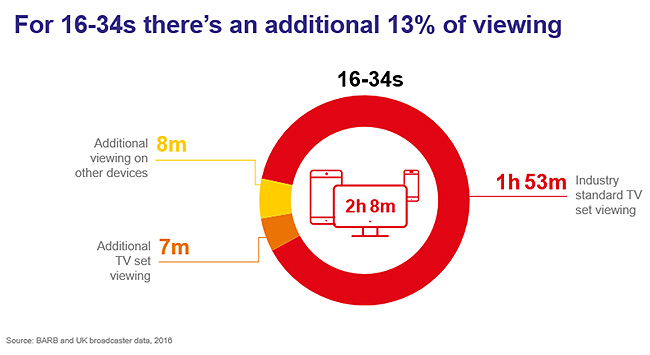
Industry standard measurement only gives a partial picture of TV. A consequence of this is that it has looked as though TV’s ability to drive cost effective 1+ reach, especially among younger audiences, had declined.
This led to a question we at Thinkbox have been asked above all others: how can Broadcaster VOD be planned in conjunction with linear TV to maximise reach?
Many media agencies have developed their own systems to estimate the combined reach of TV and BVOD. But we’ve been in urgent need of an industry standard and I’m happy to say we now have one, and a very credible and revealing one it is too.
Step forward and receive thunderous applause IPA TouchPoints’ new AV planning tool. It has a channel planner to find the optimal splits of TV and BVOD to maximise 1+ reach at the lowest budget for the key buying TV audiences.
Using data from the 5,000 strong IPA TouchPoints media diary and hub questionnaire, RSMB (one of the most reputable media statisticians around) has made it possible to model the reach build for TV and BVOD together.
So, for example, a campaign today targeting 16-34s with a budget of £1 million planned only across ‘industry standard’ TV reaches 60% of 16-34s, when it would have been 70% back in 2007.
But, with the new TouchPoints planning tool we can see that by using an 80:20 mix of industry standard TV and Broadcaster VOD, this goes back up to 70%. TV’s reach is undiminished.
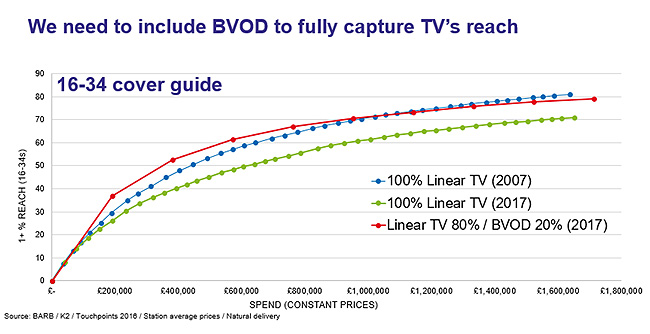
This is an important new tool for the industry. It shows the modern marketer how to generate incredibly high and cost-effective reach using the premium, brand safest advertising environment, and the optimal budget splits between TV and BVOD to achieve this.
TV’s immense reach is still easily within reach.
Matt Hill is research and planning director at Thinkbox