The past decade has seen the proliferation of digital technology with widespread uptake among both adults and children. According to a recent report by Google, the UK internet economy is worth £100 billion. As the noughties draw to a close, TGI takes a look at how British young people are interacting with the digital world…
Generation “i”
Today few school-age children are able to remember a world without widespread internet access, a wide choice of TV channels and an Apple for every eventuality. According to the latest Youth TGI data, a quarter of 7-10s agree they would be ‘lost’ without the internet, rising to 46% of 11-14s (up from last year’s figure of 44%). Over 90% of each group have internet access at home and the majority also use the internet at school. The average 7-10 year-old now spends around 8 hours a week online, climbing to 18 hours a week for 11-14s and 24 hours a week for those aged 15-19. In addition, 40% of 7-10s (90% of 11-14s) have a mobile phone and 55% (70% of 11-14s) have a TV in their bedroom. A third of 11-14s have a computer in their room, too.
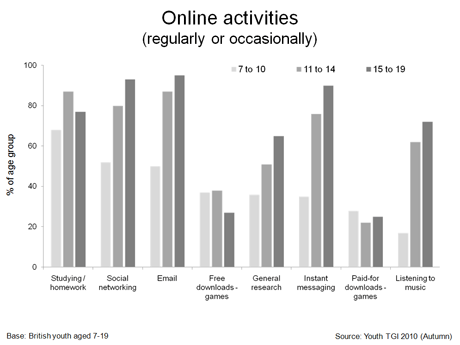
Online activity
Among 7-10s the internet is used mainly for schoolwork, social networking, email and games. More than two-thirds of 7-10s use the internet for study / homework, half use it for social networking, half for email and just under 40% download free games. A similar picture emerges for 11-14s, of whom almost 90% use the internet for study or email and 80% use it for social networking. Instant messaging comes into its own among this age group with three-quarters of 11-14s using some form of IM. The other big development is the arrival of online shopping, undertaken by two-thirds of 11-14s, and a strong interest in music – either downloading or listening online – which carries through to the 15-19 age group.
Mobile-phone internet use follows the same broad pattern. The top mobile internet activity for 7-10s is playing online games, undertaken by 6% of the age group. The top activity for 11-14s is instant messaging (14%) and for 15-19s it is social networking (30%).
Online purchasing
Youth TGI shows that 16% of 11-14s and 34% of 15-19s shop online at least once a month, up from 13% and 27% respectively in 2008. Most major banks now offer some form of debit card (dependent on parental permission) to the 11-15s, allowing them to shop online without having to pester mum and dad for payment.
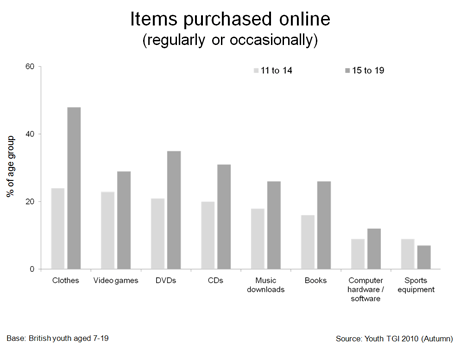
A quarter of young people aged 11-14 purchase clothes online, 23% purchase video games, 21% purchase DVDs, 20% purchase CDs and 18% purchase music downloads. Among 15-19s the most popular online purchases are clothes, bought by just under half of the group, DVDs (35%), CDs (31%), computer games (29%), books (26%) and music downloads (25%).
Even when purchasing offline, many young people now do exactly what their parents do and refer to the internet for guidance. One-third of 11-14s ‘always’ refer to the internet before making a purchase, rising to almost half of those aged 15-19. Boys are more likely than girls to do this, and they are also more likely to be influenced by comments and reviews posted online. Overall a fifth of 11-14s and a quarter of 15-19s admit to being influenced by comments posted by other internet users.
And influence…
British young people are among the most connected and digitally advanced in Europe. A fifth of 7-10s consider themselves to be ‘experts’ on new technology, rising to 40% of 11-14s and a third of 15-19s (who perhaps have a broader horizon). A significant minority of parents now ask their children for advice about new technology such as mobile phones. A fifth of 11-14s say that one or other of their parents has asked them for mobile advice, rising to a quarter of 15-19s. It is no surprise that marketers across a wide range of technology and consumer sectors are also listening to what the kids have to say, keeping in mind that the future starts here.
Source: Youth TGI 2010 (Autumn)
Base: British youth aged 7-19