



How Beehiiv is accelerating ad-funded indie publishing
The Media Leader Interview | Future of Brands: Creator Economy Week in Focus
Beehiiv’s CEO and VP of ad sales discuss how the platform is working to take on the tech giants and support independent journalists with its scaling ad product.
Beehiiv, the newsletter and podcast publishing platform, has grown its advertising revenue 50% year-on-year and now generates $1m in monthly revenue as it looks to accelerate its ads business.
CEO Tyler Denk revealed this week that Beehiiv currently has more than $35m in annual run rate, meaning advertising makes up approximately one-third of its overall business.
The ad revenue is portioned among 13,000 independent publications on the platform that have opted into the Ad Network. Approximately 3,100 of those publishers have a large enough audience earn ad revenue each month, with ad revenue doled out based on audience size, leading to a top-heavy distribution.
The top 12.5% of publishers (389 publishers) earned $1,000 during Q3, while the highest-earning publication generated $49,000 through the ad network during the quarter. The median publisher, meanwhile, earns double-digit monthly revenue.
Beehiiv also takes a cut of all ad sales; Denk has described its take rate as flexible, typically “hover[ing] in the 15-20% range”.
Speaking to The Media Leader on a call from Mexico City, he describes 2026 as a “very big building year for us”, in which Beehiiv has invested in not only building out its adtech stack, but also hiring commercial talent to attract big-name advertisers to the platform.
“I think the ad business can be an absolutely massive business,” Denk says. “I’ve always said from day one that I think it’ll actually be the majority of our revenue one day.”
Refining go-to-market
Last month, Beehiiv hired its first VP of ad sales, Jenna Castaldo, who joined from B2B publishing company Workweek after previously working with Denk at Morning Brew.
“Without a true sales leader, historically, we’ve done great, but we didn’t bring in the kind of ideal logos that we’d like to have,” Denk explains. Since Castaldo joined, the platform has already spoken with bigger brands offering prices that are “very attractive to publishers” — a “leading indicator” for growth, he says.
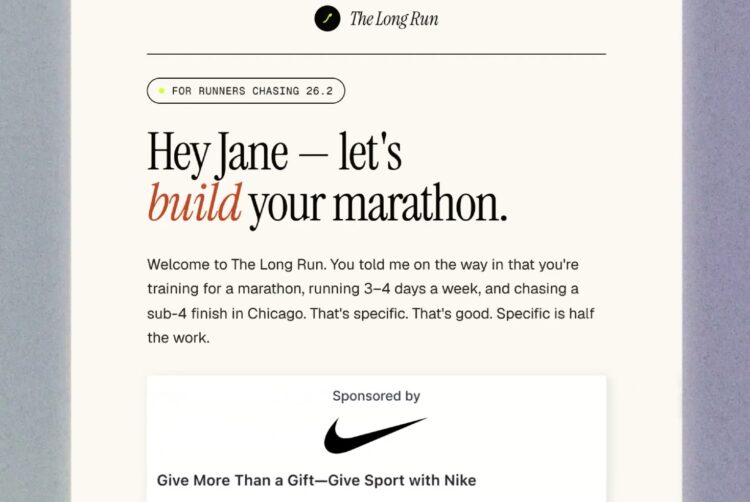
The largest advertiser on Beehiiv is HubSpot, with other major advertisers including Roku, Netflix, Nike and Attio. The Media Leader understands Roku has increased its ad investment ten-fold this year, though it’s unclear from what base.
Platform-wide, there has been a 41% year-on-year increase in the total number of campaigns delivered on the platform this year.
Beehiiv launches programmatic advertising, community-building features
Beehiiv has offered advertising since launching its Ad Network in 2022 and remains the only platform of its type to do so. Substack and Patreon, Beehiiv’s closest competitors, do not currently offer ads, though Substack has reportedly tested ad integrations and facilitates sponsorships with some of its top writers. This week, Substack also announced a new podcast monetisation toolkit centred around sponsorship opportunities.
This year, Beehiiv’s ad model has expanded to include “On-Demand Ads” and programmatic buying, giving publishers and advertisers more flexibility and easier ways to integrate ads into content. The company handles ad sales directly, with no current plans to integrate with demand-side platforms (DSPs).
Castaldo tells The Media Leader she is keen to refine Beehiiv’s go-to-market strategy with the ultimate goal of “ensur[ing] that publishers are making more money while also not sacrificing advertiser results.”
Castaldo is positioning Beehiiv as offering premium independent publications, which “begets premium audiences”. The idea, similar to Ozone for established web publishers and Atria for UK magazine brands, is to act as an entry point for advertisers wanting to reach those publishers and their audiences across text, audio and video output.
Popular Beehiiv publications include Oliver Darcy’s media newsletter Status, Joanna Stern’s tech outlet New Things, Dave Jorgensen’s satirical Local News International, and Carole Cadwalldr-led UK startup The Nerve.
As Denk describes, independent publishers operating at that scale may opt to take ad sales in-house. But for the longer tail of Beehiiv writers — especially those with under 10,000 subscribers — the Ad Network is an opportunity to diversify their revenue or, at least, cover the costs of a Beehiiv subscription.
“We are approaching about one-tenth of our users generating more revenue on the platform than what they are paying us per month,” he says. “Which means they’re basically getting the platform for free. It’s an important metric to make our software more affordable for those to use it.”
Getting publishers on board
Denk has previously said he wants to do for newsletters what YouTube did for video, democratising the medium through a centralised platform-based ad model.
“We should be competing against Google and Meta,” he says. “Now that we’re serving 5.5bn impressions per month and we have all these quality creators and publishers, where else can you find these niche audiences and be able to advertise at scale?”
Castaldo adds that while she views Beehiiv’s current proposition as ideal for brand budgets from premium advertisers, the ultimate goal is to “mimic” tech platforms’ full-funnel proposition, where advertisers of all sizes can be served by the platform regardless of which KPI matters most to their business.
Like with most tech platforms, the scale on offer comes with opacity. Castaldo confirms advertisers aren’t given information on which publications their ads are served against, though performance dashboards are available to track campaign outcomes.
“They can’t know exactly the publishers, just because that’s very difficult to scale because of how many publishers we have,” she says, adding Beehiiv does allow for advertisers to customise the types of publishers it most wants to show up against, create category exclusions, and submit blocklists.
“At the end of the day, Beehiiv is a premium platform; a lot of our publishers are on the premium side, so advertisers also trust us with that messaging,” Castaldo adds.
Journalists who built careers in traditional publishing are leaving it for the creator economy
In fact, Denk and Castaldo explain it has been more challenging to convince creators to accept ads than the other way around. Precious about their publications, a common complaint among Beehiiv’s indie writers is that the advertisers on offer might not be the right fit for their audience.
“We have so many niche content categories, and we have at any given time between 100 and 125 campaigns live right now, many of which are more large, mainstream advertisers that may not fit those categories perfectly,” Denk explains.
Another concern is regionality. UK writers, for example, would rightfully resist advertisers that don’t operate in or make sense for their local market.
Hence, while Castaldo is going after larger, US-based advertisers first, eventually she will look to bring in long-tail and regional advertisers to provide all writers on the platform with advertising suitable for their needs.
“Having the right advertiser at the right price brings in so much more demand from the publisher side,” adds Denk.
Don’t be predatory
For Denk, it’s important to balance Beehiiv’s positioning as a tech platform with a suite of enterprise tools for publishers and scale for advertisers, while supporting independent journalism.
The company has worked to support its creators and journalists beyond what other tech giants typically offer. The Beehiiv Media Collective, for example, offers leading writers on the platform health coverage, legal protections, and other benefits akin to what a journalist might expect from a traditional publisher.
Earlier this year, Beehiiv also offered journalists laid off from The Washington Post this February free access to Beehiiv’s platform for one year.
Denk prides his company on not charging a fee for paid subscriptions (“We don’t think it’s right that just by connecting a Stripe account [you can] extract a 10% take rate for that”) or building any platform lock-in, allowing users to migrate elsewhere easily if they so wish.
Denk asserts that mantra of being “creator-first” and “user-first” applies to the wider business model, with Beehiiv’s North Star being to not do “anything predatory”.
“What’s important for publishers and creators is choice, that they can monetise with subscriptions or with ads, or both,” Denk says. “That’s the maturation of the creator economy.”