
The television audience has not left the living room. But it is moving more freely than ever. Across streaming services, live channels and gaming, viewers are building entertainment experiences that follow their interests rather than any single platform. For advertisers, the challenge is understanding how those journeys connect.
Samsung Ads’ Behind the Screens 2026 report explores this shift through first-party insights from more than 70m Samsung smart TVs in Europe, complemented by consumer research.
Its central finding is clear: fragmentation is not a transitional phase. It is the established reality of television viewing.
Content comes first
For audiences, connected TV increasingly resembles smartphone use: moving between apps, choosing what suits the moment and returning to a central screen before deciding where to go next. What the industry sees as separate services, viewers experience as one connected entertainment environment.
The average household used five apps across 2025, while total app launches increased 8% year on year to 18.4bn. That growth reflects more than an expanding choice of services. Audiences are actively spreading their attention across them.
Younger viewers are leading this behaviour, using 21% more apps than average and moving between subscription and free platforms. Their loyalty lies less with the service delivering a programme than with the content itself.
More than eight in 10 consumers say content drives their app choices, with freshness, exclusivity and relevance shaping decisions. Multiple subscriptions are therefore not necessarily interchangeable; each can fulfil a different entertainment need.
Among those surveyed, 60% maintain multiple subscriptions throughout the year, while 18% rotate services according to what is available. Another 14% mostly use free or advertising-supported platforms and 8% subscribe occasionally for particular shows or events.
The implication is that a subscription does not guarantee consistent attention. Even viewers who keep paying are making fresh choices about where to spend their time.
More choice, fiercer competition
Those choices sit within an increasingly crowded entertainment landscape. In the first quarter of 2026, more than 650 football matches from Europe’s leading leagues competed for attention alongside over 100,000 unique titles on leading subscription streaming platforms and 90 new gaming releases.
These are not separate contests for separate audiences. They are competing possibilities on the same screen, often within the same household.
Nor does any single viewing environment capture everyone. The report finds that 24% of Samsung TVs account for 81% of all linear viewing, while 27% stream without watching linear television at all.
For advertisers, this concentration matters. A plan built around one environment risks repeatedly reaching some households while missing others. Understanding the relationship between linear and streaming audiences becomes as important as understanding either audience individually.
As Matt Bryan, director of analytics and insights at Samsung Ads, puts it: “As viewers follow content rather than platforms, linear, streaming and gaming have become interconnected parts of a much more complex ecosystem.”
The home screen connects the journey
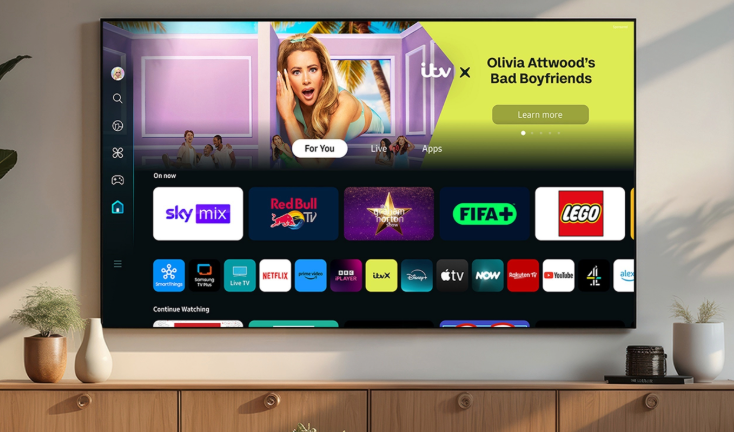
Within that complexity, the TV home screen provides a consistent point of return. Viewers access it more than five times a day as they switch on, explore options and move between apps. Nearly nine in 10 respondents use it to decide what to watch next.
That makes the home screen more than a navigation tool. It is a discovery environment where decisions are still open, before attention moves into a particular service.
For brands, the opportunity is to understand this moment on its own terms: not simply as another placement, but as part of how viewers find their next experience.
Fragmented viewing, shared experiences
More individual choice has not made television an exclusively individual activity. The living room remains a shared space, with co-viewing common across linear and streaming.
Both reach their viewing peak at 7pm, while user-generated content viewing falls away as audiences favour shared, big-screen experiences during prime time.
Gamers offer a particularly revealing example. Often considered primarily through their gaming activity, they are also highly social television viewers: 72% watch in groups of two or more and they are nearly three times more likely than average to watch in groups of at least three.
They are also receptive to discovery and advertising. Gamers are 88% more likely than average to follow home screen recommendations and 135% more likely to look up products featured in TV ads.
Planning for the whole picture
The lesson is not that television has become less valuable. It is that its value can no longer be understood through isolated platforms.
Brands need a connected view of where audiences spend time, how viewing overlaps and which environments add reach. Bryan points to solutions such as TotalView as a way to understand true reach and invest more precisely.
The audience may still be on the sofa. The media plan needs to keep moving.