
The Broadcasters Audience Research Board (BARB) has added smartphones to its unduplicated reach and time spent viewing data.
Since January 2020, BARB has been reporting this data across three screens – TV, tablets and PCs. With the installation of router meter technology into panel homes, the organisation can now measure average audience data and time spent viewing in smartphones across the full range of demographic groups.
“Using the Dovetail Fusion process, collecting smartphone data from our panel means that we can now report on people rather than devices, so reach and incremental reach are now supported as well as reporting demographic profiles of the smartphone view audience,” a BARB spokesperson said. “Extending our reporting of unduplicated reach and viewing time to smartphones builds on our established census-level reporting of BVOD viewing across all four devices.”
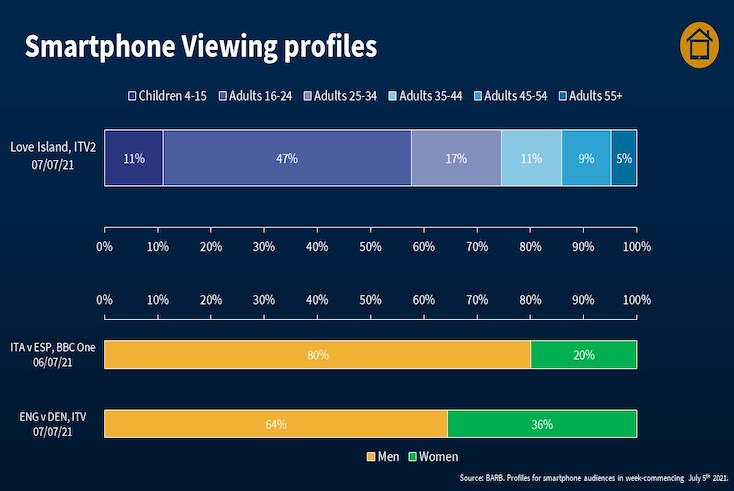
To support the announcement, BARB provided smartphone data collated on 7 July. It shows that episode 10 of Love Island delivered a four-screen total audience of 3.8 million individuals with 412,000 (10.7%) viewing on a smartphone. Of these smartphone viewers, 46.6% were aged 16-24 and 75.8% were female.
On the same day, ITV broadcast the semi-final of the Euro 2020 tournament between England and Denmark, which delivered a four-screen viewing audience of 18.3 million. Device-viewing contributed over 660,000 viewers to this total and smartphones were the second most popular non-TV device with 213,000 viewers – 35% of the device total.
“The demographic detail now available allows the user to draw conclusions on the audience for more effective TV planning,” BARB concluded.