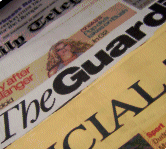
Britain’s newspaper market continued to see overall circulations decline throughout 2005, although a new wave of compact titles succeeded in bucking the trend, while new launches in the free-sheet market saw healthy starts.
By far the largest change within 2005’s national newspaper market was the Guardian‘s switch to Berliner format, undertaken in September (see Guardian Hits Newsstands In Berliner Format). The paper, which is now published in full colour, adopted the reduced size ahead of sister title the Observer, which will follow later this week (see Berliner Sized Observer To Launch Early January).
The paper’s circulation has improved since making the switch, with the latest ABC figures showing sales of just over 401,000. Rival compacts the Times and Independent have also flourished in their smaller formats, while the newly-tabloid Independent on Sunday saw its circulation increase following its reduction in October (see Independent On Sunday To Make Tabloid Switch).
It was a tumultuous year of change for newspapers as a whole, however, with Trinity Mirror staff facing nation-wide job cuts (see Trinity Mirror Staff Face Nation-wide Job Cuts), while the Telegraph Group underwent a similar process as part of its re-shaping (see Telegraph Makes 90 Editorial Staff Redundant In Reshaping).
Elsewhere, Andrew Gowers, editor of the Financial Times, announced his resignation, citing “strategic differences” with the paper’s management (see FT Editor Steps Down Citing ‘Strategic Differences’) before slamming the industry as a whole for its denial over the power of the internet (see Former FT Editor Slams Newspapers’ Online Attitude).
Gowers’ departure came as the FT’s fortunes looked to be improving, with the title’s publisher Pearson finally announcing the title’s profits were out of decline and looked to break even for the year end (see Pearson Optimistic As FT Faces Break Even).
Rupert Murdoch surprised many towards the end of the year, with his decision to sell subsidiary firm TSL Education, publisher of the Times Educational Supplement, in a deal worth £235 million. The sale was the first of its kind for Murdoch, who has never previously offloaded newspaper interests (see Murdoch Sells Education Titles For £235 Million).
Elsewhere, new free-sheet launches City AM and Standard Lite saw a promising year, with the former proudly announcing new distribution deals (see City AM Signs London Airports For Business Distribution), while claiming a readership larger to that of paid-for rival, the FT (see City AM Claims More Readers Than FT).
The Standard Lite, which launched at the very end of 2004, saw much speculation surrounding its future at the beginning of the year, and may yet merge with Metro to bid for the afternoon newspaper distribution contract with London Underground (see Livingstone Opens Bidding For London’s Afternoon Freesheet).
The magazine industry also saw new launches flourishing, with new weekly titles Emap’s Grazia and IPC’s Pick Me Up both performing well in their first ABC results. The only new publication in the women’s monthly market, Conde Nast’s Easy Living, reigned in a respectable debut circulation of 171,038 meanwhile.
Figures released by the Advertising Association showed the industry as a whole in rude health, meanwhile, with consumer spending on magazines now topping the £2 billion mark for the first time (see Consumer Magazine Spending Tops £2 Billion).
Some sectors of the magazine industry saw disappointment, however, with the most notable casualty of 2005 being Highbury House Publishing. The company’s future remains in the balance, following chairman Kelvin MacKenzie’s decision to step down just three months into the role, citing defeat by a “mountain of debt” (see Mackenzie Steps Down From Highbury).