
Want to see the future of agencies? Go back to 1994.
That was the year Charlie Munger told the story of Berkshire Hathaway’s textile mill, which I wrote about a year ago. A vendor pitched a loom that would double productivity. Warren Buffett’s response: “I hope it doesn’t work. Because if it does, I’m going to close the mill.”
Every rival would buy the same loom, the savings would be competed away in lower prices and the mill would end up with thinner margins in a smaller market.
That column followed last year’s Future of Media London, where holding company executives mentioned agentic AI dozens of times but offered very few examples.
This year, the loom started working.
That matters well beyond agency land, because agencies sit in the middle of the money: between the marketers who spend it and the media owners who sell to them.
Swiss Army Knives
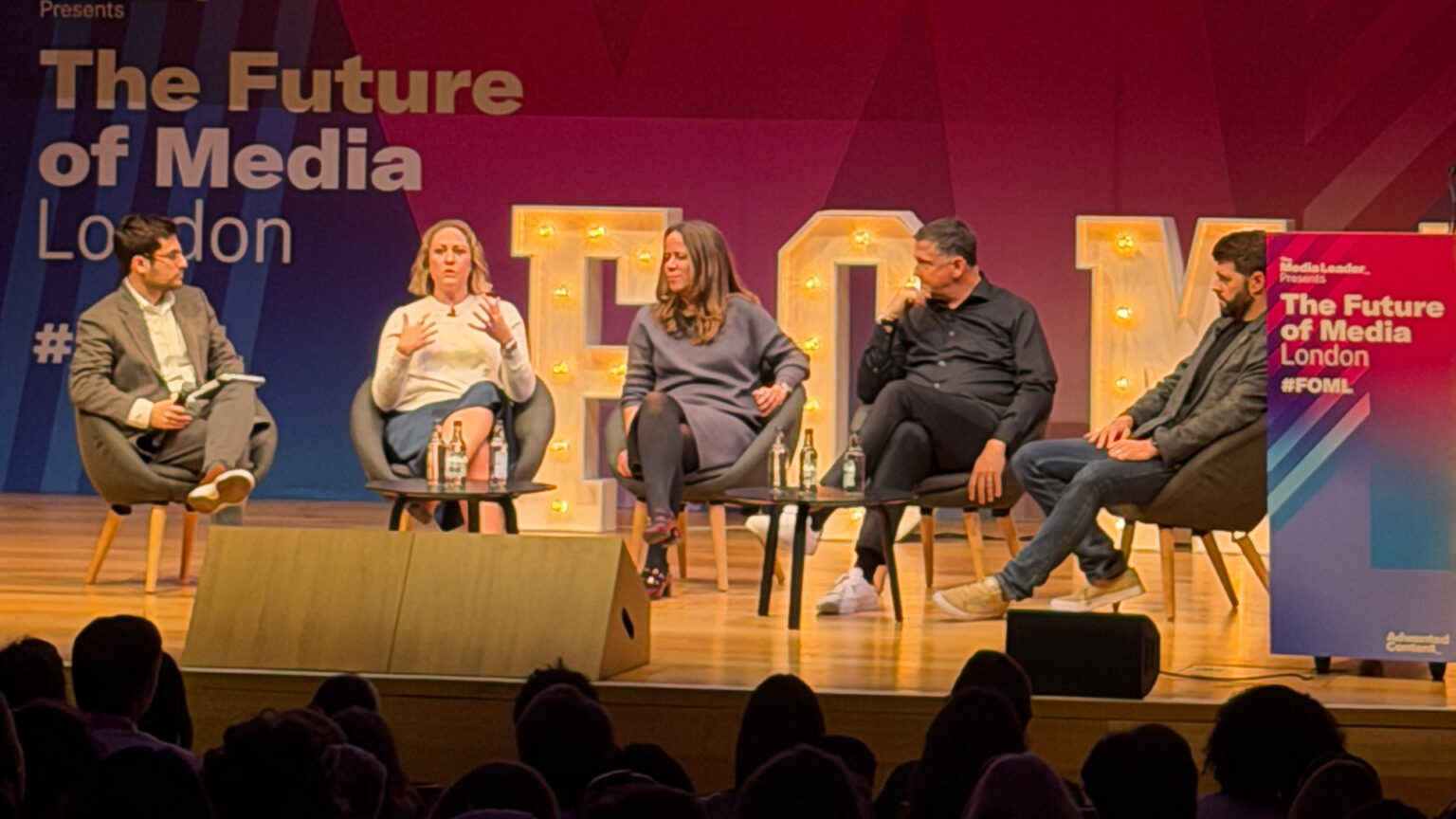
The event’s first panel featured Dentsu Northern Europe CEO Annette Male, WPP Media Europe CEO Michael Karg and Omnicom Media EMEA CEO Dan Clays, who said most of the right things.
Clays: “We’re now in the business of integration.”
Karg wants the industry to “cherish the craft a bit more”.
Then Karg let slip something more revealing: “The vast majority of the number of pitches is still media [pitches].”
That’s the gap: holding companies describe themselves as strategic partners while operating a business model that pays them for delivery. They’re Swiss Army Knives: a tool for every job, but every job is execution.
When it comes to what clients increasingly need in a world of mediocre AI slop — judgement, wisdom, dare I say consultancy — they’re apparently closer to Swiss cheese.
You could see it in how they talked about value — an important word given the event theme this year was “Media Means Business”.
Clays made an impassioned case for funding quality media: “We don’t want to be in an industry that’s racing to the bottom.” But he located that fight in the pitch process: “We talk a lot to [pitch] consultants about this… there’s also a procured part of the process, which will come down to media pricing.”
A trusted advisor wouldn’t need to win that argument with the procurement department. They’d have already won it with the client.
Advertising Association president Andria Vidler, who chaired the panel, closed with a sharp question: what should clients ask agencies to prove to show they are a trusted advisor? Karg: “One thing. Business impact.” Male: “just incremental value” — or, borrowing from Jerry Maguire, “show me the money”. Clays agreed, adding the long term.
No client wants an agency that can’t prove its worth, but “prove you’re worth what we pay” is a supplier’s answer. An advisor’s answer sounds more like: “We’ll tell you when not to spend.”
Call it a mentality of incrementality.
Old bloke at the disco
For a client’s view of what judgement looks like, take Rightmove chief marketer Matt Bushby, in conversation with WPP strategy EVP David Wilding, recounting his time as UK&I marketing director at Just Eat.
The food-delivery business had leaned on performance marketing and incentives, and a focus group was not kind about the result: “You’re like an old bloke at the disco. Everyone knows you’re there, but no-one wants to dance with you.”
So the fix couldn’t be just incremental. Just Eat went big on brand. Snoop Dogg, Love Island, Euro 2020 — each demanding a creative leap with real risk attached. The kind you can’t prove will work in advance.
Bushby also had a warning for anyone selling to people like him: “The temptation is to hand over the plan that has worked in five other places.” And a reality check on where media sits on a CMO’s agenda: “You spend a vanishingly small amount of time thinking about marketing and then even smaller amount of time thinking about media.”
Which is awkward for agencies pitching media “plus CRM or… media plus content”. Adding more services to a media pitch doesn’t make it more strategic. It makes the pitch bigger, for a buyer with even less time to hear it and even more incentive to in-house it.
The transformation conversation the holdcos say they want is happening at the exec table, not in the media pitch. That’s the future agencies need to be talking about.
Spending money on free tools
The session that talked about the future most clearly was the agentic AI panel. And the most striking voice was the most pessimistic one.
Tom Kelleher, director of emerging technology and AI at The Telegraph, described how AI-assisted software development went from many divergent approaches to just one in the space of two years: “Now there’s probably, by and large, one way of doing it and it’s faster, and it’s better, and it’s cheaper — and it’s everyone’s doing it.” He expects media buying and selling to follow.
It’s Buffett’s loom all over again: everyone’s costs fall together, so no-one gains an edge and the savings flow to the customer. As Kelleher put it: “I don’t think we’ve yet arrived at the paradigm where we’re doing things differently at all.”
For four or so years, the industry has made a series of apparently rational decisions: hire prompt engineers, build an AI stack, build an agent. The catch? Laura Kell, chief data and product officer at Havas Media Network UK, expects that within five years, “the agents that people have spent tons of money investing in will just be available for free online”.
Oops. Lots of little correct decisions, which lead to one big, wrong outcome.
And it could be even worse. What if the agents inherit our worst habits?
Kell warned that they will tend to optimise for short-term platform metrics, with “the big risk… repeating the same patterns of short-termism”. Thomas Biedermann, global head of media and advertising at Star, put it more bluntly: “Average in, average out.”
So what must come next, you’d think, is transparency over all this AI-fication: norms, standards, possibly rules, if regulators ever catch up. Which prompts the obvious question: who decides?
As moderator Jack Benjamin noted, the companies building the frontier models “include Meta and Alphabet and Amazon, who are also the biggest global ad sellers”.
Kelleher’s question hangs over all of it: “Who watches those watchmen?”
The impact that matters
Every agency will have agents and soon so will every client. Whatever savings they create will be competed away or handed straight back to procurement.
What’s left to sell is judgement: telling a client to take the creative leap or not to spend at all. The thing that can’t be benchmarked in a spreadsheet.
The holding companies told the room they will prove their business impact. The impact they should be worried about is on their own business.