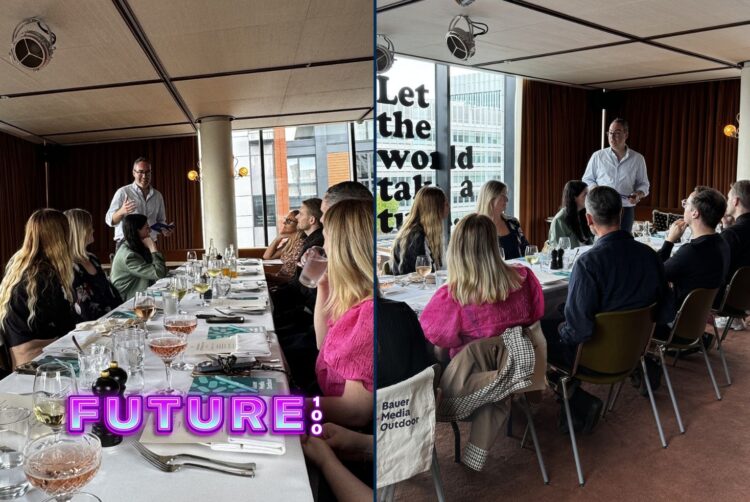
On the eve of Future of Media Manchester, planners and strategists from agencies across the north of England gathered for a lunch convened by Bauer Media Outdoor and The Media Leader.
Operating under Chatham House rule, the group covered out-of-home’s (OOH) role in an AI-mediated world, the stubborn challenge of attribution, and a pointed conversation about the industry’s London-centric blind spots.
The trust premium
The roundtable opened with a question about OOH’s superpower, and the answer that kept returning was trust. As algorithmic and AI-generated content floods digital environments, a significant number of attendees had noticed growing client and consumer appetite for media that feels unmediated.
One participant described clients who had been sceptical of OOH on econometric grounds undergoing a complete change of approach once new senior leadership arrived with a sharper instinct for brand.
“You can go and look at an outdoor site, and it feels premium, it feels alive,” was one sentiment that captured the mood.
The point was made that OOH is one of very few formats where a brand has to say something publicly, to everyone, without the safety net of targeting. That transparency, the group agreed, is increasingly a feature rather than a limitation.
AI and the search for disruption
The most substantial discussion centred on how AI-mediated search is reshaping the value of brand building, and what that means for out of home’s planning role.
As conversational and zero-click search grows, the ability to intercept consumers mid-research journey is diminishing. One planner argued that this makes mental availability, built through channels like OOH, disproportionately valuable: if AI platforms reason more like people, they favour brands people already know and talk about.
The corollary, the group agreed, is that clients with budgets concentrated in lower-funnel performance activity face a structural problem.
OOH, particularly in high-footfall or directional contexts, was cited as one of the few channels that demonstrably bridges brand and activation.
Attribution: Still the yin and yang
The attribution challenge was present throughout. Several attendees noted that econometrics has historically struggled to capture OOH’s contribution, particularly for brand metrics, though regional holdout testing was raised as a more effective approach.
The absence of OOH, one participant noted, is sometimes easier to measure than its presence.
Community, responsibility and the regions
The final stretch of the lunch produced its sharpest exchange. The group was broadly unaware, or had forgotten, that a substantial proportion of OOH revenue returns to local communities via council and public infrastructure funding.
The consensus was that this is not being used effectively in planning conversations, though it was suggested it tends to land better at board level than with heads of marketing, for whom it sits outside their KPIs.
The discussion became more pointed on regional representation. Attendees pushed back on the industry’s reflexive London-first planning instincts, with one participant describing detailed modelling work that showed a challenger financial brand’s investment would have significantly greater impact outside the capital than in it.
Adwanted UK is the trusted delivery partner for three essential services which deliver accountability, standardisation, and audience data for the out-of-home industry.
Playout is Outsmart’s new system to centralise and standardise playout reporting data across all outdoor media owners in the UK.
SPACE is the industry’s comprehensive inventory database delivered through a collaboration between IPAO and Outsmart.
The RouteAPI is a SaaS solution which delivers the ooh industry’s audience data quickly and simply into clients’ systems.
Contact us for more information on SPACE, J-ET, Audiotrack or our data engines.