



Eggcelent ads – Who won the Easter social media attention battle
Lumen Research
The Media Leader has partnered with Lumen Research for the first in a regular series analysing which social media ads garnered the most attention during a given cultural moment. First up: a selection of Easter-themed ads across Facebook.
Cadbury has produced the most attention-grabbing Facebook post of the Easter season, according to Lumen Research’s Platform Pulse research.
Its simple, visually compelling egg hunt beat out strong competition from the likes of Thorntons and Disney.
Each week, Lumen Research collects eye-tracking data on the reality of attention to advertising across social media platforms. 250 respondents are recruited to download Lumen’s eye tracking software and go to a social media feed into which selected ads have been inserted.
At the end of the session, they are asked to complete a short recall questionnaire, so that attention data can be linked to memory formation insights.
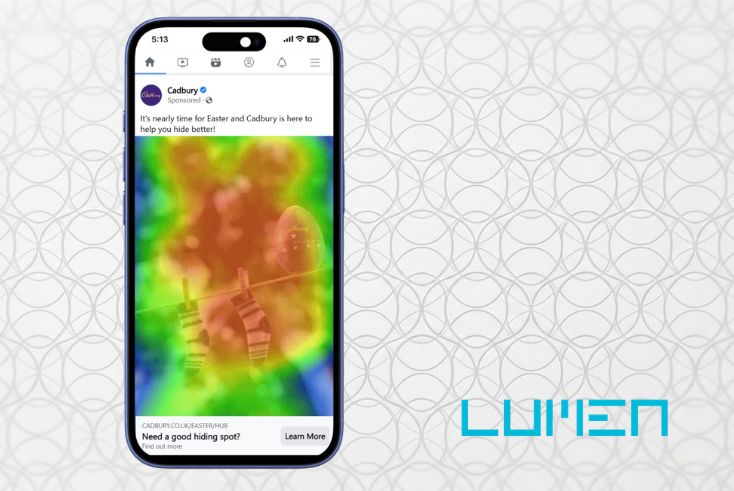
1. Cadbury – Egg hunt
Results: Cadbury’s deceptively simple short delivered TWICE the attention Lumen Research would normally expect (2091 attentive seconds per 000 impressions vs norm of 1068 APM), and generating 53% prompted recall (32% norm) – proving that great creative can drive impressive results in a short time.
Insights: Taking inspiration from the logic of silent movies (most social video is sound-off), Cadbury’s told a five-second story with the egg as the hero. Heatmapping shows that people followed the action closely – and would have no trouble finding where this egg was hiding.
2. Thorntons – Wish them a happy Easter
Results: 1965 APM (norm=1068 APM) 55% prompted recall (32%)
Insights: Thorntons knows how to get your attention on Facebook: SHOW ME THE CHOCOLATE! But, because it has used strong branding principles (brand colours, prominent/permanent logo), you are more than likely to remember the brand. Lumen research often says that to win in social media, brands have to ‘think like a poster’: Thornton’s has obviously got the message.
Disney store
Results: 1478 APM (norm=1068 APM) 35% prompted recall (norm=32%)
Insights: Above average attention for Disney Store – but recall is only at the norm. Perhaps this is because viewers need to watch the whole ad to appreciate that it is an ad for the Store rather than the mother brand. The recall of Disney Store was high among people who watched the whole ad, but in reality, few people get to the end of an ad on social media.
Lindt & Hampton Court Palace
Results: 1349 APM (norm=1068 APM) 19% prompted recall (norm=32%)
Insights: A strong performer in terms of attention, but let down by confused branding – often the way with a collab between two partners. Great to see the ‘silent cinema’ approach to visual communication, but just because people can’t hear doesn’t mean that they want to read your message.
Ocado
Results: 1066 APM (norm=1068 APM) 43% prompted recall (norm=32%)
Insights: A great little trade ad. Sure, attention is at the norm (people looked at this for on average 1.3 seconds in total), but what more do you need to say about deals on hot cross buns for Easter? Simple, effective, poster-like communication with strong branding makes this a highly effective ad for Ocado. Job done!
TUI
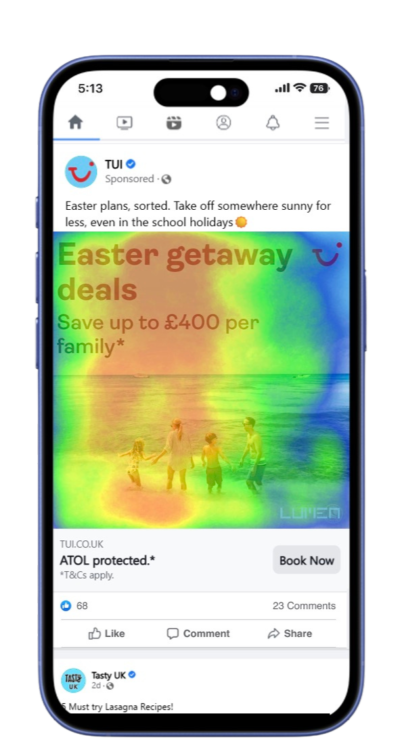
Results: 775 APM (norm=773 APM) 42% prompted recall (norm 33%)
Insights: Static digital display ads tend to get less attention than video ads, but they can still pack a punch if well-designed and well-timed. With the Easter break approaching, who isn’t thinking of getting away? TUI’s picture-perfect holiday snap (and attention-grabbing offer) works perfectly in the time budget available.
To find out more about Lumen Research you can get in touch here.