



Ever wondered how to measure the advertising on a moving bus?
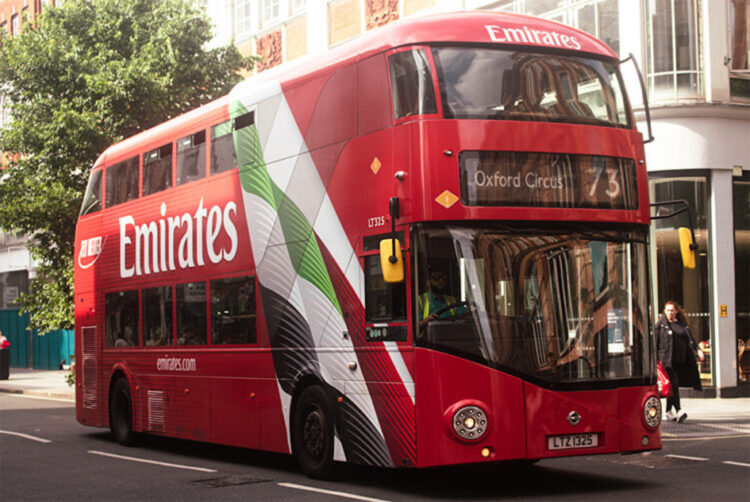
Week in focus: The Future of OOH
Route’s research director explains how to measure advertising that’s constantly moving and interacting with people who are also moving.
I recently passed my one-year anniversary at Route. While celebrating with a Krispy Kreme (kindly provided by our CEO), I felt it was a good moment to reflect on what I’ve learnt and what’s surprised me most.
Before joining Route, I hadn’t fully appreciated just how complex OOH advertising is to measure.
It’s a medium that appears across a wide range of environments – at the roadside, in shopping centres, on trains, underground, and on buses moving through a city. Unlike other media, people don’t actively choose to engage with it. It’s something they encounter when they’re out and about living their lives.
And that creates a challenge: just because someone is near an OOH ad doesn’t mean they’ve seen it. Over the past year, I’ve spent a lot of time getting to grips with how Route approaches this.
Not a black box – a clear box
The Route methodology is designed not to be a ‘black box’, but its complexity can sometimes make it feel that way. As a Joint Industry Currency, trust and transparency are key. For me, the aim is a ‘clear box’ – complex, but visible and understandable.
One example that really brought this home to me is how we measure advertising on moving buses.
I should say up front that I’m not the one building these models. That credit very much goes to the clever data scientists at Ipsos, who do all the hard work of turning this into something robust and usable. But having spent time understanding how it works, here’s my attempt to explain it simply.
At first glance, it feels almost impossible. How do you measure something that’s constantly moving, and interacting with people who are also moving?
Getting down to basics
In simple terms, it starts with understanding two things: where buses go, and where people go.
We model buses across the road network, including their routes, stops, speeds, and movement throughout the day. Alongside that, we use Travel Survey data to understand where people go, how they move – whether they’re walking or in a vehicle – and how fast they’re travelling.
By bringing these two together, we estimate the likelihood of someone being in the vicinity of a bus at the same time – effectively, the chance of an “intercept”.
Wait – there’s more
Sounds straightforward enough, but that’s just the starting point.
Being near a bus doesn’t mean someone actually sees the advertising on it. So we then factor in things like distance from the bus, the angle at which it’s viewed, and how people are moving relative to it.
For example, a pedestrian waiting at a bus stop will have a very different opportunity to see an ad on the bus than someone travelling past it in a car. And if you’re travelling on the road towards the bus, you won’t be able to see the rear panel ad on the bus at all. Pedestrians can also only see the nearside ads on a bus. i.e., if the bus has ads on both sides, they can only see the ad closest to them (which is why they are often sold in pairs).
All of this feeds into a realistic opportunity to see.
Underpinning this is Route’s Travel Survey, where 25,000 participants carry GPS devices to track their movements, combined with other data sources such as traffic counts and TfL data to scale up to the wider population.
The end result
The result is not a perfect measure, but it is a considered and evidence-based way of reflecting how people encounter OOH in the real world.
And that, for me, has been one of the things that stood out the most in my first year; the need for balance between complexity and usability.
There’s a huge amount going on behind the scenes, but the goal is always to make the data we output meaningful and usable for media owners and agencies to plan campaigns.
It’s also been a transition moving from a large media agency into a much smaller team. I now find myself responsible not just for insight but also remembering to run the dishwasher and put the bins out. That said, I don’t miss timesheets.
More seriously though, what I’ve come to appreciate is the importance of being able to explain complex systems in a way people can understand and trust.
How much OOH reach in conurbations is people who don’t live there?

Ruth Chalisey is Route’s research director