



Farage versus the media: Nigel’s last stand. Or is it?
Opinion
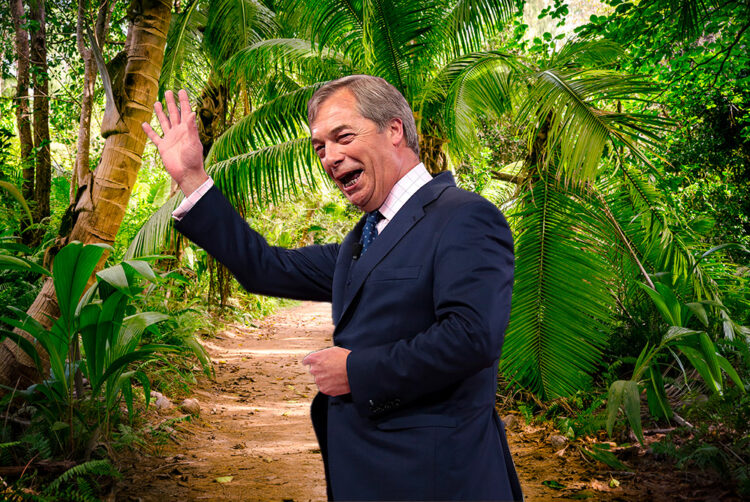
Nigel Farage may be at personal loggerheads with Sky News and Times Newspapers, but by potentially triggering a tsunami of media interest in Reform UK, who knows where the biggest waves may land.
Say what you like about Nigel Farage, leader of Reform UK and the party’s former owner, he has great capacity to surprise.
When it was announced yesterday that he was going to make a statement about his future public life, the speculation was endless.
The smart money was on the fact that he had had it with the intensifying media scrutiny of his financial affairs and was wandering off into the sunset to enjoy his millions.
Maybe, as an admirer of President Donald Trump, he was off to America or even Belgium, where his partner often lives.
Wrong all of it. Farage sprang the ultimate surprise. Yes, he was resigning his Clacton Parliamentary seat as could have been predicted, BUT (and it’s a big BUT), he is going to stand again in the same constituency in the by-election as an elaborate two fingers to the British establishment and the media.
Anger at the media
That is quite a manoeuvre and will obviously generate endless publicity for Farage, who also expressed deep anger at the media and The Times, in particular, for, as he claimed, revealing where his daughter lived, someone who is not involved in public life.
Farage has also been in battle with Sky News, who he accuses of harassing his family, something that Sky denies.
The media of all political hues will obviously love this by-election, which still represents a challenge for Farage despite his majority of more than 8,400.
The only party which can realistically compete against Farage in Clacton is Labour. What if the other parties did not stand or there was heavier-than-usual tactical voting by an electorate who did not want to be caught up in what many would see as a political stunt?
The single theme that shone through the Farage statement was his almost visceral anger at the media for daring to challenge his right to make money when, as he insisted, he had done nothing wrong or illegal. After all, making money is a fine and noble thing to do.
For many people (myself included), it has taken an eternity for Farage to face detailed media scrutiny, in particular over his finances. That scrutiny has certainly provoked an extravagant reaction.
In the past, Farage has enjoyed an easy ride from the media, and indeed it was the BBC who almost single-handedly created Farage’s public persona through no less than 39 appearances on BBC 1’s Question Time over the years.
Partly as a result, Farage has been able to reshape the British political system.
By taking, and sustaining, a lead in pubic opinion polls, backed up by success in this year’s local elections, Farage was able to claim plausibly that he might become Prime Minister after the next general election.
It is a dream he is still pursuing, albeit now by a circuitous route.
And though Sir Keir Starmer was unable to articulate a vision for the future of the UK and lacked basic political judgement, it was the rise of Farage and Reform which ended his prime ministership after only two years.
Starmer’s backbenchers, fearful of losing their jobs at the next election in the face of Farage and Reform, panicked and turned their thoughts to Manchester and Andy Burnham.
Farage’s finances
Two newspapers in particular, The Guardian and The Sunday Times, have turned over a few stones hiding the Farage finances.
The first blow for the Reform leader came two months ago when The Guardian’s finance editor Anna Isaac revealed that just before deciding to stand for Parliament at Clacton, Farage had accepted £5m from Thailand-based crypto-billionaire Christopher Harborne.
He gave conflicting explanations for why he was given £5m by Harborne. It was an ‘unconditional gift’, a ‘reward’ for bringing Brexit to Britain, or to help him fund security.
Oddly, journalists found out that he did not seem to have spent any of the money, and he either avoided questioning or got extremely irritated when asked about the details.
Although causation was never proved, journalists were also interested in Farage’s opposition to regulation of cryptocurrencies, something that would not have displeased his generous benefactor.
The coup de grace came at the weekend when The Sunday Times’ Insight team, with investigative journalist Gabriel Pogrelin in the vanguard, went on the attack.
Farage, the paper reported, with pages of supporting detail, had failed to disclose that a convicted criminal and crypto-gambler funded his operation in the year before his election to Parliament.
“The Reform leader appears to have broken parliamentary rules by accepting security, driver, staff and accommodation paid for by George Cottrell, who was jailed for participating in a US money laundering conspiracy,” The Sunday Times reported.
The Insight team, in an echo of its glorious past, went on to claim that Farage did not declare benefits that included the recruitment of a right-wing activist who managed his social media, produced political content and helped him gain hundreds of thousands of online followers.
The dust has not even begun to settle, but there are still a number of outstanding singularities.
If, as Farage claims, The Sunday Times story is full of inaccuracies, why is he not suing for libel instead of causing what is strictly speaking an unnecessary by-election?
There are also certain oddities about the timing.
A complaint about Farage’s handling of the £5m gift is already being examined by Daniel Greenberg, the parliamentary standards commissioner, and if, as a result, Farage is excluded from the Commons for 10 working days or more, there could be a recall petition… err for a by-election in Clacton.
Now Greenberg’s work could be held up because he is also being asked to investigate the latest allegations by The Sunday Times.
It is not inconceivable that Farage’s by-election could come first. If the Reform leader then wins, he could face a later recall petition and a further by-election later in the year.
What the long-suffering voters of Clacton, who have seen little of their MP during the past two years, would make of all that unsought political activity, God alone knows.
The media will, however, love it all, and as Private Eye likes to say, this is a story that will definitely run and run.
 Raymond Snoddy is a media consultant, national newspaper columnist and former presenter of NewsWatch on BBC News. He writes for The Media Leader on Wednesdays — bookmark his column here.