



The heat is on for the press to start taking climate change seriously
Opinion
Less-than-perfect press performances of late fade into nothingness compared with the greatest failure of the media in any age: the failure to communicate the existential threat of climate change.
There are many areas of crucial national interest in recent years where much of the media has failed to cover itself in glory.
The media, in general, failed to adequately warn about the downsides of Brexit, a decision that Lord Alan Sugar has described as the biggest disaster of his lifetime.
The mainstream media has been extraordinarily slow, until the past few months, in exposing the obvious flaws in Nigel Farage and Reform UK, ignoring individual, wiser voices who have been raising the alarm for more than a decade.
The media must also accept its role in helping to undermine successive Prime Ministers, seven in little more than a decade, undermining stability and making the UK more difficult to govern.
Those failings are as nothing compared to the failures of large sections of the US media to daily expose the extraordinary nature of the second Presidency of Donald Trump, which has done such damage not just in the US but throughout the world.
It was epitomised at the weekend by White House reporters sitting passively in their black ties at the annual White House Correspondents’ Dinner to be abused by a corrupt President who seemingly cares nothing about ignoring both the oath he took and the US Constitution.
Some spoke out, but none of them should have been there in the first place.
But all those less than perfect performances fade into nothingness compared with the greatest failure of the media in this or almost any age- the failure to get across to the wider general public the existential threat of climate change.
In France and Spain, people are dying
Homes and forests are being destroyed in unprecedented wildfires that are increasingly difficult to control.
Of course the dramatic nature of the fires is being covered as news, as it should be, particularly by television news outlets.
But what is generally missing is what it all means: what the science is saying and, much more importantly, what governments and their public should be doing about it with the greatest sense of urgency.
Instead, those arguing for a push towards net zero are regularly pilloried because of the short-term costs.
While President Trump, calling on the depths of his ignorance, is still calling climate change “ a hoax” and calling for “drill baby drill”, new Prime Minister Andy Burnham is being urged to expand the extraction of oil and gas from the North Sea to please the industries of Aberdeen.
The right-wing press in particular is replete with columnists who are either climate change sceptics or who downplay the threat. Those who warn are not exactly killed like Cassandra, but figures like Geoffrey Lean, who has been writing about the environment and the dangers of climate change for more than 50 years, are pushed to the sidelines.
Signs of serious trouble
Yet even setting aside the dramatic nature of the lethal fires everywhere you look, there are signs of serious trouble.
Last week, a civil aviation record was reached. For the first time, there were more than 153,000 flights in a single day.
It is scary to even think how many tonnes of carbon were released into the atmosphere as a result.
The problems of reporting the science of climate are obvious and difficult to remedy.
It is a process, not an event, and ironically the dangers of repetition could lead to the very normalisation we are trying to avoid. But somehow the effort must be made to do this better.
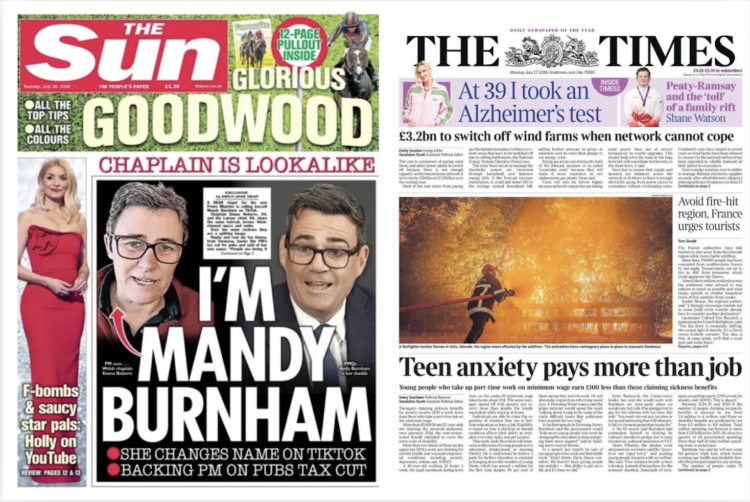
Yesterday’s papers unfortunately illustrated the true scale of the challenge to enlighten the average citizen.
The Sun thought the most important story of the day was the fact that there is a female chaplain in Wales who they thought looked a bit like Andy Burnham. The fires were covered on page nine, but there was no comment and an absence of what it meant or what scientists were saying.
The Daily Mail in its front page splash, without any sense of irony, fulminated against Burnham’s “death tax” nightmare.
The fires were covered, again on page nine, and included a single quote deep in the story from Prince William describing the blazes as “ a stark reminder of the challenges posed by an increasingly extreme climate.”
Apart from that, there was no comment, no context, no science. The 40th anniversary of Suzy Lamplugh’s death received far more extensive coverage.
The Times put a dramatic fire picture from Spain on its front page alongside a story about the French racing against time to stop the fires heading towards the city of Bordeaux.
There was detailed coverage inside, an explanation of the phenomenon of “fire thunderstorms,” and a warning that the UK was set for its fourth heat wave of the year, after southern England had 1% of its normal rainfall this month.
A series of extraordinary happenings without the sense of how truly extraordinary they were.
For good measure, there was a ‘daring do’ front page on The Times 2 devoted to telling how a family from Shepherd’s Bush fled “the French inferno.”
Great sympathetic reporting but …
Of course, The Times has covered such serious issues in the past, but yesterday there was no sign of a leader, science, or detailed context.
Arts graduates are splendid, speaking as one of them, but they have their limitations, and many of them tend to get to edit national newspapers.
As a result, facing such an existential challenge, there is an obvious need for more scientists, and climate scientists in particular, being given greater prominence, on a much more regular basis, across all of the media.
Tell people once, then again, and maybe even a third time
There may be a worry that spreading gloom-and-doom about the impact of climate change could hurt circulation and ratings. That could be well founded, but the opposite, trying to turn a half-blind eye to reality, could be much more economically damaging in the long run.
A television documentary maker of my acquaintance liked to say that on any important issue, you had to tell people once, then again, and maybe even a third time before they got it.
There is no simple answer to how the media should tackle the implications of climate change for politics and society, other than to emphasise the urgent need for action before it is too late.
A step in the right direction has to involve giving people with the necessary expertise more opportunities to tell of the implications of what we are all now seeing before our eyes as many times as it takes – before it really is far too late for stories about Andy Burnham lookalikes.
 Raymond Snoddy is a media consultant, national newspaper columnist and former presenter of NewsWatch on BBC News. He writes for The Media Leader on Wednesdays — bookmark his column here.