



Why brands are investing in live experiences and why the future of experiential is about proving impact
Opinion
Goodwood’s Festival of Speed is just one place brands are investing increasingly in live experiences says Andrew Orr MD at TRO, part of Omnicom. The challenge now for the industry is how to prove effectiveness.
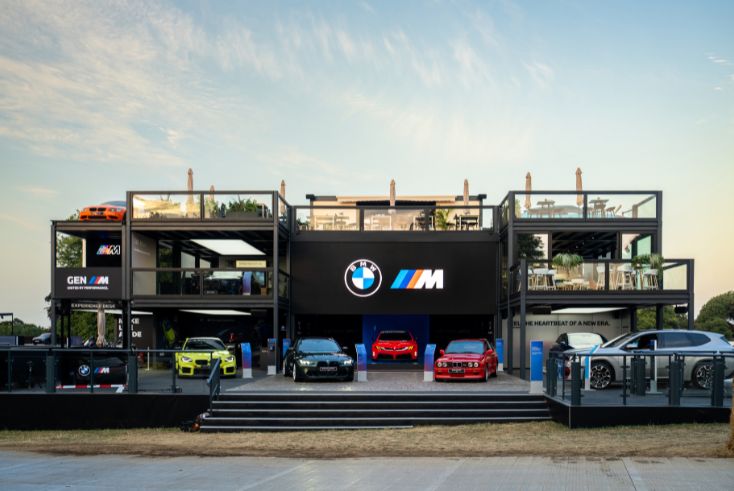
At this year’s Goodwood Festival of Speed, BMW was not just showcasing the future of performance. It was exploring a much bigger question facing brands today – can a live experience genuinely change what people think and feel?
Working with BMW, we created an immersive activation for the launch of the BMW M Concept Neue Klasse, designed to explore whether the emotional connection commonly associated with performance vehicles could translate into an electric future.
The goal went beyond creating a one off memorable moment or interesting event space. By combining experience design, audience insight and real time measurement, the activation explored whether a physical brand experience could influence perception.
And that very question extends far beyond the automotive sector. Across industries, brands are investing in live experiences because they offer something incredibly difficult to achieve through traditional media channels – genuine attention, participation and sincere emotional connection.
The challenge for the industry is no longer whether experiential works. The challenge is proving exactly how and why it works.
From attention to impact
I think it’s fair to say that for decades, live events have occupied a slightly strange place in the marketing mix. They are often among the most emotionally powerful things a brand can do, and yet traditionally they have been some of the hardest to measure.
A TV campaign can report reach, likewise a digital campaign can track clicks. Social activations can also measure impressions, engagement and sharing. But what happens when someone physically steps into a brand experience, feels something, changes their view or perception and actually changes their future behaviour?
That is where the next evolution of experience is happening.
In the past measurement has focused on outputs – how many people turned up, how long did they stay for, how many interactions took place and how much content was generated. Of course, those metrics remain important, but brands are increasingly looking for something deeper than that.
What changed because someone experienced this? Did the experience improve brand perception? Did it increase consideration? Did it create advocacy? Or did it influence future behaviour?
And I believe these are the questions that are starting to truly define the future of experiential – and it’s actually one of the only channels that can measure these very personal insights in their truest form.
Why brands continue to invest in moments like Goodwood
Goodwood demonstrates why live experiences remain such a powerful part of the marketing landscape.
It is not simply a venue for brands to display products. It is a vibrant, passionate community of likeminded people, built around heritage, hobbies and shared enthusiasm for a cultural moment in the summer events calendar. Audiences arrive already interested and emotionally invested in the day ahead, creating an environment where brands can engage people at a much deeper level.
And that context is super important when we are living in a world where consumers are exposed to thousands of brand messages selling to them every day. With this in mind, relevance and authenticity have become increasingly valuable. Brands cannot simply demand attention; they have to earn it.
Live experiences create an opportunity to do just that by giving people an active role in the brand story. They are not passive recipients of advertising, they’re not being actively sold to. They on their own terms become participants of a moment – and that is really powerful.
It’s high time to rethink the role of live experiences and events
The strongest experiences have always created emotional responses; that isn’t new. The difference now is that brands are becoming better equipped to understand those responses and connect them back to wider marketing and business objectives.
This represents a big shift in how brands should think about experiential. For years, brands have tried to understand audiences through digital signals, surveys and research environments. Valuable as these approaches are, much of consumer behaviour now takes place behind a screen – where interactions are often fragmented, measured through proxies and removed from the actual context in which decisions are made.
Live experiences however offer something different. They have the potential to capture people in moments of genuine engagement – when they are physically present, emotionally invested and interacting with a brand, product or idea in real time. They allow brands to observe reactions as they happen, rather than relying solely on what audiences remember, report or think they should say afterwards.
That creates a totally new layer of consumer insight.
The future is not about measuring experiential success purely by attendance, dwell time or engagement numbers. Those metrics remain important, but they only tell part of the story.
The bigger opportunity is understanding what changes as a result of an experience. Did it shift perception? Did it increase confidence in a product or category? Did it create a stronger emotional connection with a brand?
Experiential should no longer be viewed as a standalone activation or a “nice to have” brand moment. The most effective experiences are strategic platforms – designed to create connection, generate insight and deliver measurable impact.
This does not replace traditional research methods. Instead, it complements them, giving brands a richer understanding of consumer behaviour by revealing not only what people say they think, but how they respond when they are genuinely immersed in an experience.
Experiential is becoming a media channel in its own right
For many years, experiential sat alongside media rather than being treated as media. It was often seen as an activation layer – something added to campaigns to create excitement or bring a brand story to life.
From my conversations with brands, that view is changing. Brands are increasingly recognising that live experiences can deliver many of the same strategic roles as other media channels: building awareness, creating association, changing perceptions, generating content, collecting insight and driving action.
The difference is that experiences create a two way relationship. A well-designed experience does not simply tell people what a brand stands for. It allows them to experience it for themselves.
Experiences designed with impact from day one
The next stage of experiential will not be about creating bigger spectacles for the sake of attention. It will be about creating more meaningful experiences where measurement and impact are considered from the beginning.
The most effective activations of the future will bring together creativity, technology, data and insight to understand not only what happened, but why it mattered.
Because the true value of a live experience is not just that people remember it. It is that it changes something in culture. It changes how they feel about a brand, it changes how they think about a product, it changes what they might do next.
The brands that succeed will be those that recognise live experiences are not simply moments in time – but build purposefully creative technologies and activations around their events calendar. They are powerful media platforms capable of influencing perception, generating insight and driving measurable business impact.