



A modern Greek tragedy
Opinion
Ray Snoddy examines how responsible the journalists who wrote about Jason Arday were for his death.
It is a difficult and almost painful thing to write about the extent of media responsibility for the likely suicide of Jason Arday after resigning as a Cambridge University professor of the sociology of education.
The Chancellor of Cambridge, Lord Smith, has criticised the “racist feeding frenzy” involved, presumably in reference to the media.
There have been numerous complaints to the independent media regulator IPSO, mainly about accuracy and the scale of the coverage.
Black academics have condemned the “ridicule and vilification” of Arday, and Labour MP Diane Abbott said that the Cambridge academic had been subject to a “vicious and bitter media campaign”.
She added that people “who didn’t believe a black man should be a Cambridge professor” had started as soon as he was appointed by the university in 2023.
One Instagram visual I’ve seen lists all the journalists who had written about the academic and the number of articles involved- and how few times they had written about Arday since his death – some not a word.
In The Sunday Times, Matthew Syed was more balanced, more reasonable when he wrote to his sister Rebecca, a friend of Arday, before the academic’s death: “He’s clearly been targeted in a vicious way. But it’s also clear that he’s plagiarised and violated other academic standards.”
After he learned of the death, Syed wrote that Arday “was failed. By the system. By some in the media. By me.”
How to unpick such a multi-faceted tragedy?
There is an obvious truism that if the media had not reported on the case of Jason Arday, he would still be a Cambridge professor, very much alive and enjoying the publication of his autobiography, Great and Unfortunate Things, for which the advance is said to have been more than £1m.
That argument is obviously ridiculous. Some of the allegations were already in the public domain in the academic world, and further revelations were inevitable given that Cambridge had trumpeted the achievements of the autistic child who had triumphed over adversity to become the University’s youngest black professor.
He had also been happy to do media interviews, and an international promotional tour had been organised to coincide with the launch of his book.
The complaints made to IPSO? It is highly unlikely that IPSO will uphold any such accuracy complaints, except perhaps on minor points.
Arday was almost certainly guilty of lifting considerable chunks of his PhD thesis from other scholars without attribution and of wild, impossible claims about his sporting and charitable exploits.
Even old classmates have challenged claims that he was non-verbal throughout most of his childhood.
In terms of coverage, IPSO has no provisions for such accusations, and anyway, why should it? What does such a concept mean in the real world of 24-hour international news? How many articles or television or radio reports are too many? Is one or two fine but six too much?
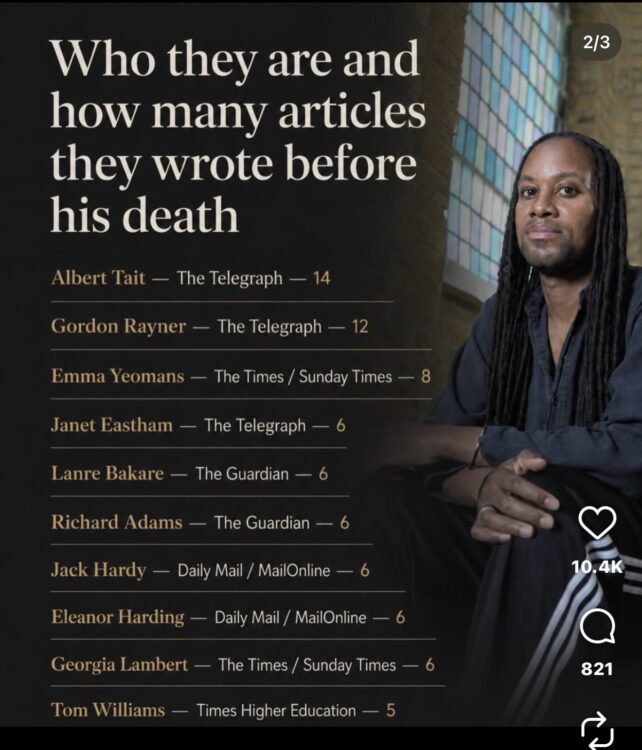
By chance, the Instagram list (pictured)- obviously meant to be a list of shame- notes that Lanre Bakare and Richard Adams of The Guardian each wrote six pieces about Arday, as it happens, the same number as Janet Eastham of The Daily Telegraph, Jack Hardy of the Daily Mail and Georgia Lambert of The Times and Sunday Times.
The notion of too much coverage is, at best, a slippery argument. At worst it is absurd.
The obvious truth is that, encouraged by Cambridge University, Arday received lots of positive publicity for his apparent unprecedented achievements in overcoming autism and a disadvantaged start in life to triumph on the world stage.
His was, or as we now know, appeared to be, the ultimate happy success story.
It was inevitable that when everything started to unravel, it would be a massive story.
At least at the outset, Arday was hardly a shrinking violet.
He set the Metropolitan police on Jack Grove of The Times Higher Education, alleging “harassment” for sending three emails, politely seeking a response to the findings in a 60-page dossier he had assembled.
Then vigorous libel lawyers from Carter Ruck were hired to discourage journalists covering the story.
The most serious allegation, however, against the media is that the attack on Arday was racial. While it is impossible to know the exact motives of every journalist involved, it seems unlikely.
The Guardian, for example, is scarcely noted for random, racist attacks on academics.
There is also circumstantial evidence from a previous case where unreliable claims were made and fell apart when a memoir was published. Raynor Winn’s The Salt Path got extensive media coverage, and Winn, of course, is white.
Arday was exposed not because of who he was, but because of what he has done, or often more precisely, what he had not done.
As Sarah Ditum wrote in yesterday’s Times, there was “ a childish brazenness” about many of his claims, such as running 600 miles in six days and 30 marathons in 35 days, some with a broken leg.
When The Guardian’s Bakare investigated many of such claims, found they didn’t stand up and challenged Arday, his reply was both hilarious and revealing.
“To be honest with you, I thought you’d just believe me.”
As at least one psychiatrist has pointed out, Arday was not just autistic but a fantasist.
On many counts, it was a story very much in the public interest
It is a story of an under-qualified academic with a questionable doctorate and false claims of being a visiting professor at several universities when he was not.
There is also the issue of why he should have been preferred to three more senior academics to become professor of the sociology of education at Cambridge University.
It fulfils all the characteristics of a modern Greek tragedy in which the powerful protagonist makes a critical error or errors driven by pride or fate and heads to an inevitable downfall.
Journalists were participants in the tragic downfall, but mainly through doing their job – tough as it may seem in the circumstances.
 Raymond Snoddy is a media consultant, national newspaper columnist and former presenter of NewsWatch on BBC News. He writes for The Media Leader on Wednesdays — bookmark his column here.