



Beyond the black box: The case for anti-ultra-processed planning
Opinion – The Indie Leader – AMI
By feeding brands a diet of automated templates and opaque algorithmic media, we are stripping out the vital nutrients of communications strategy. We have entered the era of ultra-processed planning, writes Charlotte Netherwood.
The advertising industry is systematically outsourcing strategic thinking to automated platforms.
From the rise of programmatic — which today accounts for 78% of all digital display spend — to black-box proprietary tools and the inescapable boom of AI, more money than ever is being plugged into automated assembly lines. Planning has become fast food: mass-produced, pre-packaged and dangerously addictive.
The last few years have seen a rise in public consciousness around ultra-processed foods. As a society, we have finally woken up to the dangers of the synthetic and chemically engineered.
At Craft, we can see a direct and urgent parallel in media; a similar sickness has quietly taken over the advertising industry. By feeding brands a steady diet of automated templates and opaque algorithmic media mixes, we are stripping out the vital nutrients of communications strategy.
We have entered the era of ultra-processed planning.
The trap of the aggregate middle
To be clear, this is not a Luddite crusade against technology. When used alongside human intelligence and critical thinking, these tools are immensely powerful. But an overreliance creates a massive problem for brands.
More often than not, these automated tools and AI suites are built from sound logic and marketing theory. But their foundations rely on massive, aggregate analysis which, by its very nature, can only identify the variables consistent across all data points. It misses the anomalies and the specifics – the rule-breaking creative risks or unique contexts that make an individual campaign a spectacular, high-performing outlier.
When an entire industry optimises towards the same guardrails, optimisation simply creates parity. AI naturally pulls things towards the middle – creating a safe, homogenous space that flattens the very thing advertising is supposed to create: distinctiveness.
This is the “middle lane” where many marketers inadvertently find refuge. But middle-lane marketing, much like middle-lane driving, is a dangerous place to be.
Most paid comms are already expensive wallpaper businesses put up in public places (as Dave Trott famously calls out, 4% of advertising is remembered favourably, 7% is remembered negatively and 89% isn’t remembered at all); for legacy market leaders, the sheer size of their budgets helps to offset this. Those with category-leading budgets can simply spend their way into people’s mental availability.
But if you’re not huge, that approach can’t work for you. Media costs are rocketing, the “law of double jeopardy” means that your competitors’ ads naturally work harder than yours, and fast-moving market entrants require your constant reorientation.
For all other brands, you have to turn off cruise control, get out of the middle lane and find a more deliberate way to navigate the road.
An antidote in comms planning
The antidote to this synthetic commoditisation isn’t to throw the machines out of the room. It is to remember that these automated tools are only meant to be used in service of executing brilliant, human thinking, not as a substitute for it. We need to go back to the fundamentals of communications planning.
Today, most advertising systems are organised around two dominant disciplines. Brand and creative planning tends to answer the question of what the brand will look like, what story we will tell and what we are going to say.
By contrast, media planning tends to answer the question of where advertising will show up. Which channels, formats and paid environments, largely dictated by the task and the budget, and often results in an expression of the former in a combination of squares and rectangles.
Sitting between these two, and critical in binding them together, is the discipline that receives far less attention: communications planning.
This missing connective tissue sits directly between message and placement. It acts as the emulsifier that binds creative intent and media buying into a single, coherent whole.
While the automated status quo treats media as a giant distribution exercise of squares and rectangles, comms planning asks a deeper question: how should a brand show up in the world?
The need for anti-ultra-processed planning
When comms planning is done well, a brand develops a recognisable way of moving through the world. It goes beyond logos, colours and taglines into something you can feel – even if the messaging changes. We call this a brand’s body language.
In human communication, we intuitively understand the importance of this. Research by Albert Mehrabian suggests that a significant proportion of communication is conveyed non-verbally; through posture, movement, tone and expression rather than words alone. But, just like people, brands have a natural posture, cadence and way of occupying a space, and it should be unique to them.
This non-verbal energy governs the weight, pace and context of your strategy. It dictates where you show up as much as where you don’t, and determines how you show up across paid, owned and earned. It is the ultimate antidote to category templates; it is the reason why Oatly does not move like Alpro, and Liquid Death does not move like Evian.
Yet, as agencies slim down in the chase for speed, this layer is systematically squeezed out in place for machine-made efficiency. When you rely on automated systems filled with aggregate data, plans begin to look eerily identical, relying on the same recycled recipes over and over. When everything looks the same, brands stop feeling different.
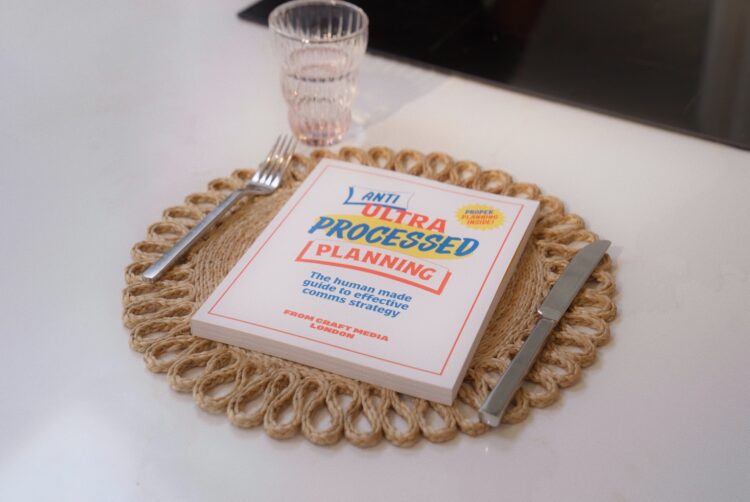
That is precisely why we wrote The Anti-Ultra-Processed Planning Cookbook. It contains six distinct recipes designed to rescue critical thinking from the automated black box, giving independent minds the tools to cook with fresh planning ingredients once again.
It’s time to step out of the middle lane, put down the pre-packaged media templates, and give your brand a body language that demands attention.
 Charlotte Netherwood is a strategic consultant for Craft Media. AMI members write regularly for The Media Leader in 2026 as part of our new Indie Leader series.