



The battle to protect journalistic investigations
Opinion
Do we want the company that owns Sky News to control ITV News, which provides news not just for ITV but also Channel 4 and Channel 5? Ray Snoddy believes it could impact vital investigative journalism.
Two notable media stories in the past week seemed, at first glance, unrelated.
One was about regulatory affairs and concentration in the media marketplace. The other story involved programming and investigative journalism in particular.
Culture secretary Lisa Nandy made it clear that she is “minded to intervene” in Sky’s £1.6bn deal to buy ITV’s broadcast division.
Nandy argued that there were reasonable grounds to believe the deal could affect free expression in the media and the variety of Britain’s news landscape.
The company that owns Sky News would also end up controlling ITV News, which provides news not just for ITV but also Channel 4 and Channel 5.
After such a deal, there would, effectively, be only two television news providers of substance in the UK – the BBC and the greater Sky, although the Comcast-owned company has pledged that all the existing news programmes would retain their individual identity.
As the culture secretary pointed out, the deal would mean that 86% of the linear TV news market would be controlled by the BBC and Sky/ITV in future.
So Nandy told ITV and Sky, both of whom obviously strongly want the deal to go ahead, that she is considering issuing a public interest intervention notice to the Competition and Markets Authority (CMA) and Ofcom, making a full investigation inevitable.
The culture secretary noted that the matters to be considered included the need for free expression in news media and the range of both people controlling the media across the UK and the programmes offered.
Inside Reform UK
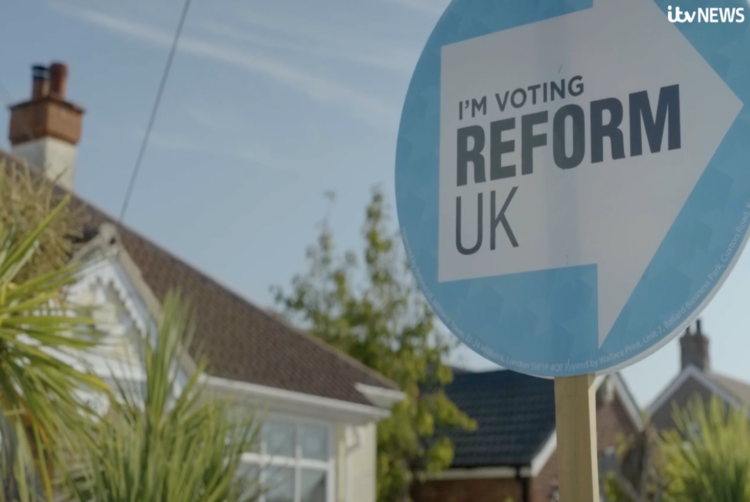
Nandy’s announcement came around the same time ITV began broadcasting the results of a year-long undercover investigation into Reform candidates, councillors, supporters and top executives by ITV Exposure and Hardcash Productions.
The cleverly packaged series of revelations was launched in News at Ten across the week, culminating in a 90-minute documentary on Sunday evening.
The centrepiece came from an undercover reporter who managed to get herself hired as a Reform press officer at the centre of Reform headquarters in Millbank Tower and filmed heroically until she was rumbled, presumably for asking too many questions.
The reporting unveiled staggering levels of racism and xenophobia among Reform activists, would-be MPs and councillors in many parts of the UK.
One who said he had passed vetting to stand as a Reform Parliamentary candidate said he did not believe “Muslims could be British” and that those who arrived in small boats should be immediately sent to concentration camps.
Another said the non-white population should be less than 1%, while one Reform supporter claimed, ludicrously, that King Charles was a Muslim and should be beheaded.
Apart from their racism, what was striking about many caught on camera was their ignorance and stupidity, although many were just about cunning enough to realise it wouldn’t look good if they were caught saying such things in public
Hilariously, one activist warned that they needed to be careful, otherwise “ they would end up in the papers.”
Not the papers – just national television.
A few rotten apples
Naturally, Reform leader Nigel Farage deployed the “few rotten apples” justification and said that, of those who had passed vetting, no one could predict what anyone would say in future.
It is impossible to say how representative the Reform supporters caught on camera are of the entire party, although the undercover reporters did not seem to have much trouble finding those happy to say “unmentionable” things.
While there were a couple of examples of the witnesses being led, those recorded seemed, in the main, very happy to expose what were obviously deeply held convictions.
Another disturbing aspect of the coverage was the number of Reform supporters with strong links to even more far-right groups, although councillors were very wary of demonstrating such support in public.
Unsurprisingly, Farage and other Reform supporters seem more interested in prosecuting ITV for its coverage than in properly dealing with what could become an existential threat to the party.
Come media awards ceremonies, there will have to be a special section devoted to exposing Reform and all its works.
Should the top prize go to Anna Isaac of The Guardian for revealing the £5m gift to Farage that was not correctly declared, or John Sweeney for exposing the depths of Farage anti-Semitism at Dulwich College in his new book The Real Nigel Farage?
More likely, it will be a battle between Channel 4 News, which broadcast Verbatim’s undercover investigation into how Reform appeared willing to bend the rules on accepting foreign donations, and the latest epic from ITV News.
Nandy’s choice
A very close link exists between Nandy’s decision and ITV’s undercover filming of Reform, and it takes the form of a single question.
Would a Sky-controlled ITV News ever have been able to authorise spending a year filming undercover across the country to expose Reform, given the cost and attendant legal risks?
It is, of course, impossible to answer such a hypothetical question, but you can surmise that the answer might be “no”, given that Sky News is loss-making and has never undertaken such a project.
And as the BBC has gone missing in any serious investigation of the activities of Nigel Farage, Reform and its billionaire backers, losing ITV in any such challenges in future would be serious indeed.
It is at least another question the culture secretary might add to her list of public interest questions that flow from the £1.6bn takeover of ITV minus its production arm.
As former ITV chairman Sir Peter Bazalgette has argued, the deal is both necessary and inevitable to strengthen British broadcasting interests in the face of ever-intensifying competition from streamers such as Netflix and increasingly, YouTube.
If so, the issue comes down to firm conditions to underpin promises that ITV News and its different news programmes will remain autonomous.
But for how long? The 10 year-funding commitment to Sky News runs out in around 18 months.
At a minimum, any deal going forward should include a new long-term funding commitment for Sky News.
But how, ultimately, can anyone in future protect against a year-long undercover investigation into a matter of great public interest being quietly strangled at birth by Sky’s owners, Comcast, on grounds of cost, risk, or both?
 Raymond Snoddy is a media consultant, national newspaper columnist and former presenter of NewsWatch on BBC News. He writes for The Media Leader on Wednesdays — bookmark his column here