



A welcome reprieve or delaying the inevitable?
Opinion
As he fights for his political life, can Starmer bore the media into turning its attention elsewhere? There are plenty of distractions if you know where to look, writes Ray Snoddy.
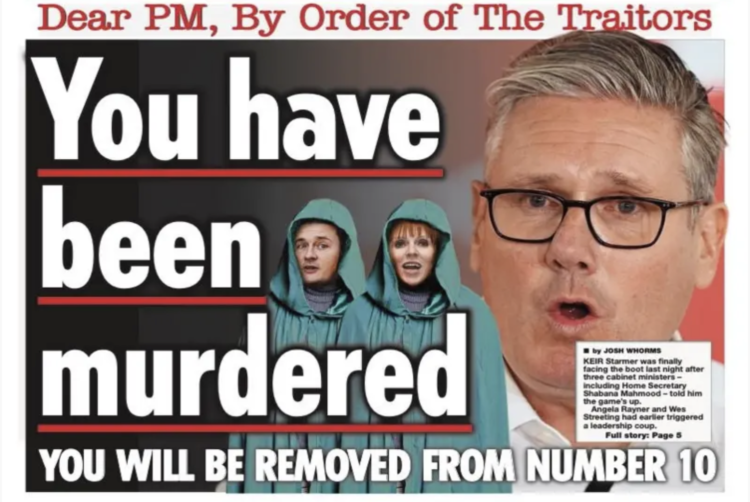
The stubbornness of Sir Keir Starmer, if he continues to stick to his guns, could pose a problem for large swathes of the media that do not wish him well.
There was near unanimity yesterday that the Prime Minister was on the brink, or on the edge and was certainly fighting for his political life with his back against the wall.
There is a small problem. The right-wing press can’t have Starmer remaining on the edge or the brink or fighting for his political survival day after day without the story getting a bit boring, err, rather like the Prime Minister himself.
In fact, showing dogged stubbornness and being unusually boring even by his own impressive standards might actually turn out to be a viable coping strategy for him in at least the short term.
Luckily for the Prime Minister, today is the King’s Speech and the media will have to pay some attention to that, relieving the pressure a little, however much they might want to concentrate on pushing Starmer ever closer to the brink and the edge.
The truth is no one knows what is going to happen now, probably including the Prime Minister himself, except that his position may, for a number of reasons, be less weak than it first appears.
It will not be easy for his opponents in the Labour Party to get rid of him because they are split and have different interests, particularly on when the coup should be launched.
Health Secretary Wes Streeting wants to go as quickly as possible before his main rival, Andy Burnham, can find a path into the House of Commons to be able to stand for the leadership, while Burnham is obviously a man who needs time.
The Starmer–hating newspapers might also underestimate the wariness among many Labour MPs about launching the chaos of a divisive leadership campaign at a time of multiple external crises, where Sir Keir has been making a decent fist of things.
So far, only six Parliamentary assistants have resigned, plus two middle-ranking ministers.
That doesn’t even get close to the tidal wave of resignations that swept Boris Johnson from power in July 2022.
Welcome distractions
Talking about Johnson, the former deputy leader of Reform, Ben Habib, made a serious allegation yesterday.
The allegation, obviously unconfirmed and possibly false, is that the Thai-based billionaire Christopher Harborne, who gave Nigel Farage £5m in 2024, previously gave Farage and Johnson £1m each to essentially agree to fix an election.
Former Guardian editor Alan Rusbriger described the allegation as explosive and noted that Habib has challenged Farage and Harborne to sue him for libel.
If true, it might help to provide a tiny bit of distraction for Starmer from his tormentors, as does the inadvertent error made by Green leader Zack Polanski in not paying council tax on the houseboat he shared with his partner.
Little comfort for Sir Starmer, maybe, but the more stuff flying about, the better, and there is also the daily drumbeat of disappearing Reform UK local councillors.
They may have gained 1,453 in last week’s regional and local elections, but at the last count, 12 have gone already, either because they didn’t want to be elected in the first place or have been shamed for previous utterances, such as the new Reform UK councillor who said Nigerians should be melted down and used to fill potholes.
Another cannot be found at all amid claims that he was an AI-generated Reform UK candidate.
Each local by-election costs £20,000 a pop.
Meanwhile, perhaps we should take Starmer at his word and let him get on with governing something that culture secretary Nandy is clearly doing.
The BBC’s future funding
The latest from Nandy is an explosive media story about the BBC’s future financing.
Nandy, according to The Times, after deciding to end the cycle of having to negotiate a new BBC Royal Charter every 10 years, is now considering extending the licence to cover streaming services.
It is a really good idea to make sure that everyone funds what should be a universal service, not just in the public interest, but in the interests of all of society.
Those without children cannot opt out of funding schools, and you pay for roads whether you have a car or not.
Properly funding a national public service broadcaster should be a similar primary responsibility of the Government.
It may have taken Lisa Nandy a very long time to cover the well-trodden turf and get to the bleeding obvious – that funding the BBC through advertising, subscription, or direct Government funding is a seriously bad idea.
Advertising on the BBC would harm commercial broadcasters, and direct government funding would call the BBC’s independence into question.
As for subscription, Nandy believes that British society is already quite divided enough, and subscription paywalls would hardly help.
That leaves us all with the licence fee, but it obviously has to be updated to reflect changing consumer behaviour, as only 80% now pay the licence fee while 94% of people still access BBC services.
The BBC has suffered a 25% real-terms drop in income over the past 10 years, and 2,000 jobs could be lost over the next two years.
The problem is that, at the moment, on-demand media consumption is not covered by the licence fee unless it is BBC content viewed via the iPlayer.
The tricky bit would be finding a workable way to include streaming services within the BBC licence fee remit. One method might be to impose a charge per UK viewer on the multi-billion-dollar streaming services such as Netflix.
Finding a way to fix the BBC’s finances would be a small, middle-ranking achievement for the Starmer Government, but not one that would have much influence on a leadership challenge.
You can be sure that by the day after tomorrow, Sir Keir Starmer KC will be back on the edge and on the brink, fighting for his political survival with his back against the wall.
 Raymond Snoddy is a media consultant, national newspaper columnist and former presenter of NewsWatch on BBC News. He writes for The Media Leader on Wednesdays — bookmark his column here.