



Brand security in the creator economy

Opinion | The Future of Brands: Creator Economy Week in Focus
Following several high-profile influencer backlashes, Billion Dollar Boy’s co-founder assesses what went wrong and how brands should balance protection with speed and scale.
Bud Light’s ill-conceived partnership with Dylan Mulvaney in April 2023 has become the pin-up case study for what can go wrong for a brand’s reputation if creator partnerships are mismanaged.
Bud Light miscalculated the cultural review – the brand hadn’t earned the right to align with the LGBTQ+ community; its values matching was flawed; the brand and creator personalities were misaligned; and it failed its audience checks.
But beyond the headlines, the story shows that brand protection starts well before contracts are signed and continues beyond the partnership you entered into.
It requires strategic decision-making and continuous governance across the entire campaign lifecycle – from strategy and planning to briefing, to on-the-ground creator management and long-term support.
And it goes both ways. The impact wasn’t just an immediate commercial challenge for AB InBev; it also had devastating personal effects on Dylan (who wasn’t given sufficient support) and significantly damaged creators’ confidence in partnering with Bud Light in the future.
Three years on, recent headlines show some of these cornerstone principles of the creator economy still get neglected: from courtside disruptions at the Arthur Ashe Stadium to internet outrage over OpenAI’s luxury tech retreat.
The instinctive reaction from risk-averse institutions – such as Wimbledon signalling a shutdown on creator accreditation – is to pull back.
That response is shortsighted. These brand safety risks aren’t isolated to the creator; they are operational breakdowns. Brand safety is not a one-off gatekeeping check or a keyword search; it is an end-to-end operational discipline.
What OpenAI taught us about creator identification and campaign planning
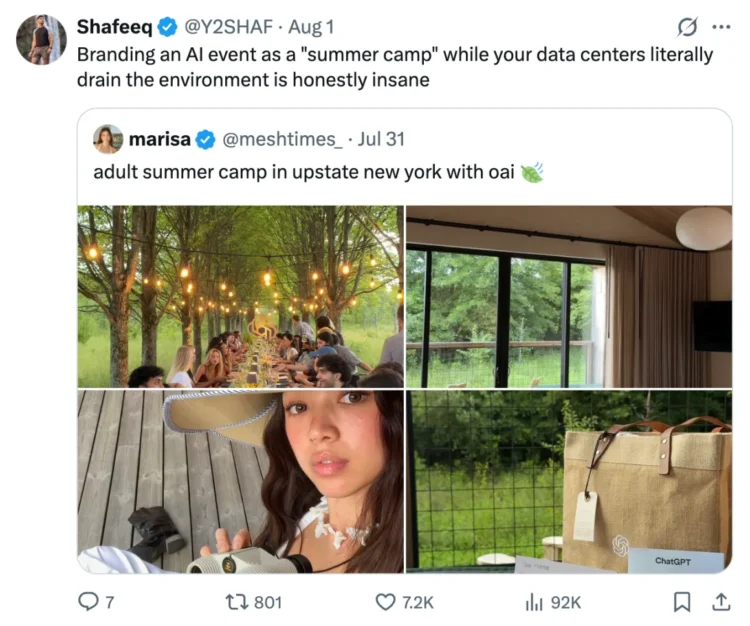
OpenAI’s “Summer Camp” illustrates what happens when campaign planning and creator identification lack strategic depth.
Flying creators to a luxury eco-retreat featuring $2,000-a-night suites, wellness activities, and farm-to-table feasts triggered immediate backlash. Audiences called out the glaring disconnect between an idyllic nature retreat and the realities of a $500bn data centre’s carbon footprint.
OpenAI copy-pasted an outdated luxury fashion playbook into a high-scrutiny tech category. Filming skincare routines in silk robes does nothing to help an audience understand complex software. And misaligned creator identification – selecting lifestyle influencers for tech messaging – triggers instant cynicism.
When campaign planning focuses on substance, creator partnerships deliver real commercial impact. Microsoft proved this through its Creator Connect programme, supported by our FiveTwoNine platform. Instead of flying influencers to a luxury resort, Microsoft invited creator entrepreneurs into its New York Experience Center to solve actual business pain points using Microsoft and LinkedIn tools.
By partnering with genuine business owners to tell utility-led stories in their own voice, Microsoft generated authentic advocacy that it then scaled beyond social feeds and into retail media networks and product detail pages, delivering 3x higher click-through rates.
Lessons from The US Open on creator briefing and management
At the US Open, bright ring lights mid-serve crossed the line from tournament coverage into disruption.
The individuals responsible were never part of the USTA’s official creator programme; two had improperly registered on a food vendor’s staff list. But because no one had signed them up officially, no one had briefed them on court etiquette, spatial boundaries, or gear restrictions. A complete absence of on-the-ground agency management allowed them to operate unchecked in a live, high-stakes environment.
Wimbledon’s decision to decline dedicated accreditation categories for creators misses the point entirely. Removing accredited lanes eliminates the exact paper trail that holds talent accountable. Anyone can still buy a ticket and film from the stands. The solution is not exclusion; it’s rigorous on-the-ground governance and clear briefing.
When brands get briefing and management right, creators elevate live events. Morgan Riddle proves the power of this approach. Through vlogs and beginner-friendly rule explainers, she rebranded professional tennis into “the chicest sport in the world,” introducing new demographics to traditional tournaments while respecting court etiquette.
More scale, more problems?
The problem is not an inherently creator marketing one. Creator partnerships are now commonly heavily vetted and rigorously planned long before execution, leading 82% of marketers to consider creator marketing at least “somewhat safe”.
But when we polled 2,000 senior marketing professionals across the US and UK on the most common challenges they face in creator marketing, at number two, 29% cited ‘identifying and vetting the right influencers at scale’.
Scale is the challenge for time-poor marketers who want to protect their brands’ reputations.
With US brands alone expected to spend $13.7bn on influencer marketing by 2027, managing creator networks at scale is the primary operational friction for time-poor marketers. Over 50% of marketers spend 30 minutes or less vetting a creator, while 22% vet under a quarter of creator content.
That scale keeps brand safety a continued concern. But it needn’t be.
Smarter due diligence at scale
Speed cannot come at the expense of rigour.
Traditionally, creator vetting meant choosing between losing hundreds of hours to manual scrolling or relying on blunt keyword filters that flag false positives while missing contextual risks. But reputational risk often doesn’t sit in obvious keywords; it can lie hidden in nuanced language, in old video thumbnails, audio transcripts, or web pages.
We built SafeMatch within our Companion platform to fix this broken system.
Using brief-aware contextual AI, SafeMatch assesses historic visual, audio, text, and web content against brand-specific criteria, surfacing genuine risks with clear explanations. Human experts then review the context to make the final call, creating a permanent, auditable record of governance.
Brand risk shouldn’t dictate your creator strategy—it should sharpen it.
Forward-thinking brands aren’t pulling back; they’re building modern campaign infrastructure. By combining structured identification, contextual vetting, explicit briefing, active on-site governance, and utility-first planning, you protect your equity, move fast, and scale with total confidence.
 Thomas Walters is chief Innovation officer, and co-founder of Billion Dollar Boy