



Don’t let YouTube take you to the cleaners
Opinion
Anyone whose marketing budgets are at stake should firmly resist YouTube’s land grab. But will they? asks Bob Wootton.
The not-so-silly season burns bright. Disasters and wars around the world, Dolly, yet more Harry and Meghan (yawn).
Closer to our home here, the (latest and certainly not the last) Facebook whitewash lawsuit settlement has already piled heavily on top of AI slop, widespread – and well-earned- distrust in advertising, and synthetic audiences (confession – I’ve never really understood how someone can manufacture audiences and then impute their viewing into a base for trading real money).
AI is already being mooted to control a third of all media trades. It may be whip-quick and capable of canvassing much more information than humans, but so far, it’s pretty dumb when it comes to questioning those inputs.
Talking of inputs, another day, another shameful attempt by a platform to pimp up some sales on its own terms. YouTube has already decided (for us) that it’s TV as it eyes the latter’s revenues and audiences.
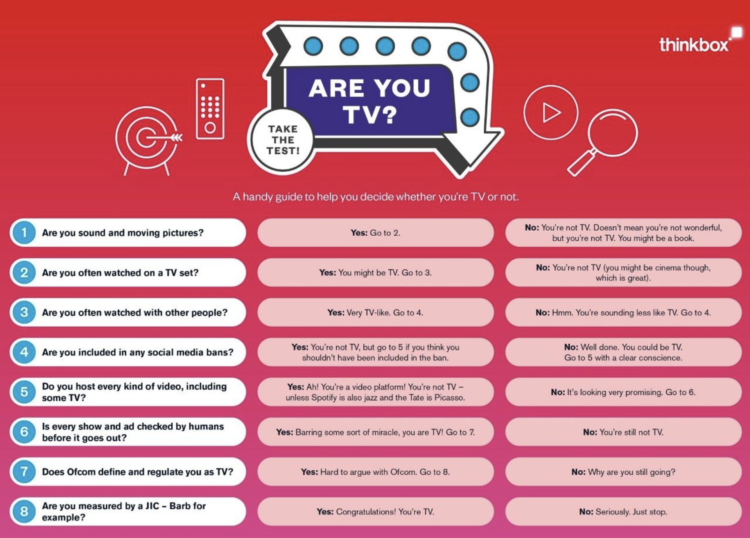
Justin Lebbon surfaces the subject here, and the irrepressible Thinkbox has produced an amusing and pointed infographic for us.
Now the social video platform has announced it will price and charge advertisers based on the first frame of any ad served. (Last time I looked, there were 24 frames per second). Such a lax measure will likely boost claimed audiences significantly.
This is from the company that claimed 200bn views a day, or 24 for every person on the planet, connected or not. As does Meta, no stranger to exaggeration either. Roku might be up to something similar.
Quite some departure from the inconveniently rigorous and independent measurements by which proper TV companies are judged and traded.
If you find the US Media Ratings Council’s online viewing definition of half the frame in view for two seconds as flimsy as I always have, then YouTube is taking things far, far further towards utter meaninglessness.
Most respected national TV audience measurement systems – chief amongst them the UK’s BARB, painted by some interested parties as an old, ossified metric rather than the rigorous and hard-debated currency it actually is – apply rules for what is called viewing persistence.
All require the item being measured to be in full view for several or more seconds, giving it some chance of being noticed, which – correct me if I’m wrong – is a prerequisite of human recall or action, no?
YouTube has flirted with BARB and withdrew earlier this year after BARB revealed viewing figures it didn’t much like – especially the proportion of children viewing. It subsequently issued cease-and-desist letters preventing BARB and its panel organiser, Kantar, from further data collection.
Google hands cease-and-desist letter over YouTube measurement
The platform’s flagrant land grab – perhaps it should be air grab? – should therefore be firmly resisted by anyone whose marketing budgets are at stake. But will it?
The platforms gamble – correctly – that the many smaller / ‘performance’ and often downright illegal long tail of advertisers that comprise so much of their revenues will likely continue to spaff their money regardless.
As for the major advertisers who have dedicated, specialist teams because they have every reason to do advertising properly, the ones I’ve spoken to think it’s outrageous.
However, they’re also loath to confront it. Their senior leadership seems to have become so indulgent towards the platforms that it’s now a brave and courageous career decision to mention the emperors’ lack of clothes.
Instead, an opaque metalanguage of attention (not much of that) and outcomes (self-marked homework) prevails. Lebbon also points to ‘FOFO’ – a fear of being found out.
Probably why the agencies – the ones who are now quickening the drumbeat around being trusted partners representing their clients’ interests, growth partners, trust, etc. – haven’t had much to say either.
Instead, the blindingly obvious isn’t being said. It’s your (and your clients’) money, so better pipe up lest you get taken to the cleaners with a bunch of at best self-styled and at worst utterly phantom numbers.
Aside #1
While I understand how such meagre input will mesh with my 2023 nomination for our very own HS2 (my most read piece ever), Origin, I fear for the credibility and reputation of any system prepared to ingest it. Especially now that it is transitioning to a standalone entity.
Lebbon touched on the subject here, and Jon Watts and Ian Whitaker have engaged in what has become an encouragingly spirited exchange.
As US expert Michael Farmer often reminds us, corporate/brand revenue growth has slowed over the ‘age of the platforms’ to a mere trickle eroded by price indices.
As a shareholder, witting or unwitting, in many such businesses, I’ve long struggled with how it’s acceptable to spend millions, even billions, on advertising without much examination of whether it is a) effective and b) good value.
Aside #2
The advertising market has become very complex, but I find it hard to explain why it now operates far less accountably, even with more auditors and consultants than ever.
I was used to rigorous audits of my media buying, but wonder what auditors do around today’s diminishing spends in legacy media? And if they’re now reoriented towards verifying online delivery, itself the essential input before assessing the keenness of the price bought, then what value will such analyses carry if based on inputs as meaningless as YouTube’s imposed metric?
Similarly for transparency and the mushrooming field of pitch consultants. I feel sorry for the agencies whose fees are being scalped in the meantime.
I doubt it’s still appropriate to call advertisers to “man up”, so instead I’ll reluctantly finish with the anodyne and more period-correct “take responsibility”.
Will this egregious YouTube ploy be the straw that finally breaks the camel’s back? I wish, but I wouldn’t bet on it. If the torrent of online brand safety issues didn’t get you thinking, what hope this?
Happy holidays – if you got one.
 Bob Wootton spent 40 years in advertising, first as a media buyer at some of the UK’s leading agencies before joining the trade body ISBA in 1996, where he served as advertising and media director for 20 years. He also founded Deconstruction, a media and tech consulting business.