



It’s not all doom and gloom. We’re just not reading enough about the good stuff
Opinion
From the economy to Reform’s role in would-be migrants from France, the under-reporting of small, yet significant events will most likely see Labour get a kicking at the polls tomorrow, writes Ray Snoddy.
As Wales, Scotland and large parts of England go to the polls tomorrow in regional and local elections, the vote comes against a background of economic and political crisis.
The UK isn’t working goes the mantra, while petrol prices are rising amid entirely legitimate fears of the economic impact of the war that President Trump launched against Iran.
Everything appears bleak, and Labour, on 18.8% in poll averages compared to Reform’s 27.1%, is bracing itself for losses that could get close to 2,000 seats by Friday.
Gloomy indeed and probably an accurate reflection of the current public mood. Obviously, Rachel Reeves is a rubbish Chancellor of the Exchequer.
Except that mood has almost certainly been created, in part, by serious under-reporting of the true state of the UK economy and the lack of prominence given to more optimistic signs and signals.
Is the anger justified?
No headlines for the fact that, according to the International Monetary Fund, the UK has just regained its former place as the world’s fifth-largest economy.
Little note has been taken of the fact that government borrowing is currently at a three-year low, as are NHS waiting lists, that unemployment unexpectedly fell in the three months to March, and that, at least for the moment, wages continue to run ahead of inflation.
A mixture of political bias in the media, compounded by the under-reporting of small but significant pieces of better news, means that not all the anger about to be unleashed in the polling stations is wholly justified.
Indeed, across a wide range of stories, both in the UK and abroad, under-reporting rather than outright suppression of information is having a serious impact, distorting public opinion.
By any standards, the news that just before becoming an MP Reform leader, Nigel Farage accepted a gift of £5m from Thai-based billionaire Christopher Harborne, and failed to declare it as he was obliged to do once he became an MP, should be a huge story.
But somehow that, and the potential conflicts of interest arising from Harborne and Farage’s common interests in cryptocurrencies, have barely troubled the headline writers.
Little interest either in the tax declaration problems of Robert Jenerick, the would-be Reform Chancellor, or the fact that former Conservative donor JCB’s Lord Bamford, now a Reform supporter, is close to a deal with HMRC on paying an owed £500m tax bill.
Perhaps the biggest under-reported story about Reform has just broken this week.
Zia Yusef, who describes himself inaccurately as ‘Reform Shadow Home Secretary’ and who is a frequent guest on BBC Question Time despite not being an MP, has announced that 2m illegal immigrants will be held in detention centres prior to deportation.
Reform has gone one step further, saying the detention centres will be located in areas that do not vote for Reform.
On the face of it, this should be investigated by the Electoral Commission as a possible breach of the Representation of the People’s Act 1983 and a possible criminal offence.
It appears to be coercive and threatening “temporal injury” to those who do not vote for Reform.
Lack of impact and accusations of fake news
Everywhere you look, the under-reporting of stories, even when they are tackled by one or two media outlets, means that they do not have the overall impact that they should.
While Donald Trump tells the world on a daily basis that he has already won the war against Iran, in fact, a lot of effort has gone into the sidelining of persistent rumours that American bases in the Middle East were much more seriously damaged by Iran than has been admitted.
Now CNN has investigated and found that all 16 US bases in the region were damaged, some so badly that they are no longer operational.
The general under-reporting of the issue allows Trump to dismiss it all as fake news.
There is also under-reporting, perhaps for understandable reasons, of the daily executions in Iran, usually of young male protestors, allegedly tortured until they confess to more serious “crimes.”
Every day, there is a sad record of their pictures on X, which most people still call Twitter – a total of more than 600 so far this year – while Western media concentrate largely on the daily fluctuations of crude oil prices.
With its limitless space, there are still things that Twitter is free to do better.
Ukraine is, alas, another example of under-reporting of one aspect of the crisis, leading to a serious misunderstanding of what is actually happening there.
Overwhelmingly, the media concentrates on the Russian death and damage which rains down nightly on Ukraine. Attacks on civilian populations, which have long since become routine in Ukraine, are a war crime and absolutely should be covered in detail.
The problem is that aspect of the story has overshadowed what is happening on the battlefield, in the Russian economy and at oil installations all over Russia, some as far as 2,000kms away from the Ukrainian border.
With the help of unmanned vehicles and drones, Ukraine has been taking back territory from Russia, and every night, there are pictures of Russian oil installations going up in flames. But because it happens every night, the economic impact goes largely under-reported.
As the US envoy for Ukraine, Keith Kellogg, put it in Kyiv this week, Russia is not winning the war; it is losing.
Small boats
One of the most toxic political issues and one primarily responsible for driving forward Reform’s current lead in the polls is the issue of the arrival of the small boats full of would-be migrants from France.
The public perception is moulded by two pieces of under-reporting – on the numbers and trends of arrivals, and on the reasons behind how such a thing could have happened.
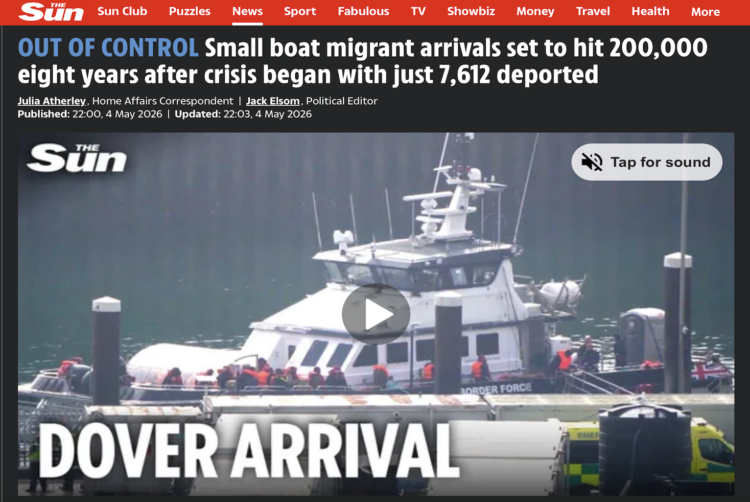
Latest Home Office figures show that from the beginning of January to the end of April 6,416 people arrived on small boats. But that was a 42% reduction compared with the same period last year amid growing evidence of increasing disruption of the gangs behind people trafficking.
No headlines for that, but there were headlines in The Sun (pictured) and the Daily Mail yesterday marking the fact that, some day soon, the 200,000th small boat traveller will arrive – a cumulative total since it all began around eight years ago.
Barely any headlines noted that the small boat phenomenon was created by Brexit. Until the UK left the European Union, it was possible to return unqualified migrants to the EU country they had come from.
Ahead of this week’s elections, the most under-reported story of all is that the predecessors of Reform, all led by Nigel Farage, who backed Brexit throughout, were the enablers of the very surge in non-EU immigration they are now campaigning against.
 Raymond Snoddy is a media consultant, national newspaper columnist and former presenter of NewsWatch on BBC News. He writes for The Media Leader on Wednesdays — bookmark his column here.