



DOOH is no longer a spectator sport
Opinion
Brands can build on OOH’s reach by inviting people not just to see a campaign, but to stop, join in, and become part of the experience, writes Kelly Eagle.
Every media debrief has a moment where someone asks: how many people saw it? And every out-of-home campaign has an answer ready, supported by audience data that helps us understand its reach and how likely someone is to have seen it.
Traditional OOH formats in these spaces reach thousands and thousands of people a day. That’s one of OOH’s greatest strengths. But brands also have an opportunity to build on that: inviting people not just to see a campaign, but to stop, join in, and actually become part of the experience.
Marketing Directors and CMOs understandably need numbers to justify spend. But combining OOH with experiential activity can add another dimension to that reach. Participation can create a much more personal connection with a campaign and the audience. In turn, that creates conversation and content, giving people a reason to remember it long after they’ve moved on.
Memory is the metric
Reach tells us how many people had the chance to see an OOH campaign. Experiential activity can build on that reach by giving audiences an opportunity to get involved and create moments they’re more likely to remember. The value of experiential activity – OOH included – can extend beyond the immediate reach of a campaign and help build long-term brand affinity.
Why? Put simply: an impression might be fleeting, but a memorable experience stays with someone. When someone asks a friend, “Did you see that?”, the answer sets off its own chain reaction: people talk about it, share it, amplify it themselves, because they actually want to.
Take the launch of the new season of House of the Dragon. A giant, hyper-realistic dragon that flew over the River Thames and the Tower of London gave audiences something striking to experience and talk about. It also created content that travelled online, letting those who didn’t see it in person experience it too.
The smartest brands treat the physical experience as a launchpad for content rather than the endpoint: one powerful concept, felt in real life, shared online, and remembered long term.
That’s where the broader, more traditional layer of a campaign- bus shelters, digital screens, etc.- becomes valuable. Paired with a big out-of-home moment, those touchpoints become more than isolated impressions and start tapping into something people already know.
When someone passes a familiar image on a bus shelter, having already experienced (or heard about) the bigger moment behind it doesn’t land cold; it reinforces a memory that’s already there.
Where interactive layers close the gap
Adding an interactive layer gives audiences a different way to experience an OOH campaign. Instead of only encountering the creative, they can play a more active role in it – as long as there’s a compelling reason to get involved.
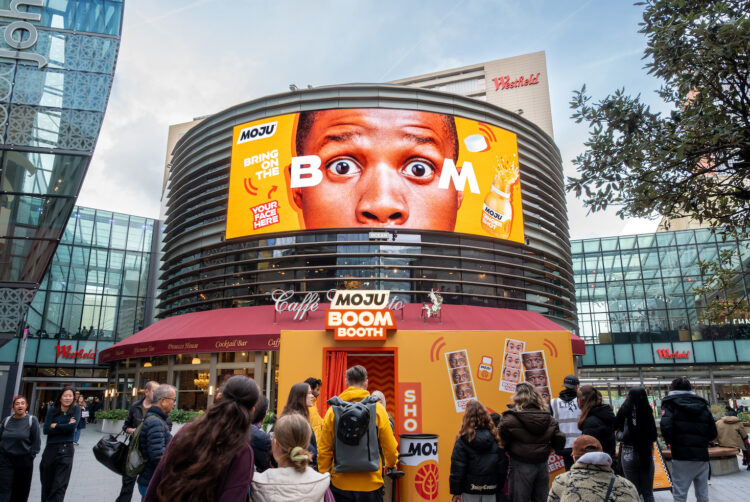
MOJU shows what an experiential layer can add to OOH scale and visibility: a direct moment of participation. More than 500 people queued up to step into a custom-built photo booth, try one of the brand’s shots, and have their unfiltered “BOOM face” reaction shown live on the centre’s landmark billboard.
Everyone who took part walked away with a personalised bottle featuring their own photo, with one lucky participant fronting the brand’s national “Bring on the BOOM” campaign.
This campaign worked because participation was worth it. People felt a benefit to stopping and engaging: a photo, a product, a shot at the campaign itself. That’s the test for any interactive layer. Tech can make almost anything interactive, but it has to be well-designed. If it doesn’t give someone a reason to stay, all we’ve built is a more expensive impression.
What MOJU adds on top of OOH’s scale is a direct moment of participation. People queued, they interacted, they generated their own content and metrics in the process.
This campaign also didn’t let the moment end at the booth. The personalised bottle gave people something to take home, while the chance to front the national campaign kept them involved beyond Westfield.
That’s the model other brands can borrow: whether it’s a product trial, exclusive access or a social moment, the activation should always lead somewhere. Done well, it stops being a moment people simply witnessed and becomes the bridge into everything the brand does next.
OOH sets the stage
Not every OOH campaign needs an experiential element. Sometimes scale, spectacle or powerful storytelling is enough. But when interaction supports the creative idea, combining the two can give audiences a more active role and help the campaign live beyond the original encounter.
OOH provides the public stage; experiential invites people into it. Together, they turn a campaign people see into something they actively get involved with, which they’ll talk about and, most importantly, remember.
 Kelly Eagle is a managing partner at Pixel Artworks