



It’s time we stop apologising for Cannes
Opinion
If the most forensically critical voice in our industry is prepared to show up to Cannes Lions, maybe it’s time the rest of us stopped being quite so embarrassed about showing up too.
Ten years ago this week, Mark Ritson wrote one of his most famous articles for Marketing Week. I was working there as a commercial director at the time, and I can still remember everyone panicking when the magazine landed on our desks.
Ritson’s much-sought-after column was nothing more than a blank page, headlined Mark Ritson: My comprehensive guide to what marketers can learn at Cannes, followed by the tagline “This week’s column covers all the important marketing discussions taking place at the Cannes Lions Festival 2016” – and then nothing. Just white space.
Classic Ritson. The point was obvious: nothing of importance happens at Cannes Lions.
I’ve spent a lot of time thinking about that blank page today, not 24 hours after touching back down in London. I genuinely believe he was wrong then, and I’d argue he knows it now.
He was in attendance this year, and speaking. And if the most forensically critical voice in our industry is prepared to show up, maybe it’s time the rest of us stopped being quite so embarrassed about showing up too.
Here’s what’s always struck me as odd
We work in an industry built entirely on the power of emotion, memory and experience. We know (because it’s our entire professional premise) that people make decisions based on how something makes them feel, not what it says on the spec sheet. We say it in pitches. We put it in decks. We charge a premium for understanding it. And yet, every June, we collectively wring our hands about whether Cannes Lions is a bit much. Whether the beach parties are too lavish. Whether all of this might look bad.
An industry that sells on emotion is embarrassed about an event that runs entirely on it.
I’ve been lucky enough to attend Cannes Lions a number of times now. I’m a kid from Mitcham who grew up in a block of flats, and I genuinely never expected to find myself pounding up and down the famous 2km of La Croisette – so I don’t take it lightly. But what I’ve come to realise, and what this year confirmed more than any other, is that what happens at Cannes isn’t a distraction from the work. It is the work.
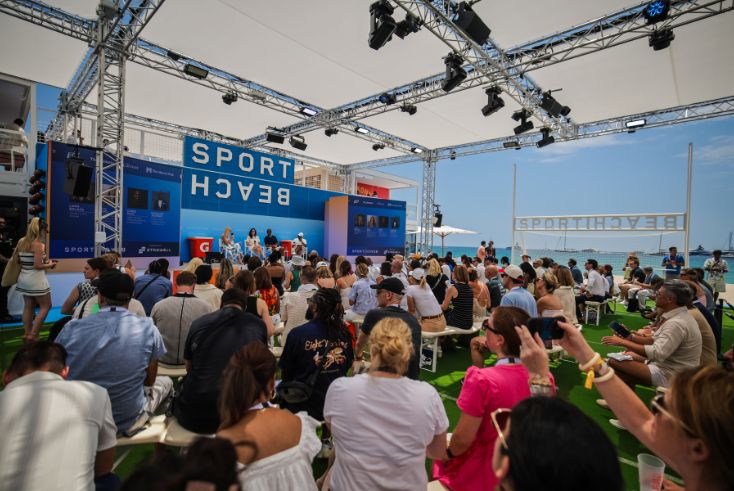
Yes, there was a lunch at the LBB beach (thank you, Bauer). Yes, there was the England vs Ghana game at the Steak n Shake (thank you Swayable). Yes, there was a rather high-energy performance from Ciara that I absolutely did not expect to enjoy as much as I did (thank you Freewheel).
At each of those moments, I had a bloody great time. I’m not going to pretend otherwise. But at each of those moments, I also met brilliant people, had conversations I wouldn’t have had in any other setting, and came away with ideas that are now turning into actual work over the next 12 months.
If you want to call that a work holiday, go ahead. But ask yourself: when did enjoying yourself become evidence that nothing serious is happening?
Cannes Lions works because it removes the excuses people use for not engaging
Back in London, everyone is busy, distracted, time-poor, and protecting their diary, like it owes them money.
At Cannes, that disappears. You turn up to a meeting on a sun-drenched terrace, your client is wearing sunglasses and so much pastel-coloured clothing you briefly wonder if Miami Vice is making a comeback, and somehow – despite the heat, the sore feet, and the fact you couldn’t get into the Spotify beach party – everyone is actually present.
The conversation flows differently. Things get agreed. Plans get made. If you genuinely believe you’d get the same outcome dropping 20,000 people into one of those behemoth conference centres in places like Düsseldorf (where I used to have to travel to when I first started in sales working for a trade publication in the packaging sector), I’d argue you’re wrong.
At a time when every content stage at Cannes is talking about how AI will transform the way we work, this feels like exactly the right moment to make the point plainly. No piece of technology, however brilliant, replicates what happens when people are in the same place, in the right environment, and actually want to be there. That’s not a sentimental argument. That’s just how decisions get made. And if our industry understands anything, it should understand that.
The real creativity at Cannes isn’t happening in the formal sessions. It’s in the serendipitous meetings, the chance introductions, the conversations that take a turn you didn’t expect.
Yes, the adtech yachts are a bit much. Yes, the whole thing is expensive. Yes, it is (and I say this with genuine affection) a bit media wankery. But we should be making the case for it, not hedging, qualifying, or worrying about how it looks.
When I land back home, and someone asks if I enjoyed my work holiday, I’ve spent years trying to explain it’s more than that. I’ve given up. But maybe the problem isn’t the explaining, maybe it’s that we’ve been making the wrong argument all along.
Cannes isn’t hard to justify because it’s indulgent. It’s hard to justify because our industry, for all its talk about the power of experience and emotion, has never quite worked out how to sell itself on those terms. We’re considerably better at making the case for other people’s products than our own tentpole event. Which, when you think about it, is a pretty damning indictment of our industry’s ability to market itself.
Mark Ritson made a brilliant point with a blank page. I’d just suggest that a decade on, the page isn’t quite as empty as he thought.
 Steve Scaffardi is global CEO, content at Adwanted Group