



On the ropes. Will the media take down another Prime Minister?
Opinion
Sir Keir Starmer has had a torrid week as he battles for his political life. As the media vultures circle, he should consider himself fortunate that Spitting Image is no longer influencing British culture, says Ray Snoddy.
The media can really bring down Prime Ministers if they choose to do so, and usually it comes from a long campaign of ridicule and denigration rather than a single, overwhelming story.
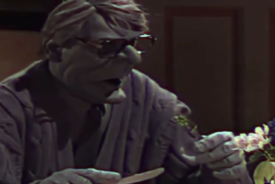
In the case of Sir John Major, the damage was largely done by Spitting Image, which portrayed him as a grey, boring man, obsessed with eating peas – and sex- who wore his underpants outside his trousers.
His latex puppet left an enduring image which had the subliminal effect of unfairly undermining Sir Major’s reputation as a serious politician.
The former Tory leader also suffered regular monstering from Kelvin MacKenzie’s The Sun, culminating on Black Wednesday in September 1992 when the UK left the European Exchange Rate Mechanism.
According to MacKenzie, when Major called to enquire how The Sun would cover the story, the legendary editor said he had a bucket of shit on his desk and that he was going to pour it all over him in the morning.
Major has always insisted he has no recollection of such a story about what was only metaphorical shit anyway, but in a way, it hardly matters because it stands as an example of Major’s public image and the one that entered the national psyche.
Major was a grey man who ate peas and was a bit of a loser.
Luckily for the current Prime Minister, Sir Keir Starmer, there are no longer Spitting Image puppets to contend with, and Kelvin Mackenzie, who has wandered off into the Reform hinterland, has little ability these days to monster Prime Ministers.
There is, however, little doubt that even before Sir Keir’s disastrous decision to appoint Lord Mandelson as the UK’s ambassador to Washington, the Labour PM had been subjected to a sustained campaign of hostility by the right-wing press.
Everything Starmer has done has been subjected to the most negative possible interpretation, exploiting his poor judgment about how often trivial issues will be perceived.
Starmer cannot help that he lacks charisma and often speaks in a dull, lawyerly tone, but the never-ending campaign against him has worked.
An unpopular public persona has been created, and Labour MPs report that the word on the doorstep is bleak: many people have formed a negative opinion of our Prime Minister that will be very difficult to shift.
A colleague even reports sharing a train with Millwall supporters, who may not follow every nuance of Westminster politics, but know enough to sing “Keir Starmer’s a wanker…”
It is difficult to come back from such firmly embedded prejudice, and that is even before we get to Lord Peter Mandelson.
Mandelson’s security vetting scandal
With hindsight, it is easy to see why Starmer was so attached to the Mandelson appointment and equally why it was so disastrous.
He saw, and was advised, that Mandy could be the ideal person to deal with this most unusual of US Presidents – on the set-a-thief-to-catch-a-thief principle.
This unfortunately overlooked Lord Mandelson’s long track record of trouble and the well-known links with Jeffrey Epstein, even though the Prime Minister has claimed that Mandy was less than frank about the closeness of the relationship.
Surely, a former chief public prosecutor should have asked more penetrating questions himself.
Starmer has admitted he got it wrong and has apologised.
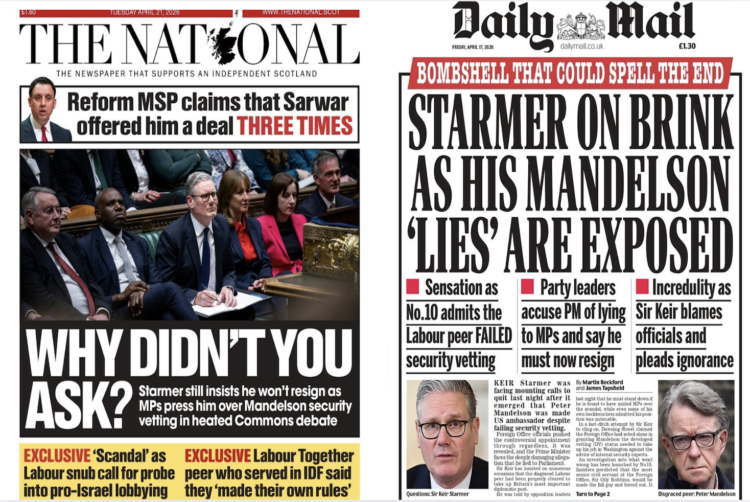
Then on to the great vetting scandal, which has generated hundreds of stories in the media over the past seven days as Starmer is accused of misleading the House.
Prime Minister Starmer has insisted that he was not informed by Foreign Office officials that Mandelson had failed the vetting process at the time of his appointment, describing this failure to inform him as “staggering” and “unforgivable”.
Naturally, he fired Sir Olly Robbins, the top civil servant at the Foreign Office, following the revelations. But it hasn’t stopped his media detractors from calling for the Prime Minister’s resignation.
By lunchtime yesterday, things had got as Conservative leader Kemi Badenoch, one of those calling earlier for resignations, put it “more murky and more contradictory.”
Or to put it more neutrally, more nuanced.
Sir Robbins was able to explain to a Parliamentary Committee that the content of Lord Mandelson’s vetting was confidential and he was under no obligation to share the information with the Prime Minister – an extraordinary state of affairs.
Sir Robbins did say he had felt under pressure to come up with “the right answer” that the Mandelson appointment should stand.
Why didn’t he ask?
Suddenly, the Daily Mail, no fan over the years of the oldest female MP in the House, Diane Abbott, was quoting her approvingly.
In the murky proceedings, the Mail said it fell to Diane Abbott to puncture Starmer’s “balloon of bluster” with a simple question: ”The Prime Minister insists on saying nobody told me. Why didn’t he ask?”
And by saying so, Abbott got to the heart of the matter.
Of course, Starmer’s handling of almost everything to do with Mandelson has been tragic for his political reputation, even though it falls short of the threshold for matters of life and death.
It has obscured a number of real achievements during his Premiership, such as his unwavering support for Ukraine, his standing up to President Trump and his illegal war on Iran, and his ensuring that the UK is only tangentially involved.
He has acted like a statesman of the first order by organising virtual meetings with 30 world leaders to try to find a solution to the current crisis in the Middle East.
He has got little credit for any of that, and few have noticed that, while the Mandy row was at full spate, the International Monetary Fund upgraded the UK’s economic position to the 5th-largest in the world.
None of the above is likely to have reached the doorsteps of England, Scotland and Wales, where local and regional elections will be held next month.
Again, according to the Mail, losing around 1,600 seats is being seen as “a best-case” scenario.
Surely if Starmer won’t resign over Mandelson, such an electoral defeat should do the trick?
Don’t count on it. However loudly the media call for his head, Starmer may lack many of the finer traits of being a political leader, but he is dogged, stubborn and courageous.
It could see him through to leading Labour into the next General Election – despite everything.
 Raymond Snoddy is a media consultant, national newspaper columnist and former presenter of NewsWatch on BBC News. He writes for The Media Leader on Wednesdays — bookmark his column here.