



People still trust people: Why creators and DOOH belong together
Opinion | The Future of Brands: Creator Economy Week in Focus
In a world of AI fakery, creators need a place to prove they’re real. Digital out-of-home has the answer, says Ocean Outdoor’s chief revenue officer.
Our industry is obsessed with AI right now. How much work it can complete, the content it can make, how quickly and how cheaply. The savings. But if you look at what real people are actually telling us, there’s a problem.
Some 92% of Brits say AI-generated content is making it harder to trust what they see online (source: DoubleVerify, YouGov). 62% trust marketing less since brands started using AI (source: Optimizely). And 78% say they trust a brand less if it uses AI-generated actors in its ads. That rises to 83% amongst 18 to 34s (source: YouGov).
So AI-made content is causing a significant digital trust problem.
We believe one of the best answers is a pairing that’s still relatively underexplored: creators and digital out-of-home (DOOH). Both are made by people. Both live in the real world. Put them together, and you get the creativity, the trust and the signal strength that an AI feed just can’t deliver.
People buy from people
UK brands will spend more than £1bn on creator partnerships this year, according to IAB UK, and the reason the creator economy is growing so quickly is simple. People buy from people. They listen to their peers and to the voices they’ve chosen to follow. And they’ll listen to them over an AI-generated model telling them what to buy every time.
In fact, 72% of Brits say they’re more likely to engage with content that feels human (source: IAB UK).
Over the last three to six months, we’ve seen brand budgets leaning into longer, always-on partnerships with creators whose voice aligns with theirs. Brands want people they can build with over time, producing content clearly rooted in lived experience and a genuine reflection of a creator’s life and community.
Creators feel the AI flood keenly. Many worry that a feed full of synthetic content makes it harder to stand out and harder to prove they’re real, and the ones doing the best are leaning into that by showing their faces, their places, and their process.
AI-developed content makes working with the right influencers more important than ever for brands looking to cut through to audiences.
The risk is creators getting lost in that noise. And if people can’t tell what’s real and what isn’t, every creator’s credibility takes a hit, and so does every brand paying them. Creators need somewhere that proves they’re real.
The real world builds trust
That’s where OOH comes in. A screen in the middle of a city is the opposite of a feed. Everyone sees the same thing, at the same time, in a place they can actually stand in front of. You can’t personalise it, hide it or quietly delete it. It’s no surprise that DOOH is considered one of the most trustworthy media.
It also sends a powerful signal. When a brand puts a creator on a large format screen, it’s backing them in public, and that builds trust in the brand and the creator associated with it.
The tech has changed
Creators and OOH isn’t a new idea, but the way it works has changed.
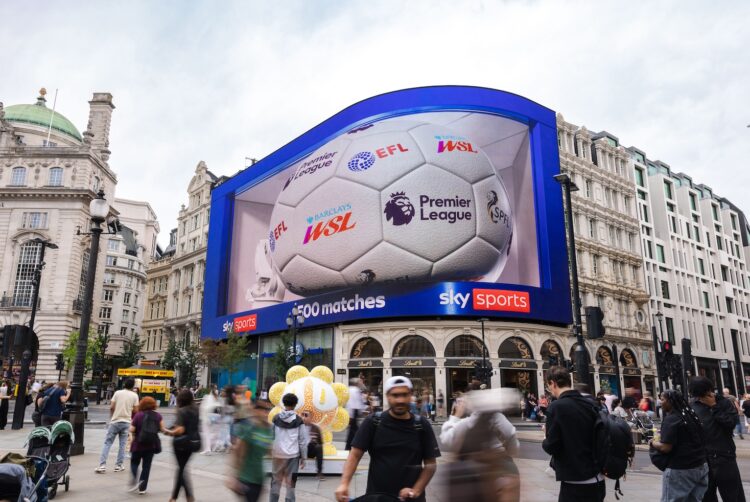
A great recent example is the work Sky has done to promote its partnership with Team GB and, more recently, the start of the new football season (pictured).
It used hand-picked creators to amplify core OOH messages to audiences across social. Most recently, Sky brought leading football influencers face-to-face with Sky’s OOH creative, then used visual FX to bring the billboards to life. Each creator put their own style on the content, so it felt native to their channels and true to their audiences rather than a straightforward ad.
Working the other way, creator content can now go from phone to big OOH screen in days rather than months, and it can be timed to real moments, so the screen and the social conversation happen together, instead of weeks apart.
The ripple effect
The screen is never the end point. Great OOH content is often shared, and getting it right means that messages will be captured and amplified to audiences at scale. This gives what is traditionally a booking confined to one time and space the ability to reach audiences at scale, delivering huge incremental value for brands.
The screen makes the creator more credible, and the creator makes the screen travel. It’s a win-win for brands.
Getting the brief right
A good brief gives the creator the ‘why’ and trusts them with the ‘how’. The most common mistake is writing a social brief and expecting it to work on a screen. DOOH has no sound, gets a few seconds of attention and is seen from a distance, so it needs one clear idea, one recognisable face and to be visually appealing.
Our advice to brands is to brief for both formats from day one, the screen asset and the social content around it, and to plan the moment at the screen so the creator can be there to capture it.
Protect the creator’s own voice, because if it starts to look like a standard ad, you’ve lost the trust you were paying for. And agree on usage rights up front so you can keep using the content after the campaign ends.
Here are a couple of recommendations:
Brands: back creators in public spaces. If you believe in the people representing your brand, show it where everyone can see it. That’s what turns a sponsored post into something people actually trust.
Creators: ground your content in the real world. Real places, real moments and real people are the best proof you’re not a prompt. In a feed full of AI content, that’s your biggest advantage.
AI is going to make content infinite. It can’t make it real. People still trust people, and the brands that win over the next few years will be the ones putting real people in real places.
 Andrew Gibson is the chief revenue officer at Ocean Outdoor UK