



Programmatic DOOH: From media outlier to omnichannel multiplier
Week in focus: The Future of OOH
A single, data-informed narrative that predicts movement and adapts to real-world behaviour means that from London to Liverpool, DOOH excels. We just need data standardisation, writes Adform’s country manager.
The digital transformation of Out-of-Home (OOH) is impossible to miss. Over the past decade, the advertising industry has poured millions into transforming roadsides, transit hubs and even gyms into brand touchpoints. We’ve successfully traded paper and paste for high-definition digital canvases and plugged them into some of the most sophisticated supply platforms in adtech. But in doing so, we made a short-sighted decision: we left those screens stranded on a technological island.
Media buyers knew DOOH’s worth – visually engaging, culturally powerful, brand safe. But is it measurable? Can it compare to other digital channels? That was a harder conversation. The industry knew the format worked; it just struggled to prove it in hard numbers that matter to CFOs.
Buyers naturally stick with what they can control, compare and prove, but when a channel sits outside the main media plan, trading, insight, and measurement all become too heavy a lift. Programmatic adoption was stubbornly, frustratingly low as a result.
That era is over.
The conditions that held programmatic DOOH back no longer apply. The measurement and data piece has caught up with the screens. What the industry now needs to reckon with is more ambitious: not just rehabilitating DOOH’s reputation, but repositioning entirely: from outlier to game-changing, omnichannel multiplier.
The numbers don’t lie
DOOH now accounts for 67% of annual OOH revenue in the UK, and an average 41% increase in programmatic DOOH spending is forecasted over the next 18 months – a notable jump from 2025.
Many brands and agencies now link programmatic DOOH to bottom-of-the-funnel performance: more than two-thirds associate it with driving sales outcomes. This is no longer a channel finding its feet, but one attracting growing interest and confidence from buyers.
The problem was friction. DOOH historically required standalone workflows, specialist knowledge and isolated planning conversations. Direct deals dominated because they were simply easier. These obstacles are fast disappearing, however.
From gut feel to hard proof
The shift begins with data. Where previously softer proxies like footfall uplift and dwell time estimates were begrudgingly accepted, advanced measurement platforms can now provide far more concrete insight. Location signals, contextual data and audience movement all produce genuinely actionable, full-funnel marketing intelligence.
Beyond raw measurement, the planning experience itself has improved. Visual tools that map screen inventory geographically are giving buyers a level of transparency and control that simply didn’t exist before.
Sit these capabilities alongside full-funnel metrics like brand lift, purchase intent and downstream conversion from mobile, Connected TV (CTV) and display, and DOOH’s missing connective tissue is in place.
That reframes the whole conversation and accentuates DOOH’s unique trait. Around 73% of consumers view DOOH ads more favourably than social media, TV, or online video. It is a premium, brand-safe environment that does not depend on walled-garden data – a structural advantage that becomes increasingly valuable as third-party signals disappear.
When exposure can be mapped to results within a single omnichannel view, the perception of DOOH looks completely different. The more important matter now is what to do with it.
From single touchpoint to full journey
Currently, 63% of UK marketers expect to integrate programmatic DOOH more closely into multi-channel campaigns over the next 18 months. The opportunity here is not simply about adding DOOH to more plans; it is about where in the planning process it enters the conversation, and how consistently it shows up throughout a consumer’s day.
Take someone travelling from London to Liverpool to watch an Everton game on a hot day. They are identified as a likely match-day traveller based on movement patterns and event signals, and catch a beer brand’s CTV ad over lunch, priming the journey at household level.
On the platform at Euston, a programmatic DOOH screen dynamically serves the same campaign, triggered by high concentrations of Liverpool-bound travellers and time-to-departure.
On the train, a mobile ad reinforces the message based on prior exposure and real-time location, adapting the creative to the moment.
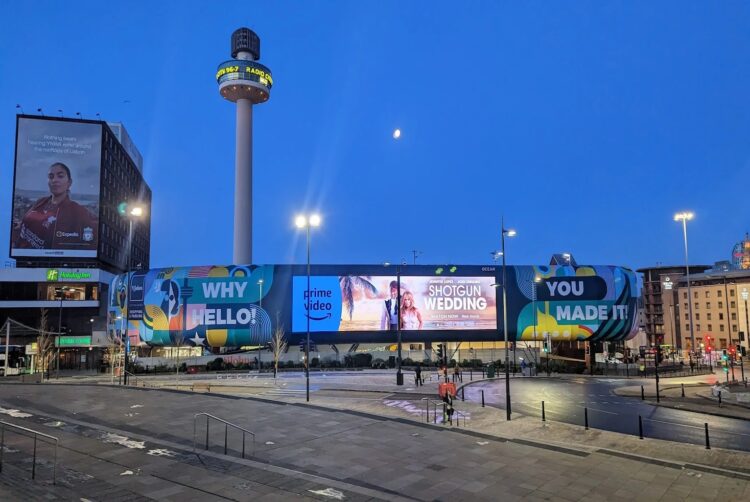
Arriving in Liverpool, a screen at Lime Street station (pictured) delivers a locally relevant execution, shaped by crowd density, weather, and proximity to venues.
By the time they’ve watched the match and are walking out of the Hill Dickinson Stadium, they are primed for a pint from that brand.
That is not a series of disconnected impressions. It is a single, data-informed narrative that predicts movement, adapts to real-world behaviour, and compounds the impact of every channel.
The future of DOOH
To fully unlock this multiplier effect, the industry must rally behind true data standardisation. Right now, every market, operator, and platform measures audiences slightly differently. That inconsistency quietly undermines planning confidence.
If a media planner cannot trust that a thousand impressions in Liverpool mean the same as a thousand impressions in London, they cannot allocate budget with total conviction.
The channels that scaled fastest – display, CTV, and social – all succeeded because they established common currencies that buyers could rely on. DOOH needs the exact same framework.
This is where AI has an important role to play. Agentic optimisation can autonomously unify signals across screens, markets, and devices in real time, making smarter decisions about creative sequencing, timing, and placement than any manual process ever could. Where standardisation has historically been a slow, committee-driven process, AI has the potential to accelerate it significantly, ensuring DOOH speaks the same language across every market and platform.
Global DOOH spend is heading toward $25bn (£19bn) by 2029. The screens are ready, and the technology is there, but that massive wave of spend won’t be captured by a channel that asks planners to jump through hoops.
It will belong to the markets and operators that commit to a common currency and unified workflows – the ones who understand that the ultimate competitive advantage is simply making the media buyer’s life easier.
The question is no longer whether DOOH deserves a place in the media mix. The real question is whether we are finally ready to take it off its island, tear down the silos, and make it the default.
 Phil Acton is the UK country manager at Adform