



Testing signals and assumptions across news

Partner content
Before excluding a news brand from an autumn plan, ask three questions. When was our assumption last tested? Does the evidence describe actual behaviour or brand perception? And what has changed since?
When I was a boy, I bought every newspaper. All of them. On the same day. And to the lasting puzzlement of my village newsagent. The pleasure was reading the same events told from such divergent perspectives; The Guardian and The Mail could report the same Tuesday as if it had happened in two different countries.
The habit left me less interested in who each title’s reader supposedly is than in how the same person reads different titles at different moments.
There is a scene in Yes, Prime Minister in which Jim Hacker runs through the nation’s newspapers and skewers the readers of each in a sentence apiece. It is very funny, uncannily accurate, and it captures a habit that still shapes media planning: treating every title as the home of a distinct tribe.
The distinction between a GQ reader and an FHM reader was never as fixed as the labels suggested; plenty of men (and a lot of women) read both.
The question is about to matter, because autumn planning brings thousands of quick decisions about which environments make a plan, and many rest on assumptions about news brands that nobody has tested in years.
Earlier this year, we tested ours
Everyday People, the research practice founded by Andrew Tenzer and Ian Murray, ran its Signal framework across the UK news category: 2,017 UK adults, nationally representative, fieldwork in May.
We measured GB News alongside six long-established fellow news publishers and broadcasters: Sky News, The Guardian, The Telegraph, The Mail, The Mirror and The Express. We agreed on one condition before a single question was asked: we would publish the full framework whichever way it fell.
The framework builds on the mental availability research set out in How Brands Grow. To the category entry points Drs Sharp and Romaniuk taught the industry to measure, Signal adds three further sets of associations.
Fitness is perceived strength: which brands people associate with statements such as “is highly successful”, “high quality” and “is a financially strong company”.
Social is what I believe everyone else thinks: “everyone knows this brand”, “everyone respects this brand”, “if I use this brand, others will think I’ve made a good choice”.
Values asks which of five universal human values people link to a brand: achievement, tradition, pleasure, self-direction and universalism.
Respondents need no experience of a brand to answer; it measures opinion, which is the point. Add it all up, and you have a brand’s share of signal across the seven brands.
Starting with the findings that surprised nobody
Fitness and social signals build with age, and a channel launched in 2021 is measured here against brands that have been accumulating them for generations.
GB News holds an 11% share of each, level with The Mail, ahead of The Mirror and The Express and behind the rest. Signals of this sort compound over decades; five years in, that is a solid base, and publishing it is the price of being believed on everything that follows.
Other findings did not track expectations. 44% of UK adults said they would definitely or probably consider GB News, level with The Telegraph and within five points of The Guardian.
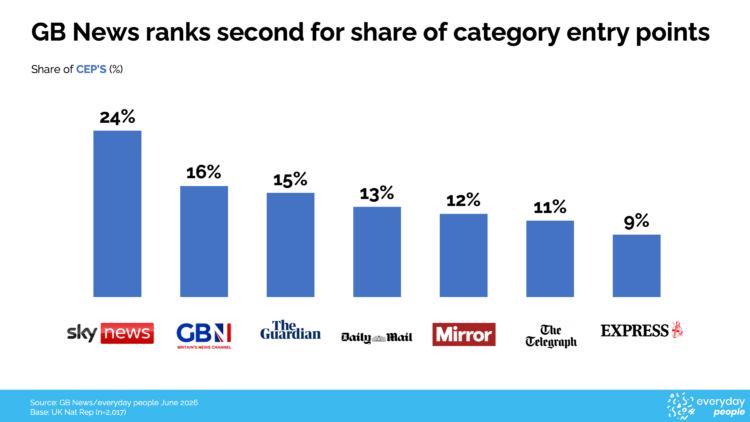
On share of category entry points, the established measure of mental availability, GB News ranks second of the seven brands tested, at 16%. Its strongest links are providing topics for conversation and helping people feel part of a community.
The values data is the finding almost nobody guesses correctly. GB News ranks third of the seven on share of values, level with The Telegraph, and third specifically on self-direction, which covers creativity, freedom, curiosity and independence, and on universalism, which covers broad-mindedness and social justice.
Its weakest value is tradition. Whatever assumptions you carry about the brand, the associations reported by a representative sample are more varied than the stereotype.
On emotion, GB News takes the second-largest share of the seven, behind only Sky News, and differentiates on high-arousal positive emotions, particularly excitement and delight.
The most instructive finding is consistency
Share of signal barely moves across the population: 13% among 16 to 34s, 14% among 35 to 54s, 13% among the over 55s, 12% among ABC1s and 15% among C2DEs. The results did not vary by age or social grade as a tribal model would predict.
Tenzer, who built the framework with Murray, draws the wider lesson: “Our findings reveal the importance of thinking more holistically about media signalling. It champions how ordinary people think about news brands in the real world, and frees our industry from some of its most cherished stereotypes.”
None of this is a media plan, and brand associations are not viewing behaviour; that evidence sits elsewhere. Instead, the study shows that the country’s view of this category doesn’t match the industry’s.
So before excluding a news brand from an autumn plan, ask three questions. When was our assumption last tested? Does the evidence describe actual behaviour or brand perception? And what has changed since?
We will run the study again next year and publish that too. The country keeps better data than the grapevine.
 Ross Sergeant is chief revenue officer at GB News.