



The $80bn shift: how creator economy is redrawing media boundaries

Analysis – The Future of TV: Global Series
Marija Masalskis at Caretta Research explores the rise of the content creator economy and how individual creators are using an intellectual property monetisation ‘flywheel’ to scale their businesses.
Once dismissed as niche, bedroom operations, the creator economy is maturing into a highly professionalised media ecosystem, blurring the lines between social content creators and the established TV industry.
Our conservative estimate at Caretta Research suggests that the content creator economy was worth $40bn in 2025 and will nearly double to almost $80bn in annual revenue by 2030.
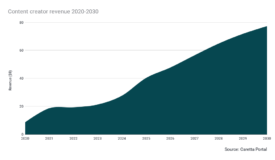
With scale comes greater operational professionalisation, particularly among the top creators whose scaled businesses will account for the majority of revenue.
This professionalisation is underpinned by three core pillars: stabilising platform revenue sharing, mastering the omnichannel flywheel, and the emergence of specialised support services.
Platform revenue sharing and YouTube’s distribution power
At the foundation of this scaling ecosystem is the widespread adoption of revenue-sharing models across major social media platforms.
YouTube pioneered this approach with its Partner Program as far back as 2007. More recently, TikTok and Meta (through Instagram and Facebook Reels) have transitioned away from fixed creator funds in favour of these revenue-sharing models.
This structural shift critically boosts creator earnings, allowing the largest creators to properly scale and invest in their businesses.
The well-established Partner Program has allowed YouTube to increasingly solidify its position as a key distribution and monetisation hub, empowering scaled content operations, including broadcasters, to control their presence and revenue.
This capability is why broadcasters are strategically increasing their reliance on the platform for full distribution, moving far beyond its initial use case as a marketing vehicle.
This evolution is heavily reinforced by YouTube’s massive prominence in the connected TV (CTV) environment, which closely mirrors the traditional television viewing experience.
Broadcaster involvement with YouTube still spans a spectrum: while some maintain a lower level of engagement, using YouTube primarily as a teaser channel to drive viewers back to their proprietary streaming platforms, others are fully leaning in.
At the highest level of engagement, broadcasters treat YouTube as a TV destination, curating premium, brand-safe channels and taking direct control of their ad sales.
Intellectual property monetisation as a flywheel system
While scaling revenue directly from social media platforms is critical for baseline growth, it is the adoption of an IP monetisation ‘flywheel’ that truly dictates how individual creators scale their businesses.
The flywheel approach means that distribution across multiple platforms continuously supports the overarching brand. Rather than treating one platform solely as a marketing vehicle and another exclusively as a revenue driver, every platform in the omnichannel ecosystem serves both to drive awareness and to drive direct monetisation.
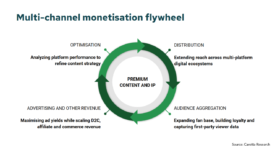
A flywheel in itself is not a new concept.
Established IP brands and personalities, like Gordon Ramsay, leverage their professional television backgrounds to diversify their business portfolios. Social platforms allow these established IPs to further charge their flywheels, tapping into deep, evergreen content catalogues to drive rapid discovery and stay relevant.
Newly scaling digital creators strive for this same professionalised model.
A prime example is digital-native creator Mark Rober (Crunch Labs), who transformed a massive YouTube following into an e-commerce science kit subscription business and eventually licensed an educational series to Netflix.
The emergence of dedicated tools and intermediaries
Finally, the rapid scaling of the creator economy has necessitated a distinct ecosystem of tools and intermediaries.
The emergence of these dedicated services is clear evidence that the market is becoming highly professionalised, requiring (and having the capital to afford) specialised B2B support.
Multi-channel networks (MCNs) have evolved drastically to meet these new demands.
Initially MCNs focused on providing basic technical distribution and analytics support to creators. Today, they focus heavily on active talent management, brand relationships, and facilitating complex, multi-platform IP strategies.
In parallel, advertising agencies are adapting their operations to structure campaigns and manage relationships across the increasingly blurred lines between traditional brands and creators.
To support this sophisticated content pipeline, an array of new technology tools has also emerged.
From advanced data analytics and campaign management platforms to AI-driven editing tools and content yield management solutions, these services empower both creators and brands to rapidly produce, optimise and monetise content.
Redrawing the media industry boundaries
In this highly professionalised and scaled content creator landscape, the once-clear distinction between an influencer, a traditional media brand, and a full-fledged production company is dissolving.
The convergence is evident in how audiences discover and consume content across an integrated mix of streaming platforms and connected TV screens.
It is also equally pronounced in monetisation, as both professional broadcasters and TV content producers, and scaling individual creators, now rely on the exact same multi-channel flywheel to turn massive social audiences into direct-to-consumer ecosystems, subscriptions and merchandising revenue.
Marija Masalskis is the research director at Caretta Research.