



The modern media trifecta: How OOH is delivering what today’s clients want
Week in focus: The Future of OOH
OOH is uniquely equipped to deliver on three core priorities – audience relevance, creative impact, and measurable effectiveness. Talon’s MD explains.
OOH has evolved dramatically in recent years, once defined solely by its role as a mass-awareness channel and sought only for that; it has now become a sophisticated, data-led medium that aligns closely with the needs of modern marketers. In an environment where clients expect precision, creativity, and accountability, OOH is uniquely equipped to deliver on three core priorities – audience relevance, creative impact, and measurable effectiveness.
At the heart of this transformation is OOH’s ability to retain its defining strength, scale, while embracing new levels of intelligence. It remains one of the few channels capable of reaching large audiences in shared, real-world spaces, but today that reach is no longer broad for its own sake; instead, it is informed, refined, and strategically deployed to ensure messages resonate more deeply.
Audience relevance at scale
OOH has successfully bridged the long-standing gap between reach and precision. Where advertisers once faced a trade-off between mass exposure and targeted messaging, OOH now offers both.
Advances in data and technology have enabled more sophisticated planning, drawing on mobility insights, location data, and audience behaviours to inform campaign decisions. Programmatic OOH has pushed this further, allowing campaigns to adapt in real time based on contextual factors such as time of day, weather conditions, or live events.
Like when Specsavers spotlighted Sarina Wiegman’s iconic specs with a cheeky “Good luck, great look” ahead of kick-off at the Women’s Euros final, before playfully switching the creative to “Good times never looked so good” the moment the Lionesses clinched victory.

With a summer of sport already underway, from last weekend’s Champions League final to the 2026 FIFA World Cup just weeks away, audiences are primed and ready. With 71% of young families and 69% of 18–35s planning to follow the tournament, OOH feels perfectly placed to deliver some of its strongest work yet.
This means brands can deliver messages that align with audience mindset and environment. A single campaign can flex across different moments, reaching commuters during peak travel, shoppers on the high street, and social audiences in the evening, without losing the scale that underpins OOH’s power. The result is a channel that feels both broad and deeply relevant, a rare combination in today’s fragmented media landscape.
Creativity that drives impact
While data enhances precision, creativity remains the true differentiator for OOH; as a physical, unavoidable medium, it captures attention in a way few channels can. There is no scrolling past, no skipping, and no competing clutter in the same format as digital environments.
This puts greater emphasis on the quality of creative execution; OOH rewards simplicity and boldness, ideas that can be understood instantly yet linger in memory. Large-scale formats, digital screens and landmark locations provide a canvas for visually striking work, enabling brands to make a strong and immediate impression.
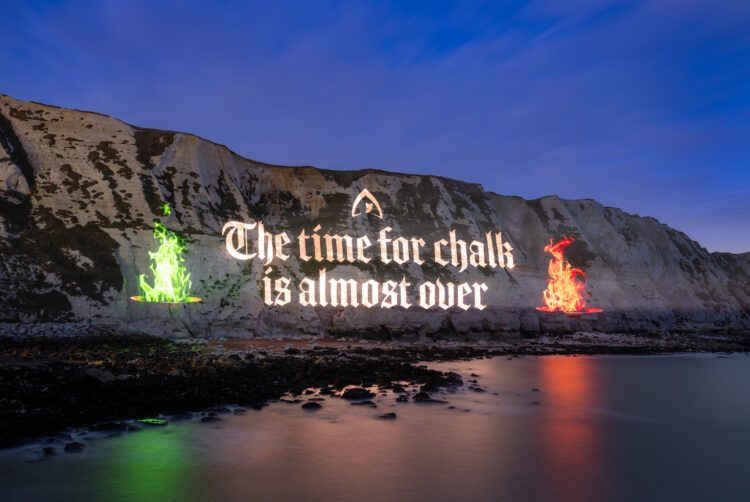
Like when the BBC marked the Celebrity Traitors final by projecting “The time for chalk is over” onto the White Cliffs of Dover (pictured) – a perfectly timed, one-off moment that built buzz and anticipation ahead of a major cultural TV event.
Or when Walkers relaunched its Worcester Sauce flavour and defied convention by deliberately limiting availability and focusing all marketing activity in Worcester itself. The campaign created intense local buzz through stunts and OOH domination through standout moments like floating a giant inflatable packet of Walkers’ Worcester Sauce crisps down the River Severn.
Beyond visibility, OOH also plays a cultural role, positioned in shared public spaces; standout campaigns can spark conversation and extend beyond their physical location through social sharing and earned media. In this sense, OOH doesn’t just deliver impressions; it creates moments that resonate and travel, amplifying their own impact.
Proven effectiveness and the multiplier effect
One of the most significant shifts in OOH’s perception is its growing reputation for effectiveness. Historically questioned for its measurability, the channel is now supported by robust data, attribution models, and analytics.
Advertisers can increasingly track OOH’s contribution across the full funnel, from driving awareness and consideration to influencing behaviours such as store visits, online searches, and conversions. This has helped reposition OOH as a brand-building tool and a performance driver.
TV and OOH work in tandem; one builds broad attention, while the other reinforces and keeps the message top of mind. Seeing a campaign across multiple formats in different contexts makes it feel more familiar and memorable, as the brain naturally connects those touchpoints. This isn’t just theory; research shows that combining OOH with TV can boost real business outcomes, with IPA data indicating uplifts of around 17%.
Giffgaff saw an opportunity to amplify the impact of its TV advertising by pairing with a bold, sustainable OOH campaign in high-traffic locations like Waterloo Station. While TV built mass awareness, OOH added immediacy and relevance, reaching people in everyday moments. By measuring exposure against website visits, the brand showed how combining TV’s reach with OOH’s real-world presence can drive both attention and action, while staying true to its eco-conscious values.
When used alongside other channels, OOH acts as a multiplier within the wider media mix, reinforcing messaging and enhancing overall campaign performance. By maintaining a visible, real-world presence, it adds credibility and salience to digital and broadcast activity, improving recall and engagement.
A modern, integrated medium
OOH today is far more than a traditional channel; it’s a modern, integrated platform that combines scale with precision, creativity with impact, and visibility with accountability.
For clients, the value is clear: OOH delivers the reach required to build brands, the targeting needed to stay relevant, and the creative potential to stand out. At the same time, it provides the measurement and integration capabilities essential for demonstrating results.
As marketing continues to evolve, success will depend on channels that can balance these demands. OOH not only meets them, but it also brings them together, making it an essential part of the modern media mix.
 Luke Willbourn is the MD of Talon