



The perfect partner for investigative journalism and the nodding Beeb
Opinion
While the BBC’s political editor nodded along to Farage’s claims of a “complainant society”, Channel 4 was preparing to break the exclusive of the year. Ray Snoddy assesses how it all unfolded.
It was, of course, a coincidence of timing, determined by the date of Reform UK’s annual conference in Birmingham.
Naturally, all serious broadcasters had done some preparatory work to key up the conference, which opened with a day when Reform tried to sell its political wares to the British business community.
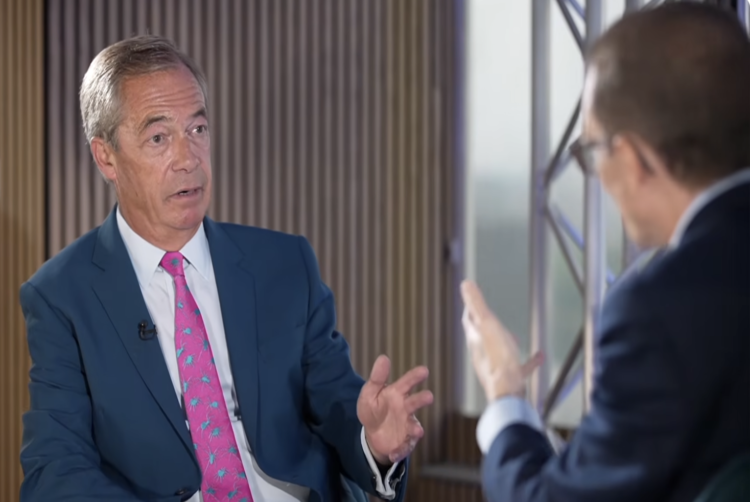
First up was an interview with Reform leader and former party owner Nigel Farage by the BBC’s political editor, Chris Mason.
Even without the benefit of hindsight-what Channel 4 News was about to produce soon after – the interview seemed soft, weak, and offered a relatively unchallenged platform for the increasingly embattled Farage.
The £5m gift to Farage from the Thai-based billionaire Christopher Harborne was raised, as it should have been.
But the Reform leader claimed the money was for his personal security. On other occasions, Farage has said the money was either “an unconditional gift” or a reward for his contribution to ensuring Brexit’s success.
Other journalists have established that none of the money has been spent, let alone on security.
The Farage statement went unchallenged.
The Reform leader, in an obvious retort to the multiple investigations he is now facing, was allowed to claim that we are now living in “a complainant society”.
Farage burbled on without challenge or contradiction, saying: “If you complain about me, automatically that triggers an investigation.”
The Farage exclusive continued with his claim that “the old two-party system, which has dominated frankly since the end of the First World War, feels for the first time that it faces an existential threat.”
Up to a point, but Reform’s role in such a threatened political disruption is developing a bit of a soggy bottom, to use Bake Off terminology, with a drop in the polls and a weekly loss of local councillors through arrest, defection and resignation.
Did Mason raise an eyebrow at any of this?
Not only did the BBC’s political editor fail to raise an eyebrow, but as the former BBC reporter and producer Patrick Howse pointed out, Mason also nodded throughout.
Howse explained in Byline Times that nodding interviewers is mainly a device to put nervous, shy or traumatised interviewees at ease.
“It is not usual while interviewing prominent politicians,” noted Howse who was a BBC journalist for 24 years.
Howse was not the only critic of Mason’s approach.
Annette Dittert, the London correspondent of ARD, the German broadcaster, argued: “This is not journalism. It’s letting Farage shine. I genuinely do not understand why the BBC does not seem to be able to competently challenge Reform and Farage.”
Dittert is not the only person, in the media and elsewhere, who finds themselves unable to explain such a fundamental phenomenon.
Unfortunately for the BBC, its wobbly-kneed scene-setter for the Reform conference was blown out of the water less than an hour later by the Channel 4 News collaboration with the Verbatim team of investigative journalists.
To get the full impact, you had to watch it live as it aired and wonder what the Reform top brass thought privately as the allegations spread.
As we now know, undercover filming exposed a willingness by senior Reform executives to break, or at least subvert, electoral law and this time it was Farage himself doing the nodding.
For Farage and his fans in the conference hall it was all only “a little local difficulty” and those involved, James Orr, the party’s head of policy and Dan Dukes, a close aide to the great leader, mere “contractors” who could be thrown to the wolves in one form or another.
For everyone else, it was one of the year’s most significant exclusives, and it will continue to have equally significant political and legal consequences.
Channel 4 was the perfect partner
While Channel 4 is understandably basking in the warm glow, it wasn’t its journalism, and such a long-term, hazardous project might have been beyond its resources.
But Channel 4 News checked and cleared everything and, above all else, had the balls to broadcast the story.
Would the current BBC coverage have gone ahead if it had been approached with such a story?
Unlikely, or at the very least it could have been bogged down in a bureaucracy unwilling to say yes or no.
In this case, Verbatim probably chose Channel 4 News as a partner because of the channel’s reputation for taking on risky, edgy journalism.
It is equally true that if Verbatim had just pumped out its work without a broadcast partner, it would have had a lot less impact, maybe hardly any impact at all.
Such collaborations, between pro bono organisations funded essentially by philanthropy and mainstream media organisations, could be an increasingly important strand in the future of investigative journalism.
Undercover reporting using secret filming can be problematic and often comes with allegations of “entrapment.”
Such complaints are hardly relevant here. This was a clear case of the public interest being served using secret filming to get a story that could not have been obtained any other way.
The Reform executives seemed very happy to get their hands on the money and equally enthusiastic about devising ways to circumvent the rules.
How did the rest of the media – and the national press in particular- handle such an explosive story?
Pretty mixed, given it broke at 7 PM.
For the Daily Mail, there was a small story at the bottom of page seven about the allegation of planning “a potentially illegal donation”, dwarfed by reports of Reform’s plans to “block immigrants, slash benefits and cut taxes”.
The following day, the paper was full of Farage pledges to cut billions in tax, while quoting the Reform leader as saying the whole thing was part of a “highly co-ordinated” campaign by the Establishment to damage the party.
The Times did better on the Friday morning with a factual page lead on the Channel 4 story.
Did the wrong-footed BBC catch up?
Alas no. The BBC allowed Nigel Farage to make the implausible claim, without noticeable challenge, that he “frankly wasn’t listening” during a conversation on what appeared to be a scheme to funnel £500,000 in foreign money to Reform UK.
Even yesterday, the former culture secretary Nadine Dorries, straight from a car crash interview with Channel 4 News at the weekend, was given acres of airtime on BBC Radio 4’s Woman’s Hour to defend Farage.
The Reform supporter, who tried to privatise Channel 4, stuck to her line, without providing any evidence, that the secret filming had somehow been doctored in the way Panorama and Trump had been edited.
Imagine where we’d be without Channel 4 News.
 Raymond Snoddy is a media consultant, national newspaper columnist and former presenter of NewsWatch on BBC News. He writes for The Media Leader on Wednesdays — bookmark his column here.