



What brands can learn from a creator’s meteoric rise to fame
Opinion | Future of Brands: Creator Economy Week in Focus
How does a creator go from nano to macro in only a few months? The answer has less to do with luck than most brands would think, writes Nutcake’s CEO.
How does a creator go from nano in August to macro in only a few months? That’s the question we set out to answer with @RobdoingRob, a creator who saw massive growth in 2025, and the answer has less to do with luck than most brands would think.
Creator marketing is having a big year, with creator revenue expected to surpass £1bn for the first time in 2026. Brands are investing heavily in the space, and creators and brands alike are competing for the same space on people’s feeds. But all that investment raises a simple question: what actually makes content grow?
Rob started out as the Terracedgarden and spent two and a half years posting, about ten times a week, before he saw any real growth. Then, in autumn 2025, he branched out beyond gardening, and within months he’d amassed more than a million followers across his channels.
We ran 1,063 of Rob’s Instagram videos through our Nutcake Blueprint model. Because Rob is authenticated on the platform, we had his full performance data, including skip rate, watch time and completion rates. We then enriched every video across 105 measures, from words per minute and edits per minute to tone, hooks and how each video ended.
The model produced a formula that is as simple as it is fascinating: reach is proportional to completion rate to the power of 1.9, multiplied by watch time to the power of 0.5.
Watch time was the biggest overall driver of Rob’s reach, but its effect doesn’t compound as it increases. Completion rate is harder to achieve, but carries far more weight. One caveat: the formula only holds for videos over around 45 seconds. Below that, the algorithm doesn’t weight completion in the same way.
Five changes, one compounding effect
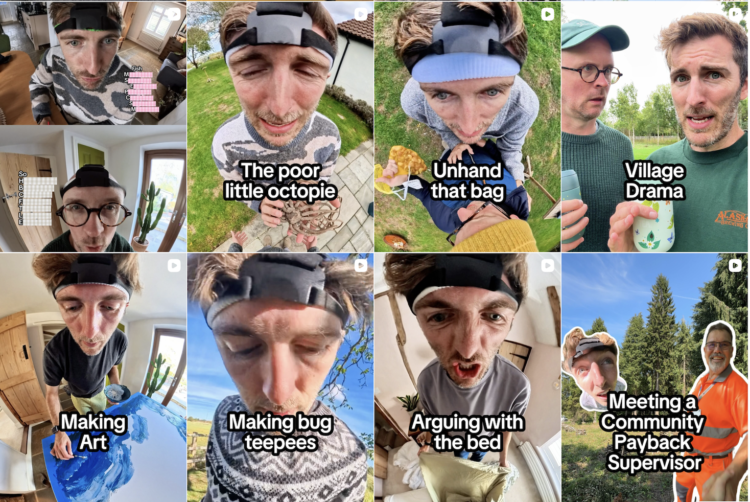
Five elements changed in Rob’s content over 2025. The first was a fisheye 360 camera on a head strap. Originally bought to film his flowers, it let him tell stories hands-free while he worked, and his audience loved how comical it made him look. Effect on watch time: +45%.
The second was stakes. Rob was already a master of hooks, routinely holding 60% or more of viewers past three seconds. But opening with tension, such as “OMG Ant is going to kill me”, or a deadline, gave people a reason to watch to the end. Stakes-first hooks reached 66.9% on three-second retention and lifted watch time by 16%.
The third was length. Rob increased his video duration 5.7 times. Short videos cap the total watch time you can earn, so creators who hold attention are handsomely rewarded for going past a minute. Effect on watch time: 4x.
The fourth was his partner, Ant. As Rob featured more of his home life, viewers became interested in Rob as a character, not just his gardening. Ant added 35% to watch time, the biggest boost of anyone, though his mum (+20%) and even his dog (+17%) helped too.
The fifth was editing craft: snap starts, spoken rather than on-screen hooks, abrupt or unresolved endings, and a chaotic, high-energy style. Together, they added 31%.
Each is a solid gain on its own, but applied together, in every video, they drove exponential growth in reach.
What can brands learn from this?
Brands and creators play by the same rules on a feed where everyone is competing for the same space. My recommendations include:
1: Make videos people want to watch.
Likes, comments, shares and saves don’t drive reach; they reflect it. Get the watch time right and every other metric falls into place.
2: Let videos fail.
Rob posted for two and a half years before he grew. Every video teaches you something, and the learning never stops, even as you grow.
3: Tailor every brief.
What works for Rob is personal to Rob. Handing creators your rules and treating them as gospel literally never works; instead, consider what would work for each individual creator when you brief them.
4: Build your own playbook from data.
Every brand has its own playbook outlining what works for them, just as Rob does. Once you know yours, write it down, then apply every element every time. It gives you a clear way to judge how well optimised each video is before it goes out.
So, what took Rob from nano to macro? A simple formula, where completion rate and watch time decide reach, and five changes that fed it: a fisheye camera, stakes-first hooks, longer videos, featuring Ant, and sharper editing. None of them worked as hard alone as they did together.
For brands, the lesson is the same. Make videos people want to watch, learn from every post, brief each creator on their own terms, and build a data-led playbook that lets the effects compound. With the right data, any brand can find theirs.
Rob’s growth didn’t come from one trick. It came from knowing exactly what worked for him and doing it every time. That’s a playbook any brand can build.
 Tim Mitchell is the CEO at Nutcake