



What CEPs can teach us about OOH
Opinion
Tessa LeGassick argues that OOH has a bigger role to play in Category Entry Point planning, helping brands move beyond reach to show up in real-world moments that drive category demand.
We know OOH remains one of the most visible forms of advertising in people’s everyday lives. The latest IPA Making Sense 8 report reinforces the point, showing that OOH remains the only medium consistently achieving more than 90% weekly reach. More interesting is what happens next.
According to the YouGov research, 21% of Britons have researched a product or service on their mobile after seeing an OOH ad, while 16% have gone on to make a purchase and 15% have visited a store. However, OOH has been a little off-radar for Category Entry Points (CEPs) despite its unique role.
Category Entry Points help brands understand the cues, situations and occasions most likely to trigger category demand. CEP-led planning allows us to understand and prioritise the triggers where a brand needs to build stronger associations.
OOH is useful in that context because it excels at connecting brands to real-world CEPs rooted in moments, routines and situations.
According to Byron Sharp and the Ehrenberg-Bass Institute, brands grow by increasing both mental and physical availability. OOH sits at the intersection of the two. It builds memory structures and salience at scale while simultaneously reaching people in environments where purchasing opportunities exist.
Many CEPs are inherently tied to real-world situations. Someone might think about buying a National Lottery ticket when they visit a supermarket, or they might consider ordering food on the journey home from work. These are the situations where category demand is more likely to emerge; they happen week in and week out. And OOH has always been good at helping brands show up within them.
Dynamic Creative Optimisation offers the opportunity to build effectiveness even further by tailoring the creative to the specific CEPs: one message for the Friday commute, another for the Saturday morning shop, but Talon research suggests fewer than 1% of digital OOH campaigns currently use it.
Relevance drives stronger outcomes, with contextually relevant messaging delivering a 17% uplift compared to using a generic campaign message.
When we serve the right message at the right moment, the impact is even greater, increasing brain response by 32%, according to JCDecaux’s Moments of Truth research.
What does CEP-led OOH planning look like in practice?
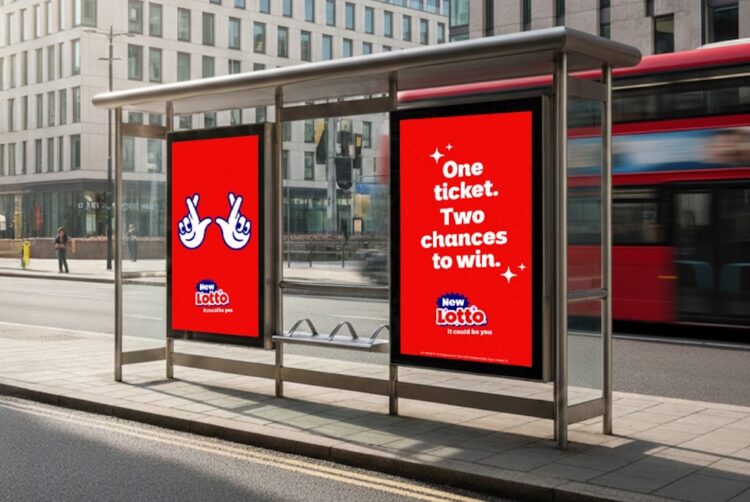
Our recent work with Bauer Media and Allwyn for The National Lottery is a great example of what OOH can do when it’s planned around CEPs.
The challenge was to rebuild associations with the live Saturday Lotto draw, particularly among younger adults and occasional players. Rather than starting with channels, we began by understanding the moments that drive play.
We identified 11 CEPs linked to Lotto, including cues such as “when I go to a convenience store” and “I have a set day to play”.
Working with Bauer, we mapped those CEPs across its media estate to understand where each moment could be activated most effectively. Radio, digital audio, publishing and OOH worked together as a connected system built around specific behavioural triggers rather than individual channels.
OOH played a particularly important role because it combined scale with situational relevance. Through the week, it kept Lotto visible while reinforcing the routines most closely associated with play.
Investment intensified on Saturdays, the category’s most important sales day, culminating in digital OOH takeovers and roadblocks between 5 pm and 6 pm – the hour before the cut-off to buy tickets for that evening’s Lotto draw.
In this way, OOH created cohesion across the week, built momentum towards peak moments and ensured the Lotto brand was visible right when it needed to be. We developed all creative work CEP first to maximise contextual relevance.
The campaign strengthened Lotto’s association with key CEPs, while the exposed audience significantly outperformed the control group across key measures, including awareness, familiarity, favourability, likeability, and consideration.
Moreover, 55% of respondents said the campaign would make them more likely to play Lotto. Among adults who had never played, consideration rose by 20.5 percentage points. Meaning, more people played Lotto more regularly, and the Saturday night ritual was reinstated.
OOH has always been good at reaching people at scale, but CEPs remind us that scale is only part of the story. Growth comes from being present in the situations that trigger category demand, and OOH is brilliantly placed to connect brands with those real-world moments.
The planning opportunity is simple: stop thinking about OOH as just a reach channel and start thinking about it as a way to make CEPs visible where and when they matter most.
 Tessa LeGassick is chief planning officer at Hearts United.