



What I’d tell any brand briefing OOH for the first time
Week in focus: The Future of OOH
For OOH, you’re not designing for attention you can hold; you’re designing for attention you have to earn instantly, writes Evolve’s MD.
OOH is a behavioural channel that lives in the real world, and the context of the placement changes everything, but a lot of first-time briefs still start with formats – we’ll take some 6 sheets, a couple of digital screens. It’s understandable, but it’s the wrong way round; a brand’s starting thought should be: what’s the audience actually doing when they see us?
We’ve had clients entering into OOH who wanted to lift their Instagram creative straight onto roadside sites. It worked brilliantly on a phone: lots of detail, multiple messages, things to explore, but on a busy road, it just didn’t land. Drivers have, what, three seconds at 30mph? No one’s decoding layered messaging in that time – it just disappears. For OOH, you’re not designing for attention you can hold; you’re designing for attention you have to earn instantly.
What to measure first
OOH is no longer a choice between brand building and performance; it can now do both. With better data, programmatic delivery and real-time triggers, the channel can be more responsive, more measurable and more closely tied to outcomes than ever before. But that doesn’t mean it should be treated like a pure performance channel.
At its core, OOH has always been brilliant at building brands, creating memory, emotional connection and mental availability at scale. It works by shaping how people feel and what they remember, so that when a buying moment comes around, your brand is already front of mind. That effect builds gradually rather than showing up overnight, which is why how you measure it early on requires a slightly different mindset.
So rather than rushing to prove short-term ROI, it’s more useful to start with the basics. Are you reaching the right people in the right places? Are you showing up consistently in moments that matter? Is your creative actually landing and being remembered? These are the early signals that tell you whether your campaign is doing its job.
What’s exciting is that, as OOH has evolved, you can layer in more responsive signals over time.
With programmatic and richer data, you can begin to look at things like location-based uplift and contextual engagement as the campaign builds. We’ve seen plenty of brands get nervous when those immediate metrics don’t show up, only to realise later that the impact is coming through more strongly elsewhere, in brand recall, consideration and improved performance across other channels.
If you jump too quickly to direct response, you risk stripping out the very things that make OOH powerful: its scale, its creativity and its presence in the real world.
Start with whether it’s being seen, remembered and felt; the results tend to follow, often in ways that last far longer than a single click.
Brief for location, not layout
A lot of OOH briefs still feel like print briefs; they’re full of specs, dimensions, logo sizes, copy lines, but the best OOH starts with place. Where is this going? What’s happening there? What kind of headspace are people in?
A packed rail station at 8:30 am feels completely different to a quiet residential street on a Saturday afternoon. One is rushed, distracted, slightly stressed; the other is slower, more local, more relaxed; the same creative won’t behave the same way in both.
The campaigns that really work tend to feel like they belong in that environment, rather than just being dropped into it. When that happens, people notice, not because you’ve interrupted them, but because you’ve met them where they are.
Place isn’t just where the ad sits; for real success, it should be part of the original idea. Like with Borderlands 4’s relaunch, which became a full-scale European takeover, transforming major cities into immersive extensions of the game world.
From London’s Vault-themed Waterloo hub to Berlin’s anamorphic projections and Paris’s city-wide transit domination, the campaign used bold, high-impact OOH to turn everyday urban spaces into something unexpected, disruptive, and unmistakably Borderlands.
Bravery matters more than budget
There’s also this lingering belief that great OOH is all about scale, big budgets and domination. And yes, scale helps and yes budget helps, but it’s not what makes something work.
The most effective OOH is brave, whether that’s bravely very simple, a single line, a clean visual, or a brave and bold creative or location, but it’s always something you understand in a split second and remember afterwards.
We’ve worked on both ends, big campaigns with bigger brands who were just stepping into OOH, and smaller ones that punched above their weight because they were so clear and confident.
OOH doesn’t reward trying to say everything; it rewards saying the right thing at the right time.
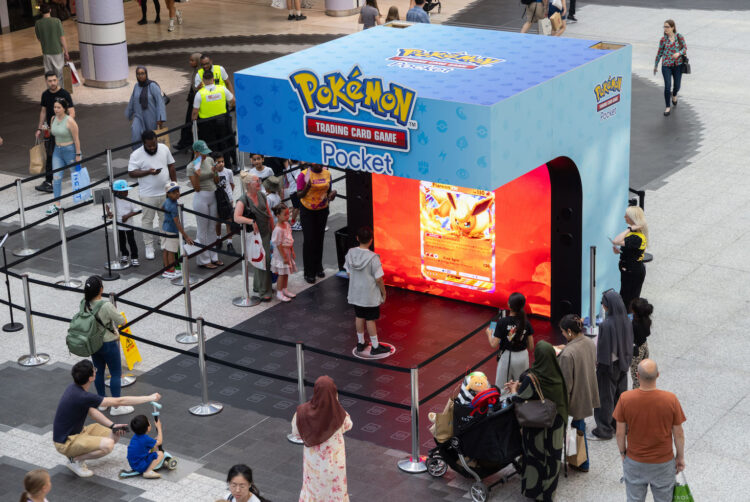
Pokémon brought the digital world of Pokémon Pocket to life through an immersive, multi-sensory OOH activation across major shopping destinations. Visitors interacted with a giant deck of Pokémon cards, swiping to reveal characters with different elemental powers that triggered corresponding real-world sensory effects including wind, water, heat and scent. Strategically placed in high-footfall malls that over-index on family audiences. The campaign successfully transformed gameplay into a memorable physical experience.
But not all OOH has to be bold; it can be impactful and timely like IFS’s recent activation at a busy conference, gaining cut-through and memorability with two delivery robots, 300 cold brews, and a crowd of curious attendees. From serving custom cold brew cans to driving QR scans and conversations, the activation helped turn foot traffic into meaningful engagement with business decision-makers just outside of their event.
OOH plays by different rules, and that’s the point. It shows up in real environments, in real moments, reaching all mankind. Don’t treat it like a bigger version of something else; don’t rush to judge it on the wrong metrics; start with location and, maybe most importantly, be bold enough to be brave.

Danielle Austin is the MD of Evolve