



Why are The Times and Sky News reporting on scam ads while carrying them?

Opinion
Journalists report on scam advertising, yet their employers still run many of the fake adverts they warn against. What can be done?
The Times and Sky are two respected media brands with a high degree of integrity and a reputation for a rigorous approach to the truth. I turn to them every day and spend a lot of money with both.
As someone involved in advertising, I have read with interest the exposés of scam advertising in The Times, The Sunday Times and Sky News, highlighting the harm they cause to the public, sometimes financial, sometimes worse.
So, you wouldn’t expect them to carry advertising for scams and misleading products that perpetuate those harms to their audiences, would you?
But they do, and they don’t even seem to know it. Or maybe they just don’t care because they want the revenue, and no one holds them accountable for their role in propagating sharp practices and fraud; it’s hard to tell.
Maybe they simply can’t manage what gets shown on their properties and the damage it does to their brands, because scammers know how to game the system and media owners can’t stop them.
Let’s take The Times first. You may recognise the tell-tale sign from this ad that appeared on 22 September.
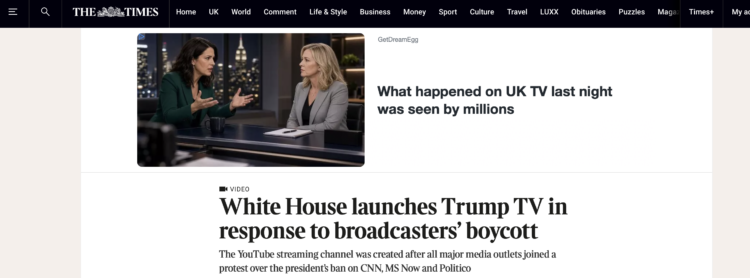
Do you recognise the people in the ad? No, because they don’t exist. They did not appear on ‘UK TV’ last night, or any other night, and weren’t seen by “millions”.
If you are gullible enough to be lured into clicking on this ad in The Times, you get this fake Guardian article. Of course you do.
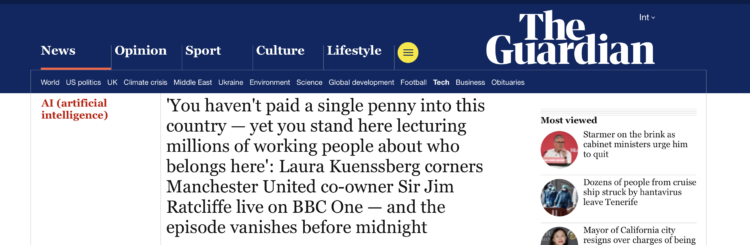
This bogus Guardian article features an equally fictitious BBC TV programme; no Laura Kuenssberg, no such interview, no ‘disappearing episode’.
If you’re still naive enough to think this is a genuine article, you may cotton on when it inevitably becomes a crypto scam ad masquerading as genuine. Or you may get caught if you’re vulnerable, as the most vulnerable do.
Why is The Times allowing one of its advertisers to promote a dodgy product that could cost readers their life savings, using practices it calls out in its own titles?
And why is it allowing scam advertisers to hijack The Times‘ reputation and respectability, while spoofing The Guardian and the BBC to con its readers?
Crypto scams are well-known and easy to spot (except for the media that carry them), but people still fall for them, especially if they see ads in The Times rather than on social media.
Mainstream media has a kind of believability; surely they’re too responsible to run this kind of con, aren’t they?
Now let’s see what The Times has said about such ads. In May this year it published an in-depth report into the vast problem of online scams, and specifically financial cons. It even launched its own reader guide to help avoid such problems.
The Sunday Times has weighed in, too, with similar coverage. This isn’t the first time, of course, with plenty of other examples in prior years, including this report regarding scam advertising on Meta (among others) posted by The Times and The Sunday Times on….Facebook.
You may notice that their coverage is almost completely obsessed with the problems of scam advertising on social platforms. They haven’t ‘outed’ themselves yet.
These crypto scams are pure fraud, but sometimes the shoddy products exist, and the crooks behind them use respectable media properties to fool their audience.
Over on the Sky News app in the ‘content recommendation’ sludge at the bottom, we can get suckered literally every day into clicking through to an ad like this for a serious medical problem that is a source of considerable angst for men.

You will be amazed to hear that this is not a real Daily Mail article, ‘Sarah Mitchell’ doesn’t exist, there is no such British urologist, there was no such episode of Dragons’ Den, and the product being flogged, called Drivenol, is not “made in Britain”, is not “approved by medical professionals” and it has not been “tested on 1,200 men”.
Drivenol is not a medicine, but is one of 33 ‘brands’ recently registered by one ‘Henrieta Davidova’ from Merthyr Tydfil who has no professional history nor medical qualification, while the trademark for the product in the ad was registered as a simple food supplement just before the ad appeared, as they all are.
Despite the white coat in the Den, Drivenol can be bought on eBay. The Drivenol website even says this:
“The statements on this website have not been scientifically proven or evaluated by healthcare professionals.”
You may not be surprised to find out that a similar product called Mendorex was also advertised using the same fake urologist in an identical fake Daily Mail feature.
Mendorex can be bought on eBay for £9.99, but if you go via the Sky News links, you pay £39.90, definitely a ‘white coat’ price.
These products are seemingly controlled by a company called Haur BV in the Netherlands, and this entity seems to be ultimately owned by a single shareholder in Lithuania.
Investigations have uncovered these advertising techniques in about 29 countries, so the takings can be vast, even if each ad generates only a trickle of demand. Now you know why there are so many of them.
Drivenol and Mendorex (and others) are being passed off as pharmaceutical products at drug prices on the Sky News app with pirated media content.
The consumer feedback on Trustpilot for some of these products tells the familiar tale of people being charged more than agreed, difficulty cancelling and disappointing effects.
Which? magazine has been following these stories for some time, but, like other industry commentators, they treat these schemes as mostly prevalent on social media and don’t question how any media channels get paid for duping the public.
There has been a lot of flak directed at Meta following the Reuters report that some 10% of its global ad revenue may come from fraudulent ads, but these ads are everywhere and are especially pernicious when they disguise themselves behind respectable media brands, i.e., not Meta.
No one seems to hold the media owners accountable, even though they clearly play a central role in duping their audiences. In the self-regulated advertising industry, ‘Know Your Client’ doesn’t apply, and The Times and Sky News don’t have the governance apparatus or voluntary codes to hold themselves responsible.
Ofcom has proposed 40 anti-fraud measures
In July this year, Ofcom introduced new rules to clamp down on scams on the tech platforms, but the reaction from the scammers seems to be to move their criminal activities into mainstream media, using the usual ad tech apparatus and the ‘content recommendation’ engines, riding in the slipstream of the titles’ credibility.
Incidentally, I alerted Sky to the ads that have slipped through the net, and it said it would ask Outbrain to remove them, but it is clear that its systems are hardly foolproof if it takes one individual to point this out.
So, I ask again, with Ofcom on the case, why are The Times and Sky continuing to carry grossly misleading ads that use fake content to sell dodgy goods that overcharge and deceive the public?
After all, both have subscription revenues and don’t rely on advertising, so it can’t be the click-through revenue share, can it?
The answer is that they don’t seem to know what they’re carrying, no one is checking, and presumably this is because of the revenue consequences of finding out or their inability to read their own properties and use the right technology.
The Times seems to run anything through its programmatic booking systems, regardless of content, judging by what it carries.
A recent ad served up to me for ‘lace thong style period pants’ gets targeting wrong on multiple dimensions and isn’t a scam, but is a bemusing example among many of just how far advertising on their mainstream titles is out of control.
Sky News fills its ‘chum bucket’ through Outbrain. Its terms and conditions supposedly prohibit the kind of misleading advertising that we see daily, but Sky and Outbrain don’t seem to have noticed that people using their booking engine are routinely flouting their terms in numerous ways or, God forbid, both have turned a blind eye.
Outbrain supposedly uses automated fraud detection to ban ‘cloaking’ and ‘polymorphic’ ad units that evade the filtering process, redirecting the user away from approved copy into the scam ads, which is pure deception and where Outbrain is also the one being conned.
However, when Outbrain floated in the US, its SEC filings quoted its relationships with Sky News and Sky Sports as iconic examples of its ‘premium’ media content partners, the kind of credential investors like.
Similarly, when Outbrain bought the video platform Teads for $1bn, its regulatory filings again trumpeted its partnership with Sky, giving it access to its ‘premium inventory’, along with claims about the robustness of its vetting processes for misleading ads.
The content platform owners who float or acquire are exploiting the reputation of brands like Sky on the potentially misleading basis that Outbrain rigorously adheres to its self-policed filtering processes, and doesn’t let the scammers get away with murder. Investors remain uninformed.
Note that the crud that the ‘content recommendation’ engines place at the bottom of the ‘premium’ content is not itself premium, to say the least, but supposedly leeches off the good material it attaches itself to. It just feels so… unacceptable.
When Taboola, the other ‘content recommendation’ engine giant, recently announced its £27m acquisition of Dianomi, a UK business, it was stated that one of its publisher clients is The Times, so we have to hope that Dianomi’s filtering processes are better than the systems The Times currently use.
Clearly Sky isn’t holding Outbrain to account; maybe the revenue comes in handy, may even be underwritten, so no one bothers to check what the public sees. It’s ‘set and forget’, except that scammers look for such vulnerabilities.
Why does any of this matter, other than that the public is being conned?
It should matter to respectable media owners and the wider advertising industry.
Unscrupulous advertisers using The Times, Sky News, The Daily Mail, fake BBC interviews, and fictional episodes of Dragon’s Den are co-opting mainstream media credibility to lend spurious legitimacy to their criminal or shoddy products.
The Times and Sky pocket the cash and leave their audience to pick up the tab, inadvertently or not. Of course it’s difficult to police millions of ads, but the conflict of interests is obvious, and they don’t seem to mind that their media brands are being hijacked in this way.
Perhaps more pertinently, the respectable advertising industry should be raising a bigger outcry over how such deceptive and fraudulent advertising is poisoning not just the internet, but the public’s trust in advertising.
The public is used to the Wild West of social platforms and the daily deluge of dubious ads, but the fact that they are more likely to trust reputable brands such as The Times and Sky News is exactly what the scammers are exploiting.
When that trust breaks down, media brands suffer, and so does the business of advertising itself in the public’s eyes. Everyone sinks together.
So what are industry bodies and law enforcement doing to prevent the public from being conned?
The Advertising Standards Authority covers online advertising, as it routinely reminds us.
However, it has no jurisdiction over scam advertising in any medium and is there to prevent legitimate advertisers from over-claiming and misleading material. It has a Scam Ad Alert reporting tool that lets the public alert the media that carry such ads, but nothing more.
It is hard to expect the public to police advertising, especially when they are inundated with a tsunami of false, misleading, fraudulent and criminal advertising all day and every day in non-regulated media.
The scammers are rarely brought to book, and by the time any reprimands emerge, the con artists have done their job and moved on to the next scam, country, technique or other vulnerability, often medical or financial.
Think about those 33 product listings across 29 countries, multiplied by many other scammers.
Note that the word ‘online’ features heavily here, with a tendency to identify social platforms as the main culprits; they are, but the supposedly respectable media owners who carry scam advertising on their online properties, such as The Times and Sky News, should not be let off the hook.
It is hardly worth adding that AI makes all of this much worse, and we haven’t got going yet.
Strong media brands, especially those who value their reputation, can cut off these schemes and scams at the source by not hosting them via their ad tech systems or widgets, and AI should help them filter out the bad guys if they care enough.
They will forego some revenue, but their respectably curated properties won’t miss the toenail fungus, cremation plans in places where you don’t live, and Turkish dentistry ads, and that’s just some of the vaguely respectable ones.
As for law enforcement, is there anything useful to say?
The key is responsible selling, as Alessandro de Zanche has been saying for ever; the problem of ad bombardment has always been a supply issue, and so is misleading and fraudulent advertising. Responsible selling can prevent both, whether through self-regulation or otherwise. Regulation will increasingly be needed in a world where the cops will always be outrun by the robbers and have no true power.
Only media owners and vendors can stop this, including Outbrain, its peer group, and the ad tech providers in the middle of the online display supply chain. But no one wants to derail the gravy train, even if the public gets ripped off along the way.
Wishful thinking, maybe, but wouldn’t it be nice to see respectable media owners selling responsibly and protecting their audiences and brands by not carrying deception, especially when their fact-led colleagues are reporting on the very scams they’re propagating?
We can’t expect much from the big platform owners, and Meta in particular doesn’t seem too concerned about the damage it does to its audiences or brands, but we should hope The Times and Sky care more about the flagrant gulf between their words and their deeds.
 Nick Manning is the co-founder of Manning Gottlieb Media (now MG OMD) and was chief strategy officer at Ebiquity for over a decade. He now owns a mentoring business, Encyclomedia, which offers strategic advice to companies in the media and advertising industries, and is the non-executive chair of Media Marketing Compliance.