



Why measurable doesn’t always mean meaningful in marketing
Opinion
A well-executed OOH campaign increases search behaviour, improves engagement and drives more efficient conversions. Its impact is not always visible in isolation, but it is felt across the wider media mix, writes the UK MD of Bauer Media Outdoor.
Modern marketing has developed a bit of a bias: if something is easy to measure, we assume it must be working.
Marketers are under constant pressure to prove immediate impact, and digital channels, with their dashboards, clicks and conversions, make that feel straightforward. As a result, they’ve become the default centre of gravity for media investment.
But there’s a risk in that way of thinking. What’s easy to measure isn’t always what drives growth. That’s why we’re seeing growing interest in channels that operate beyond the click, like Out-of-Home (OOH), which not only captures attention but also harnesses it in the real world.
In a world of growing geopolitical and economic uncertainty, that bias toward the ‘measurable right now’ has only intensified. Yet, many brands are also starting to question whether highly optimised, performance-led strategies are delivering diminishing returns, and whether something is being missed.
The misconception of “digital-first”
Digital has transformed marketing for the better; there’s no question about that. It has brought some accountability, agility and precision. But somewhere along the way, “measurable” became shorthand for “meaningful”.
That shift has consequences.
It pushes strategies towards short-term outcomes because they are easier to track and report. Over time, that narrows the definition of success, rewarding what’s easy to attribute, not necessarily what’s driving growth.
Brand building doesn’t neatly fit on a dashboard, but that doesn’t make it optional.
If people don’t recognise your brand, trust it or think of it at the right moment, performance marketing has very little to work with. Yet channels that build that kind of mental availability (*cough* OOH *cough*) are often undervalued simply because they don’t produce instant, trackable results.
Why OOH continues to grow
In this context, OOH’s resilience is telling. Even in a challenging market, the channel has maintained steady growth, reflecting ongoing advertiser confidence.
That’s because in the face of uncertainty, brands don’t experiment; they back what they trust to deliver. And increasingly, that means channels that create real-world impact. OOH shows up in the everyday environments where decisions are made – during the commute, on the high street, in your local supermarket and nearby city centres.
Context also matters. A campaign seen during a commute or near a store feels more immediate and relevant than one encountered in a crowded social feed.
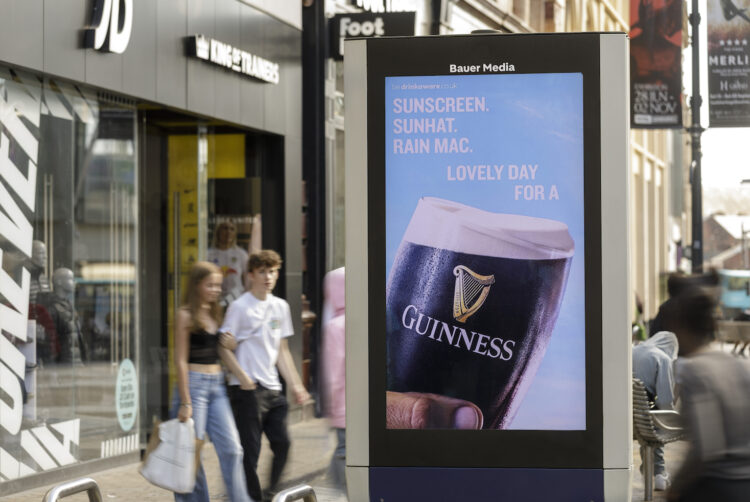
A strong example of this is Guinness. Rather than separating brand and performance, the brand used OOH to connect the two. Campaigns tapped into cultural moments and social conversations, then amplified them into the real world through OOH. Digital screens reacted dynamically to context, triggering messaging based on weather and key moments.
The impact was clear. Sales peaked around seasonal occasions, and the brand strengthened its position in on-trade environments where it already had a strong foothold. Crucially, this wasn’t just about short-term uplift. The campaign’s strength enabled Guinness to raise prices while still growing volume, ultimately becoming the number one on-trade beer in Great Britain.
The enduring power of real-world presence
OOH’s strength is simple: it shows up in the real world.
At a time when digital environments are crowded, easy to ignore and coming under increasing consumer scrutiny, physical presence matters more.
Messages encountered in physical environments often carry greater salience, precisely because they are less cluttered. OOH builds mental availability, ensuring that a brand comes to mind in buying situations, while reinforcing messaging seen elsewhere.
In this sense, it doesn’t compete with digital channels – it makes them work harder. A well-executed OOH campaign can increase search behaviour, improve engagement and drive more efficient conversions. Its impact is not always visible in isolation, but it is felt across the wider media mix.
Rethinking measurement
The challenge isn’t OOH’s effectiveness – it’s how we measure it.
Traditional attribution models, particularly last-click, were built for a digital ecosystem. They reward immediacy, not influence, which means they often undervalue channels that operate across the full funnel.
This is why there is growing interest in one way to consider your channel choices: Market Mix Modelling (MMM). Instead of focusing on individual touchpoints, when done right, MMM looks at how channels work together over time to drive outcomes such as sales, market share, and growth. Something the industry is looking at closely.
Viewed through that lens, OOH’s role becomes much clearer. It doesn’t just contribute, it amplifies. Building brand awareness and mental availability makes other channels more efficient and effective.
There’s a growing recognition that media effectiveness cannot be reduced to short-term metrics alone. Instead, it must be understood as the result of multiple channels working together over time.
A shift in mindset
OOH’s growth is a reminder that marketing isn’t just about what’s easy to measure – it’s about what actually works.
The brands that will win will be the ones investing in being seen, remembered and chosen in the real world.
OOH has always done that job. The difference now is that more marketers are recognising its value again.
 Richard Bon is the UK managing director and Europe commercial lead at Bauer Media Outdoor