



Why OOH needs accountability
Opinion
When OOH campaigns reach receptive audiences, run in attention-friendly environments, and are supported by transparent reporting, confidence will follow, writes Zoom Media’s MD.
Out-of-home (OOH) advertising has always had a strong presence. It has always been visible, physical, and woven into daily routines in a way few channels can match. From commuting corridors to leisure destinations, it reaches people as they live their lives, not as they scroll past content. That strength has not disappeared. What has changed is the level of scrutiny applied to every media decision.
Industry reports from 2026 already paint an interesting picture. According to Outsmart, UK OOH revenue reached record levels in 2025, hitting £1.44bn, up +2.6% year-on-year, with Digital Out of Home (DOOH) now accounting for 67% of that total.
Similarly, VIOOH’s state of the nation report predicts programmatic DOOH will become fully established over the next 18 months, with investment in the channel rising by 41%.
Pretty positive, right? Yet data from an IPA Bellwether report earlier this year points to a more cautious investment climate, with sentiment toward OOH cooling. That shift is often framed as a question of relevance. In reality, it is a question of accountability. When marketers struggle to show how spend translates into outcomes, even high-impact channels come under pressure.
We know OOH and DOOH work, but now the industry needs to equip planners with the tools to prove it.
When impact outpaces evidence
Marketers now operate in an environment shaped by dashboards, attribution models, and continuous optimisation. Digital channels have trained teams to expect clarity, often down to the impression. Against that backdrop, DOOH has historically relied on broader insight-led signals like estimated reach, footfall modelling, and post-campaign recall studies.
When marketing leaders are asked to defend spend in commercial terms, non-data-driven metrics can block the case for investment. DOOH can deliver attention and memorability, but that doesn’t always sit neatly on an ROI spreadsheet.
This is where frustration emerges. The channel performs well but can be hard to quantify. The result is a growing disconnect between lived effectiveness and reported accountability.
Environments where attention can be verified
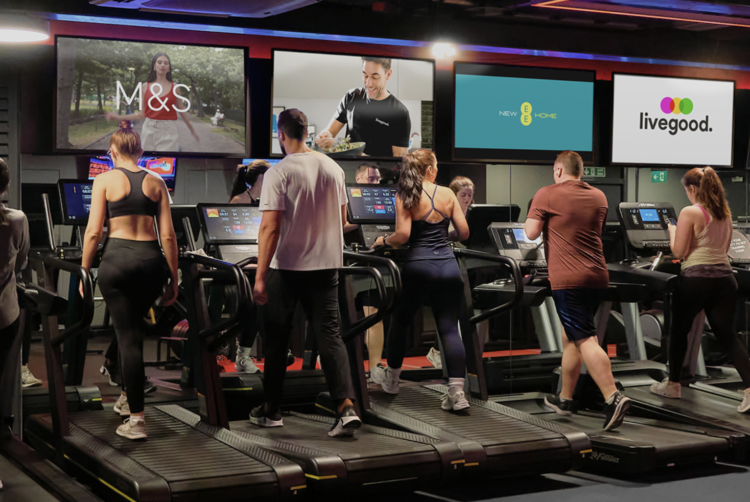
Progress is starting to come from a shift in where and how DOOH appears. As digital screens move deeper into controlled lifestyle environments, new measurement possibilities open up. In spaces where people actively choose to spend time – like fitness and lifestyle destinations or social venues – exposure behaves differently. Attention lasts longer. Distraction is reduced. Messaging competes with far fewer screens.
In these settings, measurement can move beyond approximation. First-party data lets you verify impressions rather than infer them. Audience profiles become clearer. Dwell times tend to be much longer, creating conditions where recall and message absorption significantly improve.
This matters because accountability is built on certainty. Verified delivery changes the conversation. It lets planners speak with confidence about who saw a message, for how long, and in what mindset. DOOH begins to align more closely with digital expectations, while retaining the contextual value that sets it apart.
Planning DOOH as part of the wider system
Measurement alone does not solve the problem. Planning practices also need to evolve. Too often, DOOH sits in a silo, assessed independently from the rest of the media mix. That makes its contribution harder to trace, especially when its role supports awareness, consideration, or brand salience.
More advanced approaches treat DOOH as part of a connected system. When audience definitions are consistent, exposure can complement other channels rather than compete with them. Frequency can be managed more effectively. Sequential messaging becomes possible. Over time, this creates clearer links between real-world presence and downstream performance.
Programmatic infrastructure is playing an increasing role here. Flexible buying and optimisation enable campaigns to respond to verified delivery rather than fixed assumptions. Reporting becomes less retrospective and more instructive. Planning improves because learning feeds directly back into decision-making.
Confidence grows when proof is built in
It is understandable that marketers react to uncertainty by reducing risk. Yet removing DOOH from plans overlooks what the channel still offers. Real-world reach still delivers scale that is difficult to replace. Presence in physical environments carries weight, particularly as digital attention fragments further.
The more productive response is to demand better evidence: stronger data strategies, clearer audience segmentation, and measurement frameworks that hold up under scrutiny. When campaigns reach receptive audiences, run in environments that encourage attention, and are supported by transparent reporting, confidence follows.
This is where perceptions begin to shift. DOOH moves from being defended on intuition to being justified through proof. It becomes easier to articulate its role as a measurable contributor rather than a discretionary add-on.
In a market defined by pressure and precision, DOOH does not need to be cut back. It needs clearer understanding. Accountability, applied properly, reveals the channel’s true value.
 David Wellard is the managing director of Zoom Media