



JICMAIL unveils ‘Super Touchpoints’ framework to help planners ‘build big from lots of littles’

JICMAIL, the not-for-profit industry body that measures direct mail, has released an analysis, in partnership with the Data and Marketing Association (DMA), that demonstrates the value of “Super Touchpoint planning”, a planning framework that aims to help media planners identify the “most valuable contact points” for their campaigns.
Super Touchpoint channels (and the touchpoints within those channels) are defined as providing both brand-building and response opportunities. They enable advertisers to “harness a unique audience insight, harness the power of creativity, create an emotional connection, deliver sensory marketing comms, leverage trust, deliver carefully synchronised comms, hyper-target or build scale, build full-funnel effects and deploy best practice measurement.”
Channels and platforms that are highly weighted toward Super Touchpoint strengths (evaluated using a STEP, or Super Touchpoint Evaluation Point, score) generally provide transparent measurement, strong creativity, data ethics, trust, attention, targeting accuracy, and cross-channel integration.
In aggregate, Super Touchpoint channels were found to outperform channel effectiveness averages by 25%, according to an analysis of the DMA’s Effectiveness Databank.
The report notes that “TV, direct mail, door drops, OOH and radio over-index for likelihood to contain Super Touchpoint strengths, and are arguably under-invested in versus channels where these strengths are less prevalent.”
This echoes similar findings to Peter Field, Lumen and Newsworks’ Attention study, released last autumn, which similarly found that high-attention media channels (defined as TV, cinema, radio, magazines and news brands) deliver significantly better business outcomes compared with low-attention ones (defined as OOH, social media and pure-play internet, excluding search and direct mail).
Tom Roach, VP of brand strategy and Brandtech Group agency Jellyfish, described these Super Touchpoint channels as providing “anchor” touchpoints — force multipliers that “significantly increase the effectiveness of the rest of a brand’s digital and broadcast media mix.”
As Roach described, the framework is “designed to help identify the high-performance media channels that deliver exceptionally high levels of consumer attention, engagement, trust and memory encoding.”
“Consumer attention is being atomised across more channels than ever before. Super Touchpoints is a powerful framework to help planners build big from these lots of littles,” he said. “There’s a danger of more clutter, more low attention, low value touchpoints. A danger that, if we’re not smart, all these littles don’t add up to something big.”
JICMAIL is also currently developing an AI-driven Super Touchpoints evaluation tool to help planners implement Super Touchpoint planning more easily.
Combining Super Touchpoint channels improves effectiveness
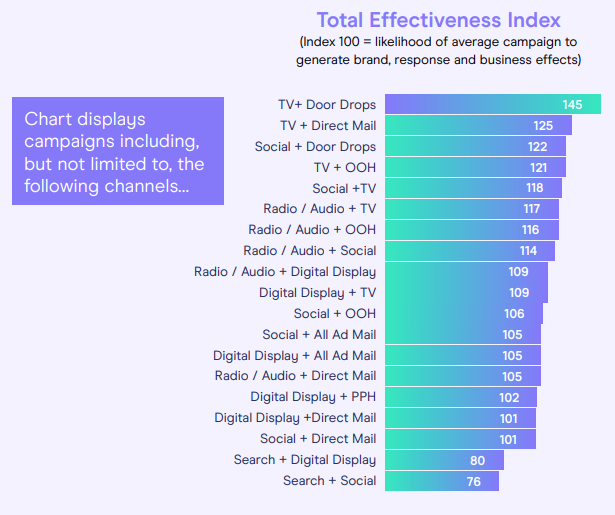
The report finds that multi-channel planning that includes at least one Super Touchpoint channel has a substantial impact on campaign effectiveness.
According to data from the DMA’s Effectiveness Databank, TV + door drop campaigns are 45% more effective than the average campaign, and TV + direct mail is 25% more effective.
Combining social media campaigns with door drops similarly increased effectiveness by 22% compared to the average.
In comparison, multi-channel campaigns that remained online only (e.g., search + social) underperformed.
The analysis notes that multi-channel combinations, inclusive of Super Touchpoint channels, provide both short-term response effects and long-term business effects.
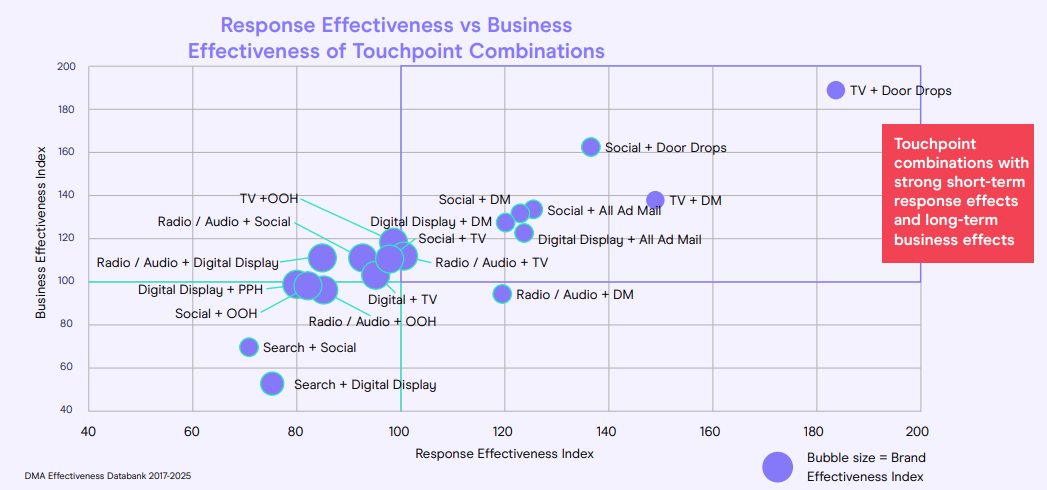
The report advocates for a multi-channel approach to planning that focuses on effectiveness rather than efficiency.
While the analysis of the DMA Effectiveness databank found that efficiency (calculated as return-on-investment) peaks at two channels for multi-channel campaigns, effectiveness peaks with 10 or more channels.
“ROI should be measured in an effort to spend hard-fought marketing budget as efficiently as possible,” the study reads. “It should not be used as a metric to optimise towards — to do so would be to limit the ability of marketers to unlock the larger number of effects recorded with broader channel usage, such as new customer acquisitions, sales, revenue, conversions and footfall.”
The argument dovetails with that made last year by Les Binet and Medialab chief data officer Will Davis, who warned that budget is eight times more important than ROI in driving effectiveness. Trying to do more with less, the duo said, risks doing less with less.