



Publishers welcome government walk back on opt-out copyright exception for AI companies
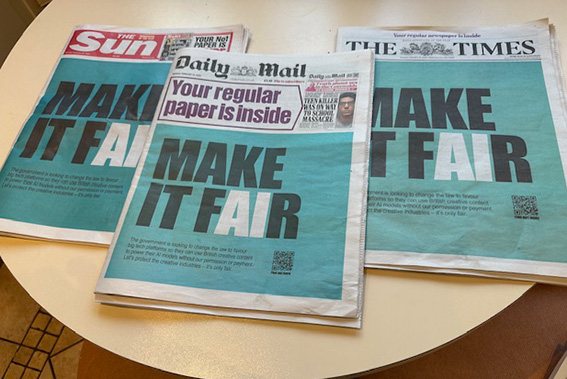
The Government has walked back a proposed policy that would have carved out an exception to existing copyright law to allow AI companies to train models on copyrighted works unless publishers explicitly opted out.
In a statement, Liz Kendall, secretary of state for science, innovation and technology, described the Government’s change of heart as a result of strong pushback from the creative industries.
“At the end of 2024, the Government published a consultation on copyright and AI. At that stage, the Government’s preferred way forward was to enable AI developers to train on copyright works, but to give rightsholders the ability to opt-out of this regime,” she wrote. “This was overwhelmingly rejected by the vast majority of the creative industries.
“We have listened. We have engaged extensively with creatives, AI firms, industry bodies, unions, academics and AI adopters, and that engagement has shaped our approach. This is why we can confirm today that the Government no longer has a preferred option.”
The Government’s concerns have been animated by conflicting economic priorities. Britain’s extant creative industries are highly valuable to the UK economy, and artists and publishers have warned that the business models supporting their work would be undermined by AI companies stealing IP to use for training models that ultimately can be used for products that directly compete with their output.
On the other hand, the Government has repeatedly identified AI as a potential drive of much-needed economic development.
In her statement, Kendall referred to the creative industries as “part of what makes us proud to be British” and one of the UK’s “greatest exports”.
The creative industry, she noted, contributes £146bn to the UK economy, supports 7% of all UK jobs, and is growing at 2.5x the rate of the rest of the economy.
Likewise, Kendall referred to the AI industry as “crucial to our future prosperity” and said it is growing 23x faster than the rest of the UK economy. “This technology is too important for the UK to be overly dependent on a small number of firms based in other countries,” she said. “The UK must be an AI maker, not an AI taker”.
Kendall added that it is Labour’s position that “people should be paid fairly for the work that they do” and that it “should not be that only the big and powerful can assert their rights.”
Clearer direction needed
The about-face was welcomed warmly by publishing industry bodies that have spent the past two years lobbying the Government against watering down copyright restrictions for AI companies, including via organisaing last February’s “Make it Fair” campaign and sending several open letters to the Government on behalf of prominent creative leaders.
“The Government’s latest update on AI and copyright is a positive indication that it is listening to the consistent feedback from across the sector, including the PPA and our members, and recognising the need to take a more balanced and considered approach to this issue,” said Sajeeda Merali, CEO of the Professional Publishers Association (PPA), the trade body for magazine publishing brands. “In particular, acknowledging that the consultation’s preferred option of an opt-out mechanism for text and data mining by LLMs was flawed, and taking that option off the table, would represent important progress for publishers and the trusted editorial brands our members represent.”
Owen Meredith, CEO of news media trade body the News Media Association (NMA), said the organisation was “pleased” the Government took its “unworkable” opt-out copyright exception off the table, in so doing “recognising that giving away our goldmine of creative content is not the way to drive UK growth.”
He continued: “By the same logic, the Government must now swiftly dismiss other exceptions that could be even more harmful, particularly an exception for ‘science and research’ or ‘commercial research.'”
Merali likewise stated the PPA is seeking “clearer direction in the near term” with regard to what will replace the Government’s original proposal. As government no longer “has a preferred option”, it is now unclear how it will ultimately work to manage the interests of both the creative and AI industries as they come into continued conflict.
For Meredith, Labour should move to support the creation of a “dynamic licensing market”, wherein publishers are solicited by AI companies to strike licensing deals for access to training data based on publisher IP.
He explained: “AI firms should now focus on meaningful engagement with news publishers to secure licenses to access their rich breadth of content, and the Government must make clear that this is what it expects. Scaling a dynamic licensing market will support the Government’s ambition for the UK to have the fastest AI adoption in the G7, with the presence of high-quality news content being crucial to building trust in AI models.”
Who will win the AI/publisher copyright fight? With PPA’s Sajeeda Merali
What’s next for Labour?
The creation of such a marketplace is on Labour’s agenda. Kendall said the Government is committed to establishing a Creative Content Exchange (CCE), which will be used as a trusted marketplace for “digitised cultural and creative assets”.
The Exchange will be supported by funding from UK Research and Innovation (UKRI), the national funding agency for science and research, and will be sponsored by the DCMS. A pilot phase has already launched to test the model.
Moving forward, Kendall said Labour is committed to “help[ing] creatives control how their work is used” while also using AI-driven innovation to “grow the economy and secure sovereign capability for the UK.”
In April, the Government is launching a Sovereign AI Unit, backed by £500m in public investment, to support the development of UK-based AI businesses. In addition, it is running an Advanced Market Commitment, pledging to procure up to £100m of new computing hardware produced by UK firms, and will invest £1bn into publicly-owned supercomputers for researchers to use for free for AI work.
Meanwhile, the Government is looking to launch a consultation on the creation of “digital replicas” — replicating someone’s likeness, often without their permission — and its impact on creatives.
It will also publish a review of mechanisms available for creators to control their works online and is establishing a taskforce to put forward proposals on best practice for labelling AI-generated content.
However, given the speed of AI development and its potentially “existential” impact on online publishers, quicker policy may be required to correct an unregulated market.