



How pay-TV operators own the discovery experience and customer
To remain relevant in an increasingly competitive TV universe, pay-TV operators must perform the same core functions that brought them their notable success as aggregators, but adjust the execution strategy.
The message from Connected TV World Summit last week was loud and clear. Pay-TV needs to own the customer experience for the bulk of its user base, but can compromise control to reach consumer groups it might otherwise miss.
Operators must be the primary source of content discovery and maintain the trust that comes from professionally curated catalogues and metadata. However, they will also have to embrace large language models (LLMs) to boost contextual understanding.
Pay-TV operators must continue to provide the best content under one roof, using hard bundles and their inherent discounts to incentivise consumer loyalty. But now they must aggregate apps and their individual content assets, where once it was linear channels and an in-house VOD (video on demand) store.
During a session focused on how operators improve content discovery and own the home screen, consultant Bernd Riefler, founder & CEO of Veed Analytics, noted that the battleground in a content-rich world is about how and where consumers access it.
“Content is king, but it is context that decides where someone watches it,” he declared.
Content discovery: driving playback
Content discovery was the first item on the agenda because, as Riefler observed: “Everyone earns money when a viewer hits the playback button.”
Sebastian Kramer, SVP business development – streaming TV solutions at Nagravision (which provides streaming backoffice, pay-TV OS/UX and content protection solutions), agreed that “while content is king, it is the context that decides who wears the crown.”
AI could significantly impact who understands context best.
Chris van der Linden, director of entertainment platforms at Liberty Global, explained how his company is harnessing the power of LLMs to improve search, with a feature introduced last summer called SuperSearch.
This debuted at Sunrise in Switzerland and has already led customers to search more often and watch more content presented in search results.
SuperSearch is designed to boost conversational content discovery, with users providing their search prompts through the remote control.
Functional commands like ‘Open Netflix’ are processed in the standard manner, but if the query is more complex, it is routed to an AI agent that harnesses an LLM to understand the intent.
This intent is translated into a standard keyword query, which is then resolved by the operator recommendation engine against its content catalogue. The pay-TV operator then checks and orders the search results before they are presented in the user interface (UI).
The search output has also been upgraded from a text/list-based presentation to a more graphics-focused experience that lets consumers compare search results.
“SuperSearch enables the use of natural language for search prompts, so customers can have a conversation with our platform through the remote control. Engagement has been really positive,” van der Linden told the London conference.
Liberty Global introduced voice navigation and search to its pan-European, multi-market TV platform, Horizon, in 2018, but van der Linden believes the use of LLMs opens a new chapter for voice.
As he pointed out: “Someone once said the best UI is no UI, and voice lets customers flip through the UI and maximises time spent with content.”
These sentiments were echoed by Christofer Peilitz, head of pay-TV at Telia, a telco and TV provider operating across the Nordics and Baltics.
He noted that voice interaction has been largely functional until now, but could be boosted by more conversational discovery, underpinned by LLMs and their understanding of intent.
“Natural language, with contextual understanding, may deliver on the promise of voice.”
Tyler Bell, SVP at Gracenote, which is best known for its extensive TV metadata enrichment services, agreed with this view. “The biggest impact of using LLMs will be the growth of voice search, so that voice fulfils its true potential.
“LLMs are wonderful at understanding natural language in multiple languages and orthogonally linking a user’s request to content.
“They are excellent at attempting to quantify very obscure terms like ‘best’ or ‘most popular’. The answer could be contextualised based on who is asking (including their demographic) and their geography.”
He added that using the Gracenote model, the LLM could also help to articulate how results are presented, with sympathetic reference to the question the user asked.
While Liberty Global uses an LLM to better understand user search prompts before feeding them to the standard recommendation systems, Gracenote’s approach allows the LLM to make recommendations itself, albeit ‘grounded’ by checks against authoritative metadata on movies and TV shows (supplied by Gracenote).
Gracenote’s content assets, including artwork and imagery, can also be integrated to enrich the LLM-powered search results.
Bell believes the use of LLMs will provide better voice search results and thereby reduce consumer frustration associated with legacy systems that use older-generation machine learning-based models.
He pointed out that LLMs can also drive recommendations without waiting for user prompts. “The prompts can come from the [pay-TV] system, which knows about your customers and your content, and your editorial and business logic.”
Peilitz reckons the next generation of discovery, powered by LLMs, will make the role of an aggregator even more natural for a pay-TV operator.
He noted that better content discovery generally helps pay-TV providers overcome fragmentation for viewers when combined with the aggregation of all services, including apps. “This combination puts us in a strong position,” he declared.
Kramer hailed the data that pay-TV operators can use as a differentiator in their fight with smart TV OS providers for the role of aggregator. This data provides insights into who is watching and what they engage with, serving as a basis for more dynamic user interfaces.
Content rails (highlighting individual programmes) – should then change to reflect individual preferences and time of day.
He agreed that combining pay-TV data and content with AI and LLMs will improve our understanding of customers and what they need.
Renáta Fülöp-Árvai, head of TV & content services at One Hungary, the telco and TV provider, said: “In a market with more streaming applications and more media fragmentation, our main goal is to eliminate decision-making.
“We have to offer content based on customer behaviour to make their choices easier, with recommendations. We try to reduce the time needed to choose content.”
Providing the content owner point of view, Kate Garland, head of digital at Narrative Entertainment, the commercial broadcaster group which bought Sony’s UK kids, movies and entertainment channels earlier this decade and operates the POP and Great! brands, declared a need for platform partners who can give them prominence.
That includes access to the home screen.
“We want our content to be surfaced as quickly as possible, with as little friction as possible.
“We are not as recognisable as some broadcaster VOD services. The vast majority of our traffic still comes from the EPG (electronic programme guide),” she revealed, reminding everyone how the traditional grid remains relevant.
Owning the customer experience
The programme guide is still an important entry point for many pay-TV viewers, while others begin their discovery journey on the home screen or a catch-up or recordings rail, or dive straight into third-party apps.
What matters to pay-TV operators is that the journey begins and ends with them, most of the time on one of their menu screens.
Speakers across the Connected TV World Summit agenda, including in this ‘own the home screen’ content discovery session, made it clear they need to control the customer experience to thrive.
This is not as straightforward as it was, with smart TV OS providers also looking to ‘own’ the TV screen so viewers are funnelled to their FAST (free streaming channel) and AVOD (ad-funded VOD) partners (who share ad revenues with them).
Global streaming services like Amazon Prime Video Channels and YouTube Primetime Channels are also becoming notable aggregation competitors, while Netflix – with its onboarding deal for TF1 linear channels and VOD – is showing early signs of being an aggregator.
Peilitz addressed the challenge. “We have the broadband access, and we provide the TV access, but you have to earn the right to be the first screen, where people go to start their journey. It is a position of trust, and you must be very persistent to keep people coming back.”
He was clear that a pay-TV operator has to command the entry point to premium TV entertainment, and Christoph Konrad, chapter lead for entertainment content & product at Magenta Telekom, the Austrian telco and pay-TV provider, agreed.
“We need to keep the customer in our environment, where we know what our customer is doing. We want the control and the ability to guide someone through an experience that we manage.”
Historically, pay-TV providers achieved this control by providing a set-top box so that a subscriber’s television defaulted to HDMI1 (where it was connected) and to the operator’s UI. Today, there are other options, such as containing the operator experience within a standard app hosted on a smart TV.
A third option, as outlined by Kramer, is for the operator to agree a special status with a smart TV OS provider to become the lead application that effectively mimics a set-top box, allowing the operator to take over key parts of the user experience, including live TV and the programme guide.
Nagravision’s implementation of this model is called TVkey Cloud and is a joint initiative with Samsung. OSNtv, the multi-market MENA platform operator, is the latest operator to use this solution, in combination with HbbTV OpApp. Claro Columbia and VTVcab in Vietnam have also followed this route.
The different go-to-market options – standard app, sovereign application and set-top box – were discussed at length during the two-day thought-leadership event, and The Media Leader will publish a separate report on this next week.
Konrad articulated the pragmatic approach Deutsch Telekom is taking in Austria.
“There is demand for our service as a [standard] app on a smart TV, so we are available in this form, but this is not our priority. The set-top box is our key device.”
Kramer characterised the smart TV standard app as an option for consumers who want to avoid set-top boxes, outlining why STBs (or a sovereign application model) will be preferred.
“Operators want to own the user experience: this is clear. [As a standard app] on a smart TV, you are a guest of the TV OS provider. It is their ecosystem. They define the rules, and you must follow them, but operators like to follow their own rules.”
He acknowledged that the current memory shortage (driven by the global expansion of AI processing) is pushing up prices for STBs, and that cutting CapEx for set-top boxes looks like an attractive idea.
“But if you amortise a set-top box over five years and consider the control they give you and compare the customer satisfaction levels and churn rates [vs standard smart TV apps], the argument is not so clear cut.”
Fülöp-Árvai made it clear that set-top boxes are the only serious option for One Hungary. “This is how we can offer the full experience and the best content to our customers in the living room. This is how we can own our customers,” she declared.
An operator-standard app does make sense, in her view, for digital-first customers looking to access the pay-TV service on their second or third television.
Kramer views the TVkey Cloud sovereign application approach as an opportunity to move hardware CapEx to the consumer (who buys the smart TV in retail) while retaining control of the TV experience. You can even include a programme guide button on the remote control that links viewers directly to the operator programme guide.
“This model provides very high consumer satisfaction,” he told a packed audience.
More competitors in aggregation
As a reminder of why pay-TV operators must get their go-to-market and content-discovery strategies right, the conference heard that operators face more competition for the role of aggregator.
François Godard, analyst at Enders Analysis, noted the role of Amazon Prime Video Channels and YouTube Primetime Channels as aggregators of paid streaming services, emphasising the reach that Prime Video can offer a streaming service.
“They have a payment system,” he added.
“If you subscribe to a third-party content owner on Prime Video channels like HBO Max, its content appears through the central interface, mixed into the content rails, including genre rails.”
This mirrors the holistic view that pay-TV operators are building across third-party apps, and Godard described it as very effective for the content owners.
He observed that consumers may lose sight of where the content comes from and eventually credit the aggregating streaming service (in this case, Prime Video).
[If they did, that would probably raise the net promoter score in the same way pay-TV gains from offering a holistic, cross-app discovery experience].
Streaming services are also starting to bundle together, organising their own discounting model without using an aggregator, Godard also noted.
He pointed to the Disney+, Hulu (both owned by Disney) and HBO Max (Warner Bros. Discovery) bundle, or the ESPN and FOX One bundle, which combines premium sports with a discount versus buying them separately.
Godard signed off with the observation that “all eyes are on Netflix” after the global streamer signed a deal with French commercial broadcaster TF1 to carry that company’s linear channels and on-demand catalogue within its interface in France (starting this summer).
He made it clear how discounting will remain a key value-add for any aggregator and noted that pay-TV used to provide a world of content behind a standard subscription price [albeit with tiers] before the streaming boom instigated a disaggregation process where there were more subscriptions [e.g. for streaming apps], each at a lower cost but in return for a narrower range of content.
“The streamers do not have a sustainable business model, however, so one of their solutions is re-aggregation.”
He is referring to the high cost of customer acquisition, combined with generally high churn rates that force streaming services to either recapture lost customers or find new ones.
The re-aggregation sees streaming services bundled together so consumers get a discount for buying in bulk.
“If you [as a streaming service] go into a bundle with a pay-TV operator or telco, you take a lower revenue per user because you must share revenue [with the bundler], but churn is lower because bundles come with contracts.
“You end up with higher lifetime revenue per subscriber,” he told the audience, based on analysis his company conducted.
He noted that pay-TV bundle discounting can be significant. Consumers may even pay for a service they hardly use because it is effectively or virtually free within the bundle.
What took everyone so long?
Riefler at Veed Analytics asked why the pay-TV industry has been slow to ramp up its content discovery capabilities at the core of its aggregator ambitions, and the answers spanned content rights, privacy considerations and a focus on other product developments – not least upgrading the pay-TV UI so it was competitive again with digital-first entrants like Netflix.
“We’ve been busy making everything work,” was how Konrad put it. “We were sorting out the mechanics, but now we are entering a new phase where the mechanics work, we have the platform performance we need, and we have a great UI.
“We know how to mix and personalise the content. But boosting content discovery requires lots of experiments and AB tests, and each market is different. You don’t just switch on personalisation and expect it to work.
“Product teams must build their expertise and also their confidence in their recommendation engines.
“The next chapter [in content discovery] does not start with AI, but this does give us more options.”
Konrad concluded that the journey towards true personalisation is only just starting.
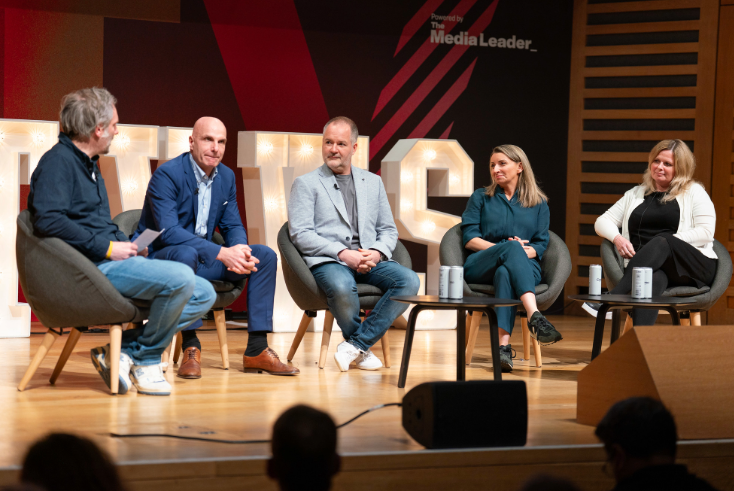
Photo shows (from left to right) Bernd Riefler, Sebastian Kramer, Christoph Konrad, Kate Garland and Renáta Fülöp-Árvai.