



Smaller broadcasters told to sacrifice streaming platforms to stay competitive
As global streaming services show more sports and other live events, tier-two and tier-three broadcasters may need to focus investment on content and live production to remain competitive – at the expense of maintaining their own best-in-class streaming platforms.
That is the view of Tom Morrod, co-founder and research director at Caretta Research, the media and entertainment tech strategy consulting firm.
He warned delegates at the Connected TV World Summit this month that only the biggest broadcasters will be able to compete as content creators and curators, as well as streaming content aggregators.
“Streamers are taking a larger share of the biggest live sports rights. They want to take tier-one as well as tier-two sports rights from broadcasters and from pay-TV operators and telcos,” he observed.
“Amazon Prime Video has already invested in live production facilities, and Netflix has started to do the same.”
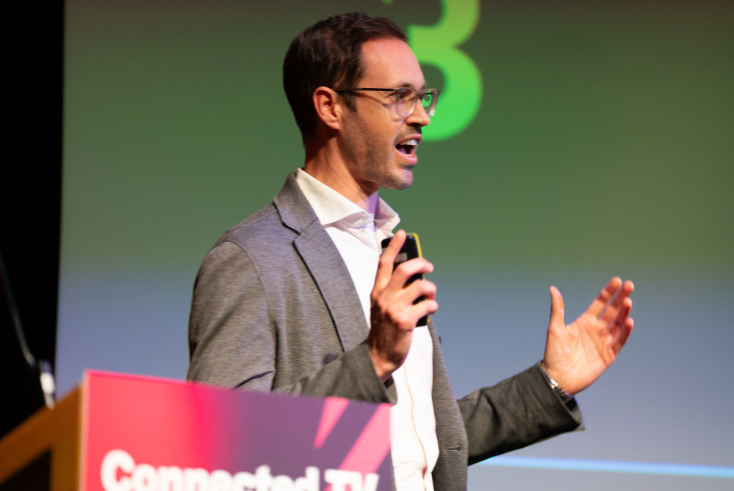
Morrod (pictured) argued that broadcasters must therefore strengthen their own position as curators of live content such as sport, news and local events.
“That is the unique selling point for local market national broadcasters. This is where they should be spending their money, which could mean limiting spending on streaming platforms.”
He reckons many broadcasters face a pivotal choice about their strategy for the next 5-10 years.
“There is now a conflict between content creation, streaming platforms and adtech, which must all come from the same budget. Do you want to be a content curator or a content platform?
“If you have a limited budget, you must choose between these options.
“If you over-invest in one and under-invest in the other, you no longer have the premium content to command an audience.”
Avoid tech over-investment
Morrod continued: “Streaming is potentially becoming an expensive luxury for a lot of media companies, especially if you are a mid- to low-end broadcaster.
“These companies must decide whether to invest more in content production to maintain their position as a content producer by spending less on hosting, maintaining and managing their own streaming platform.”
In Morrod’s opinion, streaming platform investments achieve less differentiation for a broadcaster than investments in content. “Platforms are still quite expensive,” he added.
Caretta Research estimates that an average streaming service with a million subscribers spends approximately one-third of its costs on content and carriage, one-third on marketing and customer acquisition, and one-third on technology (including CDN (content delivery network) costs).
The company also believes broadcasters will struggle to maintain competitive content platforms anyway, as the likes of Prime Video, Netflix, Disney+ and YouTube outpace their investments in UX, data analytics, AI and other technologies that drive customer-facing differentiation.
“They are moving faster and further than the broadcasters. To keep up, broadcasters will lose their differentiation as content creators [because they have to de-invest in content, given finite resources].”
Despite this, his advice to larger broadcasters is to invest to ensure they can compete on all fronts. “If you are in the enviable position that you don’t have to pick between these options, do everything.
“There are big broadcasters who can do all these things, and they should continue to do so.”
The London audience heard from one mid-sized broadcaster which made the decision several years ago to deprioritise the owned-and-operated streaming service model and instead focus on making its content available via partners for its digital distribution.
This approach is part of a wider determination to buy tech rather than build it.
Matt Westrup, CTO at Hearst Networks EMEA, the ‘passion brand’ behind The History Channel, Crime + Investigation, Blaze, Cosmo (the Spanish pay-tv channel) and FAST channels like Deal Masters, said: “There are plenty of scaled global direct-to-consumer media businesses, and it is not our job to compete with them.
“We would have been foolish to attempt that. We are a content creator, and that is our focus. Technology, and streaming platform technology, are not the core purpose of our business.”
Prioritising content creation
Instead, the channel owner is harnessing its decades of (ongoing) experience organising distribution deals with pay-TV operators and applying that to digital platform partners.
Crime + Investigation and History Play are both available as SVOD offers on Amazon Prime Video Channels, for example.
The digital partners, which also include Apple TV, are left to worry about building and maintaining a streaming platform.
The focus for tech investments at Hearst Networks EMEA is on ensuring an efficient, highly scalable distribution workflow for all its distribution partners, including pay-TV platforms, Westrup noted.
Broadcasters who follow Morrod’s advice would need viable alternatives to their owned-and-operated streaming apps, if these are to be run down. Hearst Networks has found them.
Morrod acknowledged that when balancing owned-and-operated versus partner-first, each media owner must decide how much they can rely on third parties for their digital distribution.
The Caretta co-founder observed that even some large broadcasters are taking a more flexible approach to using third parties – albeit without de-investing in their own streaming services.
TF1 and Netflix is a well-known example – starting this summer – where the French commercial broadcaster will have its linear channels, as well as on-demand content, carried within Netflix France.
TF1 has also expanded its own TF1+ service to become a destination in its own right, however. Owned-and-operated is still very much part of the French broadcaster’s strategy.
Thinking about the market in general, Morrod suggested, “[Global] streaming platforms can be really good partners to help broadcasters avoid spending some of their money.”