



Takeaways from the Future of Brands 2026: AI, culture and measurement take centre stage
This article was translated and adapted from a version first published by The Media Leader France, written by deputy editor Vincent Thobel.
Last week, The Media Leader’s annual Future of Brands conference brought together voices from Netflix, Sky, Omnicom, Reckitt, Tesco, the United Nations and more to discuss the opportunities and challenges facing brand marketers.
From the arrival of AI in the consumer journey to the measurement of advertising effectiveness, here is a look back at a day that outlined an industry in the midst of transformation.
AI rewrites the rules of marketing
It was Sean Betts, chief AI and innovation officer at Omnicom Media, who kicked things off with his session, ‘How AI is Rewiring the Internet’. His verdict was clear: generative AI platforms are no longer emerging tools but fully-fledged marketing channels that deserve to be taken seriously.
“Around 20% of the global population uses an AI platform every week,” he said, equivalent to around 1.5bn people, of whom 90% use one daily.
The market has currently centralised around two players: ChatGPT and Google Gemini, which together account for around 85% of usage. For Betts, this mass adoption means brands must rethink their online presence.
“You cannot optimise for both Google and AI models,” he warned, noting that the two approaches to search are incompatible.
The Omnicom expert detailed several characteristics of how these models work. Where a human search averages three or four words, a prompt to an AI averages 23. Crucially, AI conducts searches in parallel and goes far deeper into the sites it consults.
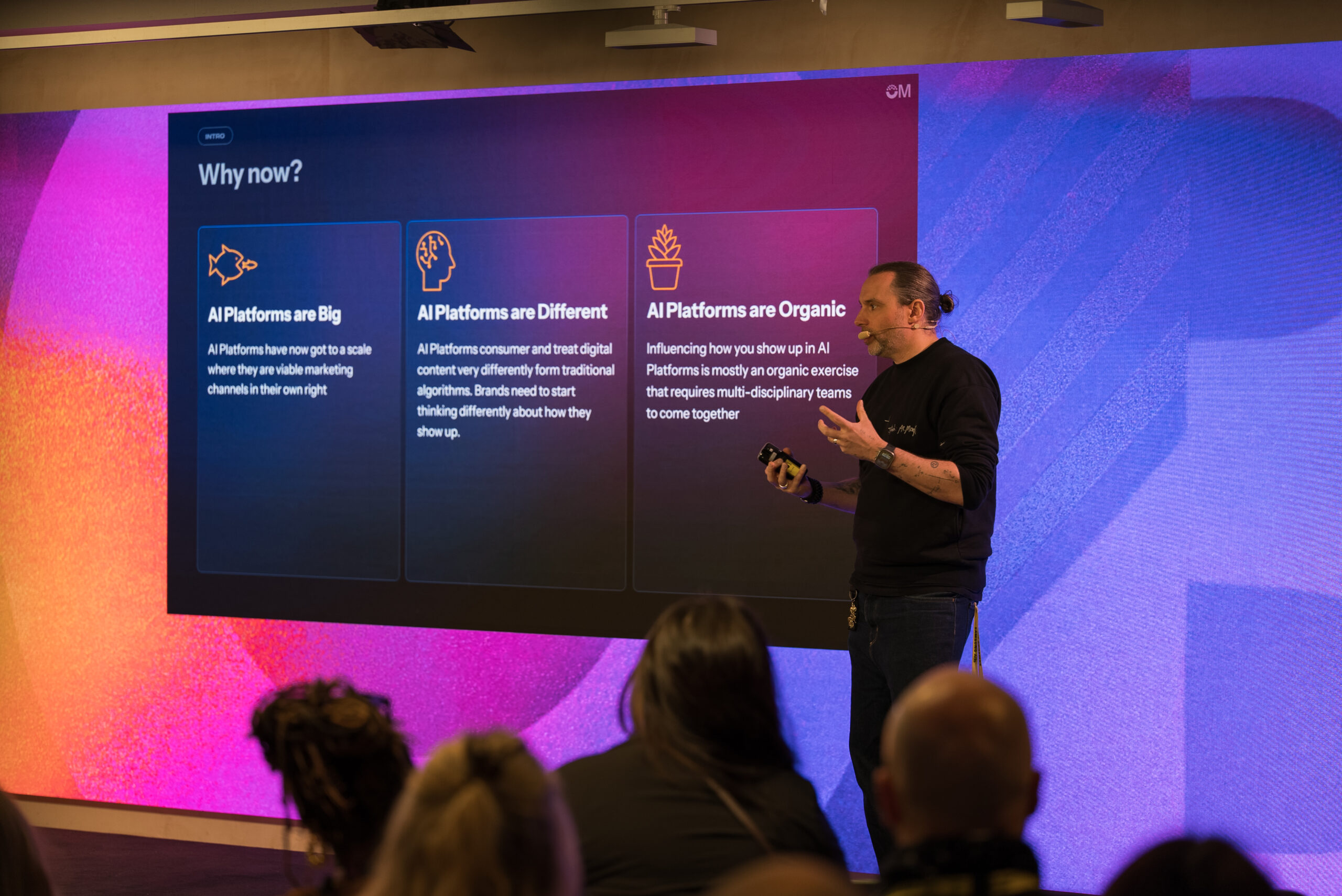
Omnicom’s Sean Betts.
Another notable finding: YouTube has become a critical source for Gemini, which draws on titles, descriptions, comments and transcripts, while ChatGPT has been locked out since OpenAI lost access in August last year.
Bett’s final word of advice to brands: “The richness of your product listing will determine your visibility in ChatGPT.”
Later in the conference, The Media Leader senior reporter Jack Benjamin prodded Publicis’ head of AI operations Marcos Angelides, Heineken’s global media and data director Olya Dyachuk, and Havas Media Group chief data and product officer Laura Kell for further advice on how brands win authority in AI search.
The trio agreed that benchmarking how your brand shows up in AI search is the first step, and that search and social media teams will need to better come together to understand and influence how brands show up in LLMs. But they also warned that brands will need to be nimble, as best practices are constantly being revised as AI search models develop.
Sky makes the case for full-funnel TV
Matt Hill, director of insight and research at Sky Media, followed Betts with an argument for addressable television. His angle: to demonstrate that TV is no longer purely a reach medium but can now drive short-term sales.
Drawing on Norman, Sky’s normative database compiling more than 2,000 campaigns across 500 advertisers, Hill shared several findings. Addressable TV delivers an average 121% uplift in ad recall and a 200% increase in web traffic compared with linear television. What’s more, the best-performing campaigns combine an average of 3.4 targeting criteria for brand metrics, versus 2.7 for the least effective.
First-party data makes a further difference. According to Hill, its integration multiplies effectiveness by six for awareness uplift and by eight for sales generation.
His message to the audience: “If you have first-party data, use it.”
Netflix: culture cannot be bought, it must be built
Jordan Peters, senior director of marketing partnerships EMEA at Netflix, followed with an argument in favour of brands’ embrace of cultural moments. His argument was structured around two core principles.
First: “Don’t shop, build.”
For Peters, brands that simply buy a licence and bolt it onto an existing creative platform miss the point.
“No football fan genuinely thinks a brand is authentically engaged with the FIFA World Cup if you just add football to your usual communication,” he said.
The Bridgerton universe, for example, is not simply about corsets: it is an exploration of romance, strong women, identity and class.
Second: think like a screenwriter.
Netflix had 32 of its partnership campaigns evaluated by creative effectiveness measurement company System1. In the UK, those campaigns ranked in the top 1% of the 125,000 ads tested on its Star Rating, which measures long-term brand impact. On the Spike Rating, which assesses short-term sales impact, they also reached the top 15%.
“When you entertain your audience, you earn the right to sell them something,” Peters concluded.
Brand building versus the tyranny of the short term
A midday panel, ‘Linking Brand Building to Business Outcomes’, was moderated by Rachel Forde, co-founder of TheZoo.London. It gave advertisers the opportunity to share their approaches for defending brand investment in front of finance directors.
Tom Mardon, head of media and campaign planning at Tesco, offered a revealing account. His team invited finance colleagues to open up the econometric models and build a shared understanding.
He said: “Now, when we go into a budget meeting, the conversation is no longer ‘how much is that going to cost?’ but ‘I know I can spend X and here’s how you can improve it’.”
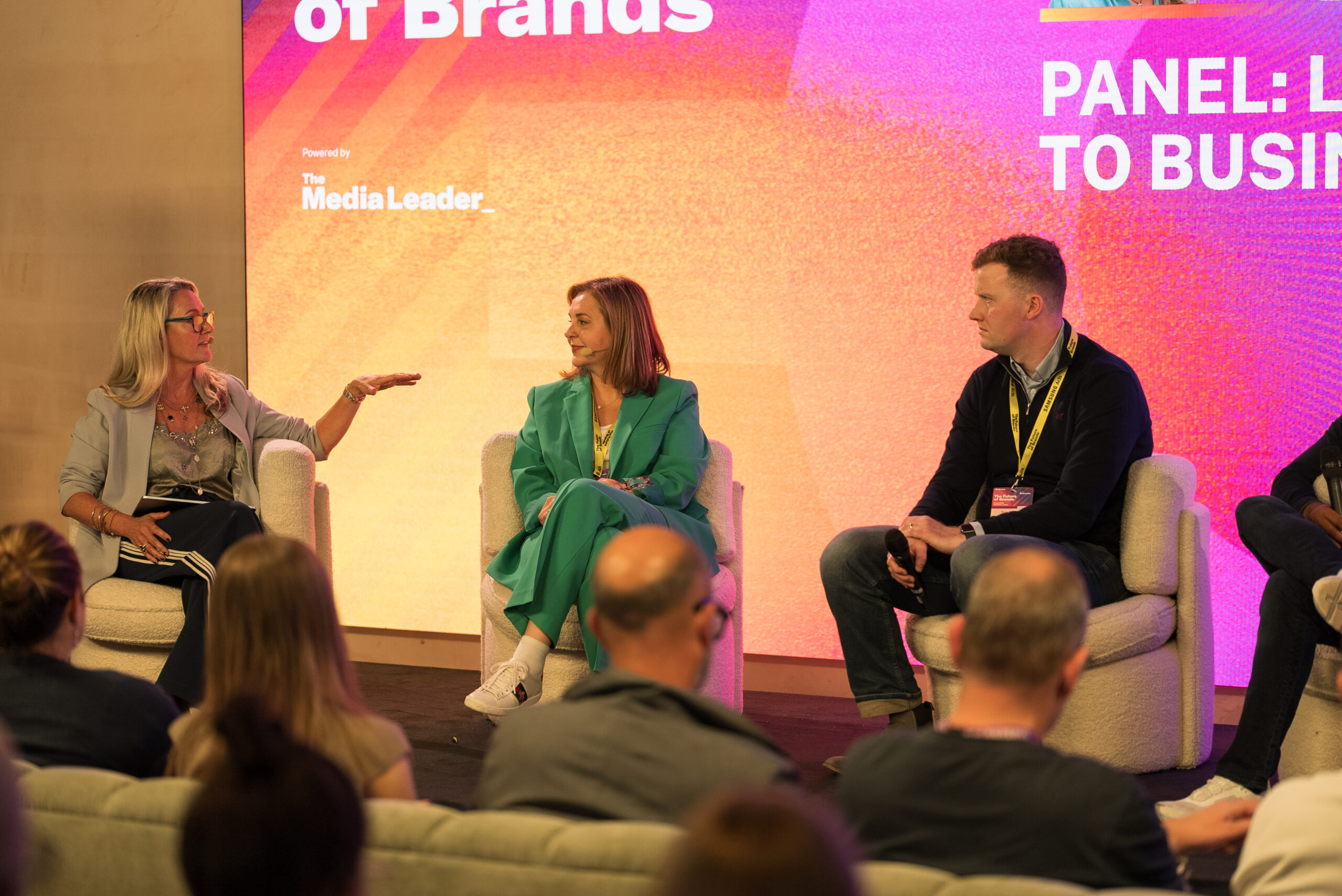
L-R: Forde, Buccisano, Mardon.
Gordana Buccisano, global brands strategy director at Reckitt, stressed the need to reposition brands as risk-mitigation tools.
“When times are tough, CFOs want stability, consistent demand, and no drama. Strong brands are resilient, strong brands survive,” she said.
Darren Thompson, vice president of sales UK at Adlook, made the case for a data-driven approach, highlighting how AI-based platforms can reduce customer acquisition costs.
He said: “The metric that interests a CFO is a lower cost of acquisition. That’s the language you need to speak.”
OOH: measurement catches up with creativity
Sarah Robson, global head of advertising effectiveness at On Device, Emily Alcorn, chief effectiveness officer at Talon, and Jennifer Carey, director of media and effectiveness at Channel 4, devoted their session to the measurement revolution in out-of-home (OOH) advertising.
On Device’s panel methodology, called Curious Cat, is based on GPS tracking of verified British panellists. An exposure zone is defined around each site, alongside a control group positioned around 100 metres away.
This methodology, now cross-referenced with programmatic delivery reports, enables granular measurement of actual exposure.
For Channel 4, the results are telling. Carey cited several campaigns in which favourability and consideration metrics improved significantly relative to the competitive benchmark.
The broadcaster also found that, at the moment of switching on their television, around 60% of viewers do not know what they want to watch.
She said: “It is crucial for us that Channel 4 is at the top of their consideration.”
Alcorn drew a broader conclusion from Talon’s database: contextual campaigns, which use the real-world environment to amplify the message, consistently outperform standardised approaches.
Zehra Chatoo warns on AI bias
The afternoon took a more political turn with Zehra Chatoo, founder of Code for Good Now. Her presentation, titled ‘Who Shapes AI, Shapes the Future’, addressed head-on the question of representation and bias in AI models.
Chatoo highlighted the adoption gap between men and women. Despite equivalent access and skills, women use AI 20% less than men. The primary cause Chatoo identified was fear of judgment.
An experiment conducted with 1,000 adults confirmed the bias. When shown as identical TV ads, female protagonists named ‘Emily Clark’ were judged 22% less confident than their male counterparts named ‘James Clark’, and their competence was called into question twice as often.
In response, Code for Good Now has developed the ‘Permission to Prompt’ programme, which creates safe spaces for experimentation. Chatoo also presented RepIQ, a tool for measuring representation in AI-generated advertising.
Her conclusion: the composition of the teams that develop and train models will determine the fairness of the models’ outputs.
The UN calls the industry to account
The ‘Guarding the Open Web: AI, Information Integrity and Performance’ roundtable, moderated by Jack Benjamin, senior reporter at The Media Leader, brought together Charlotte Scaddan, senior adviser on information integrity at the United Nations, and Harriet Kingaby, co-founder of the Conscious Advertising Network.
Scaddan noted that the UN now considers information risks, including disinformation, hate speech and polarisation, as threats to social stability, democratic processes and climate action.
She warned: “Nobody knows which sources of information to trust any more. Recent advances in AI are making this worse.”
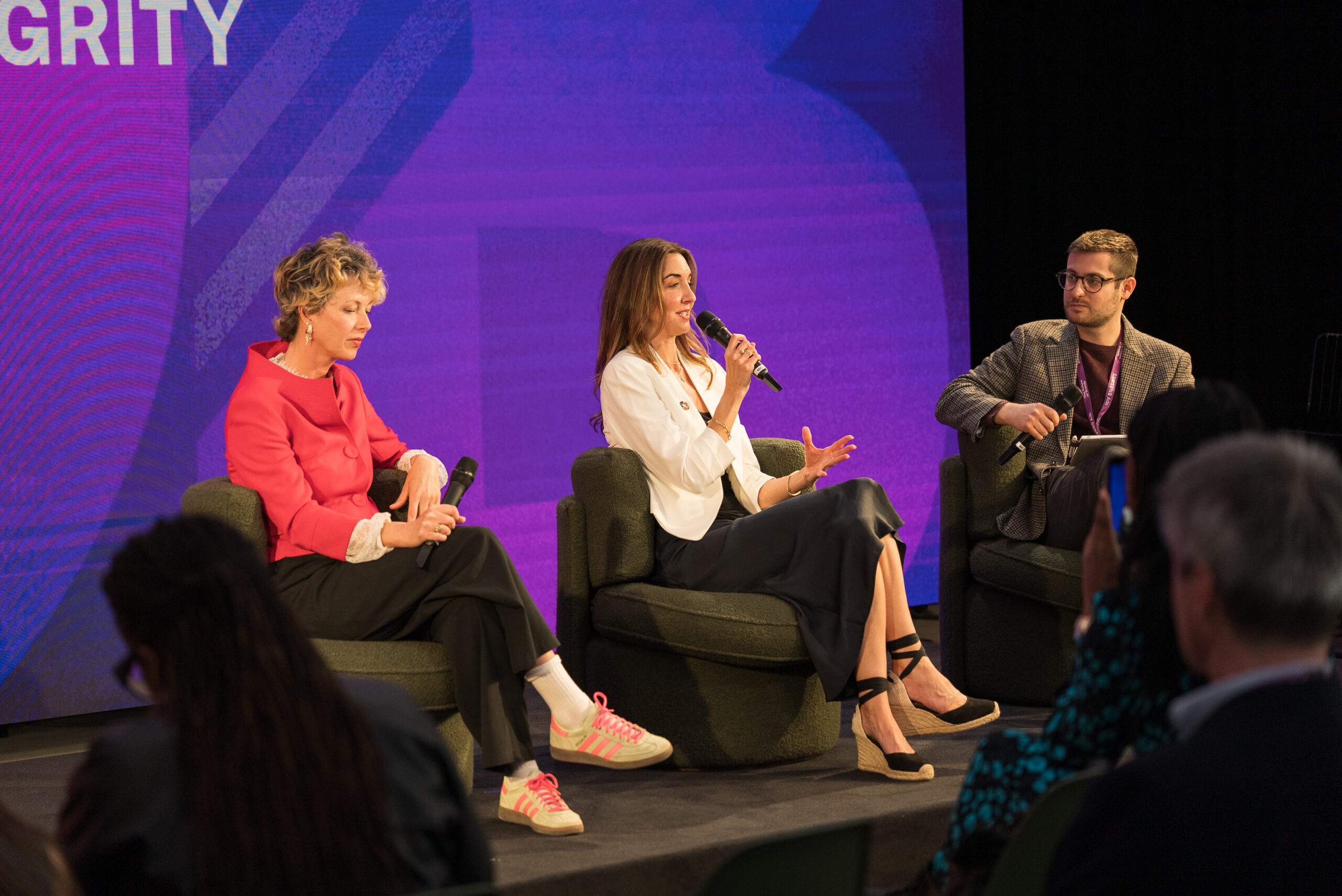
L-R: Kingaby, Scaddan, Benjamin.
Kingaby cautioned against the financial urgency facing major AI companies, which must generate returns on enormous investments. “If you found certain behaviours on social media problematic, this is just a taste of what is coming with AI,” she said, citing addictive design choices and the proliferation of inaccurate information.
Her prescription for responsible advertising came down to three words: “Transparent, accountable, thoughtful.”
TV: still a frontier worth conquering
The day closed with a panel hosted by James Longhurst, content director of The Media Leader, on the relevance of television for emerging brands.
Deirdre McGettrick, founder of Ufurnish.com, was characteristically candid. Coming from a performance marketing background, she had long hesitated before making the switch to TV.
She said: “I look at all the money we spent on performance, and I have regrets. I wish we had gone there sooner.”
For her, television made it possible to tell a story and create a category that did not previously exist in the furniture sector. An unexpected bonus: TV proved a powerful lead generator among supplier partners.
Mike Pearson, associate director and head of creative and promotions EU at Wayfair, echoed the approach. For him, the move to TV comes when you hit a ceiling where performance alone can no longer create demand. “It is by quantifying the brand that you gain legitimacy with consumers.”
Julie Selman, SVP and head of EMEA at Magnite, detailed how TV has become more accessible through Streamr.ai, the solution launched by her group to allow brands to produce TV creative at a manageable cost. “You have fewer assets than you think. You don’t need a big production to exist on screen.”
Parul Goel, territory head Europe at Zee Entertainment, captured the spirit of the panel in a single line: “On television, you are not seen, you are watched. That is a responsibility.”
One thread running through it all: the urgency of coherence
Beyond the diversity of topics covered, a single throughline emerged from The Future of Brands 2026.
Whether on AI, advertising measurement, cultural partnerships or brand investment, every speaker made the case for greater simplicity, coherence and accountability.
In a fragmented and saturated media environment, where AI models are rewriting the rules of search and audience trust is eroding, the brands that will come out on top will be those able to articulate a strategy that is legible, measurable and true to their values.