



The creator economy won’t save you. It might end up eating you, instead
Opinion
Creator businesses are hitting the same structural ceiling as legacy media companies. They’re just doing it faster, and the clever ones are building new walls, writes Omar Oakes.
“Everyone is so busy trying to be likeable that they’ve stopped being interesting.”
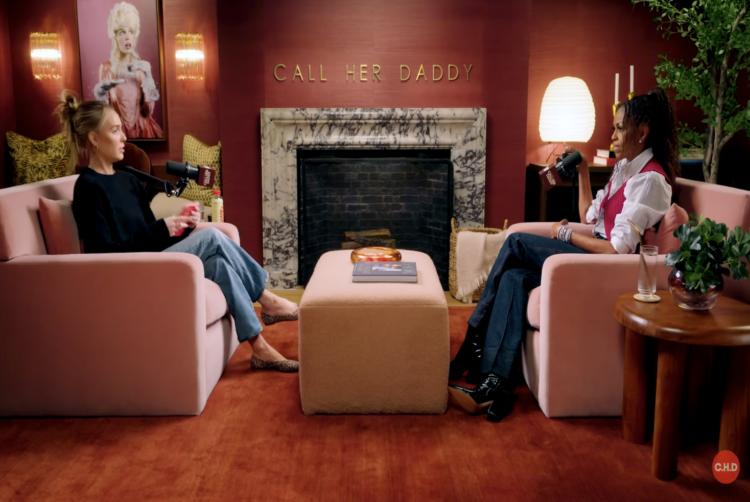
No, this isn’t a commentary about the state of LinkedIn and how your feed has become infested with ChatGPT-written slop. It’s Call Her Daddy creator Alex Cooper (pictured left chatting with Michelle Obama) telling YouTube why most ‘creator content’ is rubbish. Apart from Call Her Daddy, obviously, for which Cooper was plugging at the online video titan’s annual Brandcast event last week.
For many, Cooper is the poster child for ‘content creators’. Call Her Daddy has 13.3m downloads a month, a reported $125m SiriusXM deal, and a fanbase that trusts her; less like a celebrity and more like a confidante.
And yet, last month Bloomberg reported that Unwell, her media network, had lost its head of brand marketing, its head of the network, and its chief growth officer in the past year (not to mention at least 20 staff had quietly updated their LinkedIn profiles).
Three original shows launched under that SiriusXM deal have been cancelled inside 12 months, and rather than building new programming, Unwell is pivoting to acquiring existing shows.
That sounds pretty conventional ‘old media’, doesn’t it?
The tough sell of creator scaling
“Creator work is not necessarily stable,” communications professor Jess Rauchberg, told Bloomberg in its recent story about Cooper’s difficulties “They are leveraging their visibility into something that can be consumed off the podcast.”
As I’ve written before, the economics rarely work for normies with a ring light and a dream. I often wonder whether it’s literally easier to become a brain surgeon or rocket scientist nowadays than to make six figures as an indie creator.
And yet, year after year, whether through its own propaganda or mediated through industry events (Cannes Lions being the perfect example), we hear the same pot-at-the-end-the-rainbow tale about creators being the future of TV, audio, and all media eventually.
The problem is, as Bloomberg’s piece shows, wherever a single personality has tried to build an institution around itself, from Unwell to MrBeast’s Beast Industries (whose own growing pains are well documented), even the biggest creators hit a ceiling. As brilliant (!) as they are, a single creator’s success cannot serve as a company’s structure or strategy.
The audience loyalty that makes a creator commercially valuable exists because it is direct, unmediated and personal. The moment you build a corporate infrastructure around it — contracts, schedules, brand guidelines, three floors of HR — you begin systematically dismantling the conditions that created the value.
Before Call Her Daddy morphed into The Graham Norton Show (RIP), Cooper’s audience trusted her because she felt like a friend, not a media brand. Unwell’s job was to turn that feeling into a scalable institution, which was always going to be a tough sell.
And you can see the proof if you’re prepared to look beyond headline spend numbers.
Creator budgets in 2025 surged 171% year-on-year, but research firm CreativeX, after analysing 1.4m ads from 176 brands across 105 countries, found that creator-produced ads consistently underdeliver on brand recall. That’s because creators don’t naturally lead with logos, taglines or the consistent cues that drive memory rather than momentary attention.
As CreativeX CEO Anastasia Leng told Next in Media: “We’ve been optimising for attention vs. memory. Most creator advertising today gets reported as vanity metrics. Creative advertising isn’t a strategy, it’s a tactic.”
When that kind of spend gets (finally) subjected to the same outcome scrutiny as every other media vehicle, the correction will be sharp.
Advertisers are desperate to leverage creators for attention. But does this attention actually last long enough to be a reliable home for a brand?
The part that should really worry you
The good news is, there are creators who are solving the scaling problem.
The bad news is they aren’t looking for media partners. They’re building the infrastructure to sell around them.
Dude Perfect CEO Andrew Yaffe was candid about this when speaking to Next in Media last month: “Our partnerships business looks more and more like a media business, not a creator business, day by day.”
That is, a creator business is transactional, short-term, direct response. What Dude Perfect is building looks, in his words, like a sports sponsorship or a media opportunity. That is a creator CEO naming a broadcaster’s clients as his competitive set.
MrBeast’s Beast Industries is a more aggressive version: it is building a two-sided creator marketplace: an AI-driven platform connecting creators directly with Global 1000 brands. Not unlike what publishers did when they took programmatic off the open exchange and forced brands into direct private marketplaces.
So the largest creator in the world is not looking for a media partner; he is building the infrastructure to sell around one.
I warned in my last column how we need to constantly be on watch for platforms building the pipes to dictate the terms of media, no matter how good any media owner’s content or UX is.
So look no further than what the grand daddy of pipe layers is now saying, having apparently stopped crowing “YouTube is the future of TV”.
Sean Downey, president of the Americas and Global Partners for YouTube owner Google, told Adweek ahead of Brandcast that advertisers are increasingly asking to purchase directly from creators — and that YouTube has “facilitated that a lot over the last six to 12 months.”
The vehicle is YouTube Creator Partnerships: a system where brands and creators log in and are served AI-generated suggested pairings, with a reported 30% conversion lift on Shorts. Downey’s pitch, stated plainly: “Only YouTube can drive those integrated relationships.”
So put these examples together:
- Dude Perfect is trying to earn the same room as legacy media.
- Beast Industries is trying to make that room irrelevant.
- YouTube has already built a new room, staffed the door, and is telling advertisers it’s the only one worth entering.
This matters because media owners are, understandably, obsessed with the question: how do we partner with creators to reach younger audiences? There are no shortage of commentators (usually from the US) preaching this as gospel while tickling your FOMO.
But, maybe this question matters more: which creator businesses are being built to compete with our commercial model, and how fast?
Creators or Trojan Horses for platforms?
The creators who genuinely can’t scale — mid-tier networks built around a single personality, the Unwells of the world — may still want what you have: distribution infrastructure, advertiser relationships, editorial credibility.
Those partnerships can work, on the right terms, with clear eyes about what you’re actually buying, but you risk partnering with a business heading toward the same wall you’re already approaching.
The question worth asking before you sign anything is whether combining two businesses with the same structural problem produces a stronger business, or just a larger one.
The ones who can scale are not coming to you. They are going to YouTube, or building around it, or building to replace it.
Who are you actually negotiating with? The creator? Or the platform behind them?
Because only one of those parties built the room you’re all sitting in.
 Omar Oakes was the founding editor of The Media Leader and continues to write a column as a freelance journalist and communications consultant for advertising and media companies. He has reported on advertising and media for 10 years.