



Overlapping reach comes at a cost ‘worse than wasting money’, says Audience Project’s CPTO

Overlapping reach comes at a cost “worse than wasting money”, argued Audience Project’s chief product and technology officer during a talk at the Future of Brands last month.
Bruno Furnari, whose talk was titled: ‘Every £ Twice: What Overlapping Reach is Really Costing Your Media Budget’, warned of the consequences of brands buying frequency when they really want to buy reach, given campaigns appear across multiple channels.
He recalled how audience members had likely experienced seeing the same ad for a campaign repeatedly in a month, and how the irritation that this causes not only means brands are “wasting money”, but also “paying to decrease consumer sentiment about your brand.”
“This is worse than wasting money,” Furnari said.
Cross-media measurement, according to Furnari, can help brands avoid the ‘danger zone’ of saturation and focus on unique reach rather than frequency.
To understand unique reach, he argued brands need to understand how different channels overlap.
He referred to the 2025 IPA TouchPoints data, which reported that mobile usage is higher than TV usage in Great Britain. Furnari argued this demonstrates the “cross-media cross-screen reality that we live in and that we need to get used to when it comes to measuring.”
He further argued that while the media industry likes to fragment a channel into categories – such as live TV, BVOD, SVOD, YouTube – actually, consumers follow content wherever it’s most convenient.
He said: “If the audience doesn’t care what screen they’re on, the measurement needs to understand that.”
Furnari went on to explain the four primary elements that Audience Project uses to understand cross-media measurement: panels, big data, deterministic matching, and probabilistic matching.
Furnari identified that due to each element having its own pros and drawbacks, it means a hybrid approach is essential, alongside the use of AI for harmonisation and quality assurance.
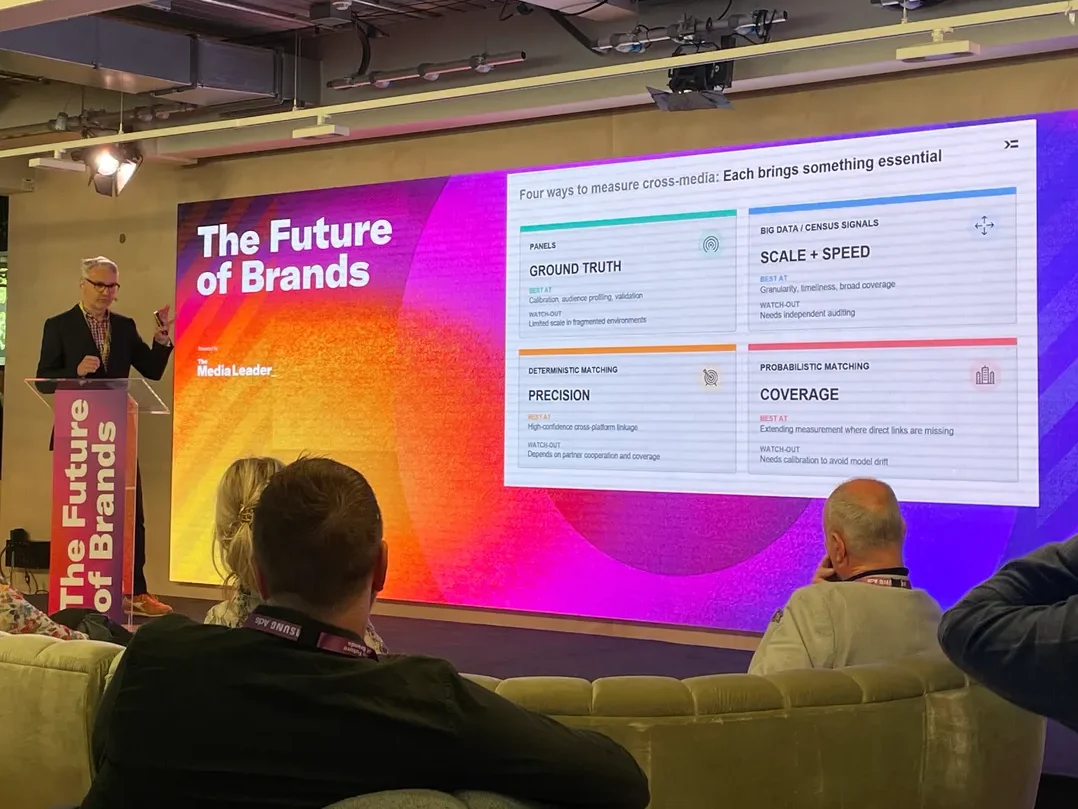
Panels are the source of ground truth and provide audience profiling, but scale is limited in fragmented environments.
Big data offers granularity, timeliness, and broad coverage, but as it is self-reported, it needs independent auditing.
Deterministic matching can produce high-confidence cross-platform linkage but requires partner cooperation and depends on a country’s regulations.
Finally, probabilistic matching extends measurement when direct links are missing, but it requires calibration as models drift with changing devices.
He closed the talk by warning the audience to be careful when using AI.
He said: “If AI can make a decision in milliseconds and you have faulty data, incomplete data, biased data, this can truly accelerate bad use of money.
“I would caution you to be careful with doing this because you could augment how fast you make bad decisions.”