



Brands could double their media investment and still generate a profitable return, claims WPP Media report
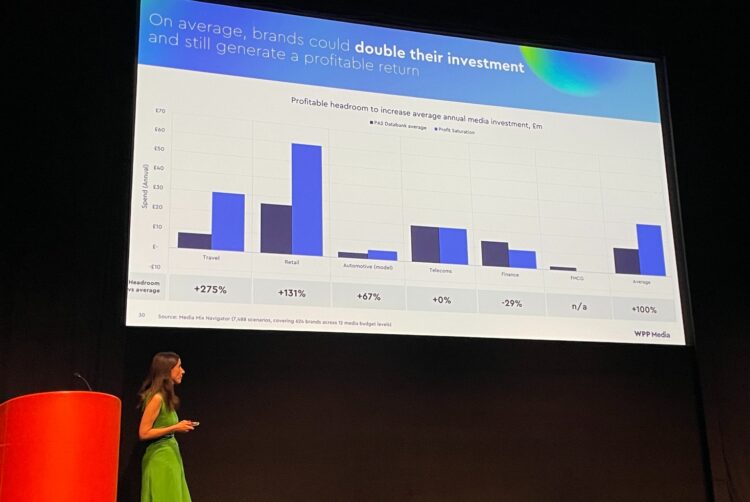
Brands are, on average, missing out on 11% profit growth based on their current advertising expenditure, a study by WPP Media has found.
Indeed, brands could double their current investment in advertising and still generate a profitable return.
This varies by brand category. Travel brands could increase advertising investment by 275%; retail by 131%; and automotive by 67% before reaching their “saturation point” of profitability.
In contrast, finance brands are broadly overinvesting relative to profitability (-29%) and telecoms companies are on average spending enough to reach profitability saturation.
The study, The Growth Gap, was commissioned by Thinkbox and presented at the TV trade body’s “Advertising Through Adversity” event in London on Tuesday. It pulls from Profit Ability 2 data, analysing 624 brands and over 7,400 different campaign scenarios.
While advertising spend has outstripped GDP growth in recent years, Dom Charles, WPP Media’s head of applied analytics, pointed out that marketing budgets are approximately 30% lower as a share of businesses’ revenue compared to before the pandemic.
When macroeconomic conditions are unstable, he reasoned, “do more with less” becomes the default behaviour.
Structural challenges to change
Charles acknowledged there is bountiful evidence proving the value of advertising to boardroom leaders, but that little has changed in terms of marketing budgets expanding, particularly in more traditional demand-generating advertising channels compared to digital-first sales conversion channels.
Olga Zaitseva, WPP Media’s head of modelling services, noted that advertising is just one of many drivers of profit, accounting for 16% of total sales effects on average. However, she argued, it is one of the few drivers that brands can fully control, unlike category trends or other macro factors.
“The single most critical decision we need to make isn’t creative execution or channel selection, it’s simply how much we decide to spend,” Zaitseva said.
Marketing budgets, however, are “uniquely flexible” and therefore “uniquely vulnerable” to cuts during economic downturns.
Perhaps more importantly, as Charles and Zaitseva explained, business leaders have short-term incentives whereas marketing effort prove their full value over a longer period of time.
This needs to be challenged by marketers in the boardroom, particularly those with larger budgets who may be underinvesting in AV channels like TV that scale the furthest and continue offering payback over extended periods. But Charles argued that “the way we talk about long-term effects is misleading”, inadvertantly creating the expectation that demand-generating advertising does accomplishes nothing in the short-term.
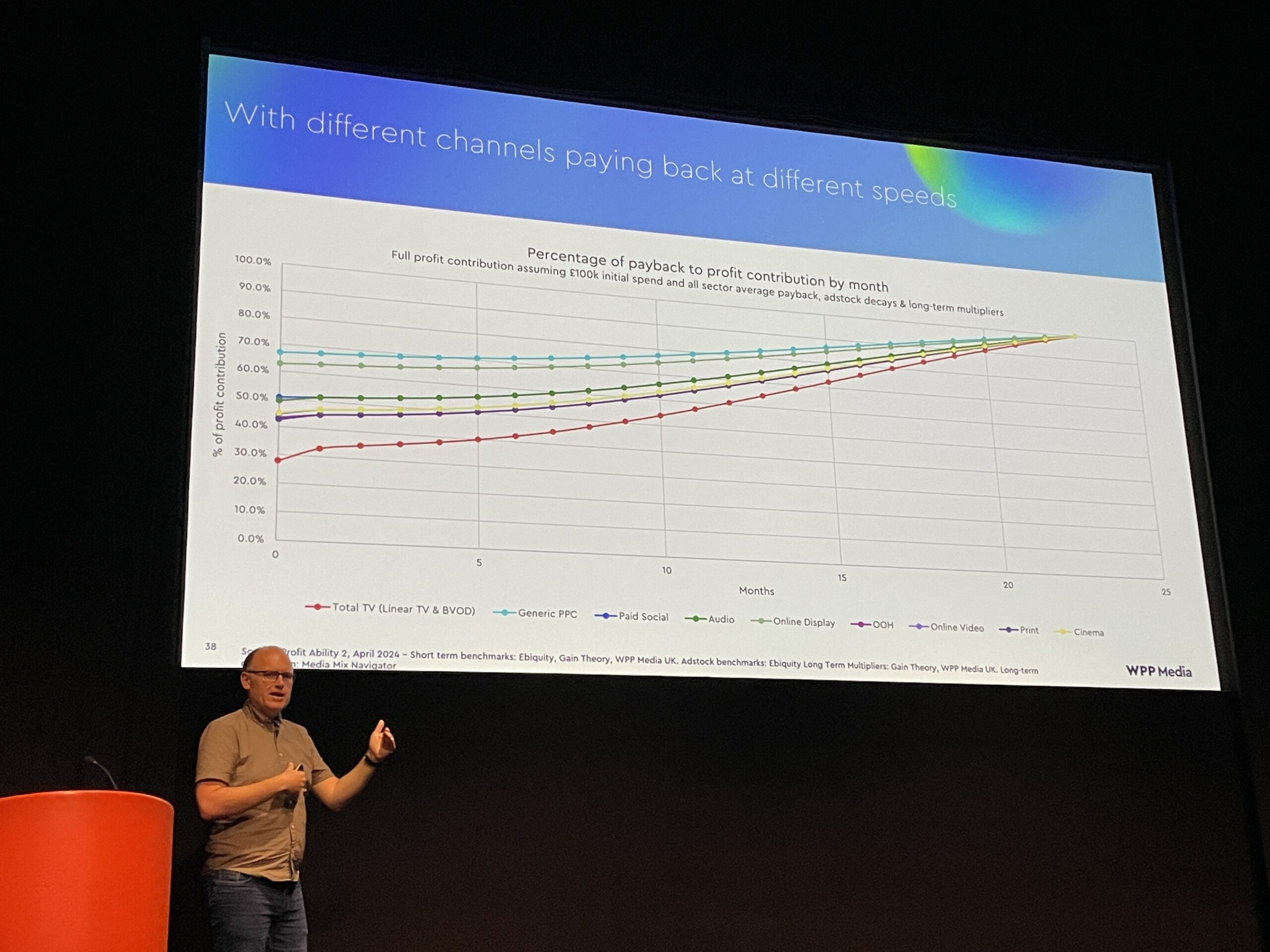
The reality is such advertising drives “sustained effects” over a longer period of time, taking longer to drive its (greater) profitability, but still delivering sales effects within the short-term in the meantime.
Given different media channels pay back at different speeds, Charles advised marketers front-load ad expenditure in demand-generating channels such as TV, radio, OOH and print earlier in their fiscal year in order to be able to prove annual payback of those investments by Q4. In contrast, search and social investment can be back-loaded because they are good at driving shorter-term effects, though Charles advised even then there’s “still a role for TV, for audio” in the short-term.
On average, brands spending in such channels in January will still be able to show 36% of the sustained effect on profit delivered by the end of the year, with the rest of the long-term brand effects delivering afterward.
‘Short-termism isn’t the problem. It’s that we do short-termism badly, that is the problem’
Still, even for brands purely focused on short-term sales goals, Charles warned that the current average channel mix is suboptimal.
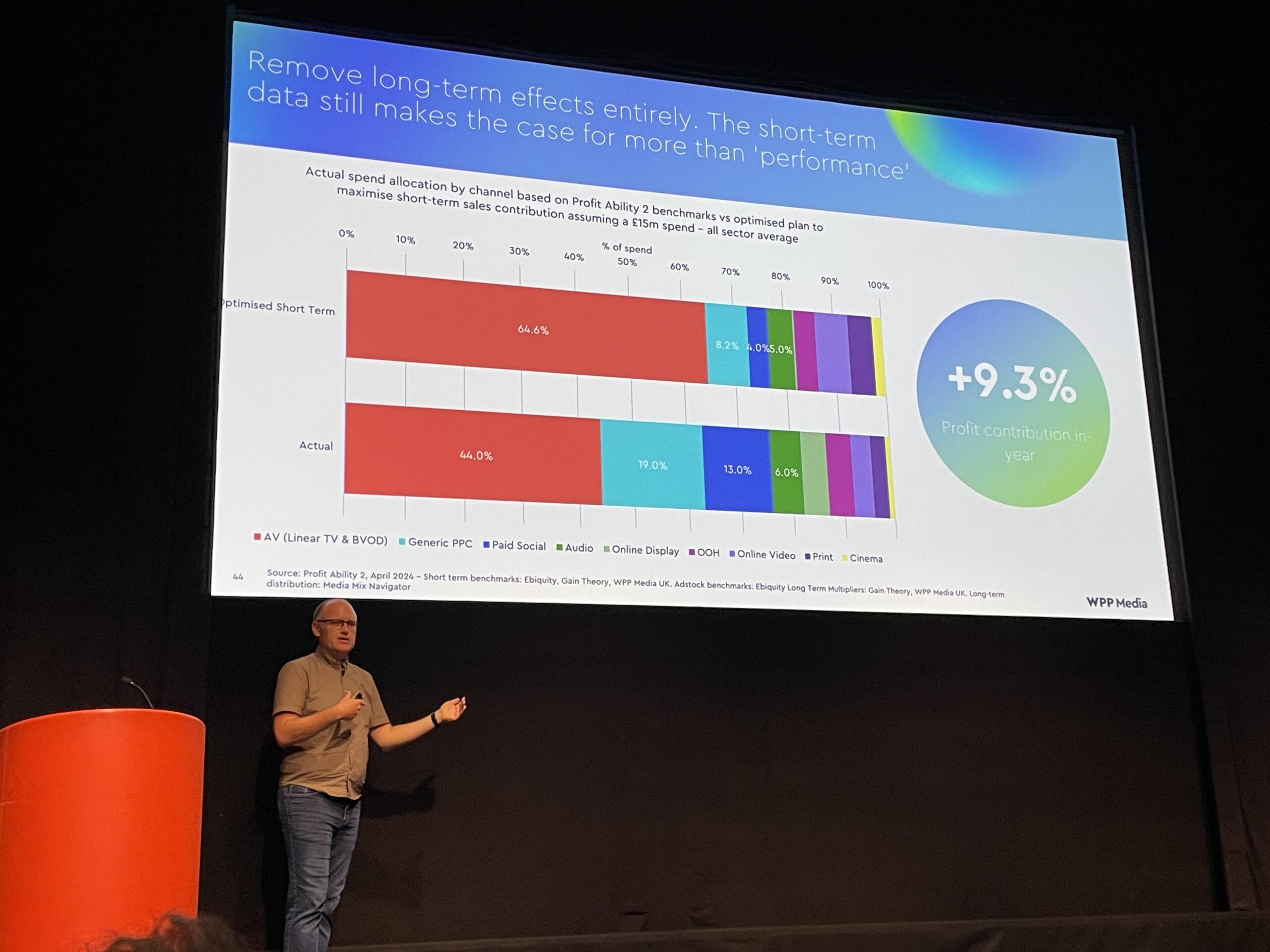
Examing the data without concern for long-term profitability, short-term data still evidences that brands are underinvesting in AV channels and significantly overinvesting in paid social and generic PPC channels.
According to Profit Ability 2 data, the optimised short-term media mix would see 64.6% of spend allocated to AV (linear TV and VOD); in actuality, as of when the data was collected in 2024, brands were investing just 44% of budget into that channel. In contrast, brands were spending more than twice what was optimal on PPC and more than three times what was optimal on paid social media.
“Short-termism isn’t the problem,” said Charles. “It’s that we do short-termism badly, that’s the problem.”
With the optimal short-term media mix, Charles shared, advertisers would receive 9.3% growth in in-year advertising contribution.
Additionally, Charles explained that “by doing the short-term stuff well, the compromise you’re making in the long-term in sustained brand-building is much smaller than we currently have, because you end up investing in a bunch of channels that happen to also produce sustained brand-building effects.